INTRODUCTION
Since its inception, psychology has focused on the limitations and disorders of human beings to improve their mental state. However, Seligman & Csikszentmihalyi (2000) recognize that positive individual characteristics of an individual contribute to improving their well-being and quality of life and promoting healthy behaviors (González-Cantero et al., 2017; López-Bustamante et al., 2021).
This new approach to intervening in human matters has been the basis of positive psychology, which identifies the subjective evaluation of an individual’s experiences as valuable, considering aspects such as well-being, life satisfaction, hope and happiness (López-Linares et al., 2023).
Psychological capital (PsyCap), a concept introduced by Luthans et al. (2007) from positive organizational behavior, includes four key dimensions: self-efficacy, optimism, hope, and resilience. These factors are considered a vital resource for the psychological well-being of individuals and their ability to cope with challenges in the workplace (Luthans et al., 2015; Luthans & Youssef-Morgan, 2017).
Luthans et al. (2015) define psychological capital as follows:
“the positive psychological state of a developing individual that is characterized by (1) the confidence to exert the necessary effort to succeed in challenging tasks (self-efficacy); (2) making positive attributions (optimism) about current and future successes; (3) persevering towards goals and redirecting one’s trajectory towards goals in order to succeed (hope); and (4) strengthening oneself and going the extra mile when faced with adversity and problems (resilience) to maintain success” (Luthans et al., 2015 p.2).
Research on PsyCap in recent years has been extensive and prolific, showing the relevance of the construct and its positive effects on various areas of work (Blasco-Giner, 2023; Nguyen et al., 2024).
PsyCap also plays an important role in various populations, particularly older adults facing unique challenges related to aging, such as isolation, decreased physical capacity and changing social roles, as noted by the World Health Organization [WHO] (2024). In aging contexts, psychological capital serves as a protective factor, making it easier to adapt to life changes. Some studies have shown that PsyCap dimensions are associated with lower levels of depression symptoms and better mental health, and increased life satisfaction in older adult populations (Bedaso & Han, 2021; Xin & Li, 2023), as well as improvements in health-related quality of life (Raluca et al., 2024).
The study of psychological capital is of interest to older adults facing a variety of psychological processes derived from aging. Precisely in relation to the retirement stage, Rivera-López et al. (2023) suggest including the development and strengthening of psychological capital in people at this stage of transition as a preventive strategy. Lack of empowerment can be a risk factor for suicidal ideation and/or behavior (Montes de Oca & Rodríguez, 2019).
This is crucial in Mexico, because over 26.9% of adults over 60 suffer from depression and more than 39.4% from loneliness, affecting their mental health and well-being. Data reveal an increase of both conditions between 2018 and 2021 (INEGI, 2023).
In Mexico, there is a scale of psychological capital validated for the working population (Santana-Cárdenas et al., 2018) and other instruments measuring components of psychological capital such as compassion (López et al., 2019), self-compassion (López-Tello et al., 2022), resilience (Camacho-Valadez, 2016) and self-efficacy (Ramírez Dorantes & Canto y Rodríguez, 2007). These scales were mainly designed for university students, and contain more than 17 items, which can be tiring for older adults to answer.
The OREA scale, developed by Meseguer-de Pedro et al. (2017) in Spain, was originally designed to measure psychological capital in working people. The OREA scale consists of a total of 12 items, with three items per dimension, included in its acronym, which stands for Optimism, Resilience, Hope, and Self-Efficacy in Spanish. The scale comprises items that were representative of a broad cross-section of the population in relation to the activities and tasks they performed in their jobs. In terms of jobs, 53.1% held operational and administrative positions, 33.9% were technicians, and 13% were managers. In terms of education, 31% had completed primary education, 31% held degrees, 20% had received vocational training, and 18% had finished high school. The scale has sufficient evidence of reliability and validity with a sample aged between 18 and 62.
The authors of the scale report adequate fit values (GFI = .943; CFI = .936; RMSEA = .07), meaning that it is a consistent measure of psychological capital with sufficient evidence of reliability and validity (Meseguer-de Pedro et al., 2017). The validation study of the OREA scale in Spain evaluated two different models to understand the structure of psychological capital in workers. The statistical analyses, using structural equations, permitted the comparison of a first unifactorial model with a second four-factor model plus a second-order factor. The results showed that the four-factor model (optimism, resilience, hope and self-efficacy) with a second-order factor, corresponding to the global construct of psychological capital, offered a better fit. It obtained satisfactory goodness indexes (GFI = .940; CFI = .946; RMR = .22; RMSEA = .070) in relation to the unifactorial model (GFI= .890; CFI= .859; RMR=.057; RMSEA = .094).
These findings support the psychological capital concept as a higher order construct in the Spanish context (Meseguer-de Pedro et al., 2017). And although OREA has shown positive psychometric properties in Spain, cultural and demographic factors require additional validation in different national contexts, particularly in Mexico, where cultural attitudes and aging experiences can vary considerably (Platania & Paolillo, 2022).
So far, no scientific evidence has been identified to support adaptations of the OREA scale in other countries apart from Spain that analyse the psychometric properties of the adapted instrument as recommended by the International Test Commission (2017). This highlights the need for research to evaluate the relevance and validity of the OREA scale in new cultural contexts, such as the elderly population in Mexico, to ensure its adequacy and accuracy in measuring the components of psychological capital.
The Mexican context of aging and the specific challenges faced by older adults highlight the need to adapt and determine the validity and reliability of this scale for this population. In the aging process, internal resources such as resilience, self-efficacy, hope and optimism are essential for coping with situations of isolation, changes in social roles and diminished physical abilities, typical of this stage of life (Luthans et al., 2015; Ortiz et al., 2021; López-Linares et al., 2023). Validation of the OREA scale in Mexican older adults will make it possible to obtain a culturally appropriate instrument to measure psychological capital in this group, facilitating the design of interventions to improve their well-being and quality of life.
Research on psychological capital constitutes an area of interest in several sectors, specifically the older adult population, which in the Mexican case represents a group that will increase significantly in the coming years. This is why it is important to have studies and measuring instruments, in this case, for psychological capital. The objective of this study is therefore to evaluate the psychometric properties of the OREA instrument in a sample of older adults in Mexico and to analyze the relationship between this construct and depression in these participants.
METHOD
Study design
This research is a quantitative, cross-sectional, non-experimental study. Current instrumental research seeks to analyze the psychometric properties of a psychological scale adapted for the Mexican older adult population.
Participants
The study was conducted with 314 older adults between September 2023 and March 2024. Inclusion criteria were being aged 60 and over, having a Mini Mental State Examination scale score (De Beaman et al., 2004) ≥ 23 and living in the metropolitan area of Monterrey, Nuevo Léon, Mexico.
Procedure
First, permission was sought from the authors of the OREA scale (Meseguer-De Pedro et al., 2017) to adapt the questionnaire into the same language in another culture. The second step was to follow Vallejo et al.’s (2017) guidelines. The scale was given to three Mexican professionals with experience in positive psychology to make observations and contributions for each item to see if they are understandable, sound natural or could be rephrased. The third step was to check the suggested changes with one of the reviewers to ensure that the items were representative and clear and that the understanding and interpretation of the item was appropriate to the content (International Test Commission, 2017; Muñiz & Elosua, 2013). Two or more experts suggested changes to two items, and one expert suggested word changes or modifications in three items. Finally, five items were modified from their original version (Table 1).
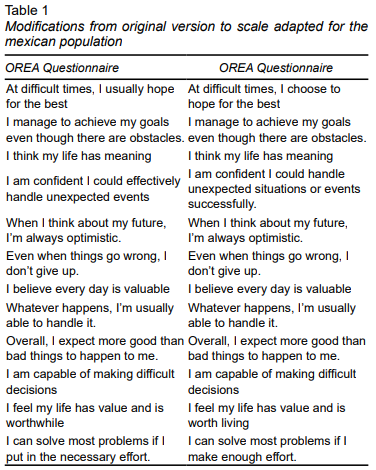
As suggested by Vallejo et al. (2017) and the International Test Commission (2017), a pilot test was conducted with 31 subjects. Cognitive interviews were conducted with four of them, contributing to content validity and minimizing the influence of any cultural and linguistic differences in the target population. Although no observations were made about understanding, reviewers altered the format, eliminating mention of the dimension being evaluated at the end of each item. Visual icons were included to avoid statistical biases.
The final version was administered in person to individuals over 60 in 29 nursing homes, seven community centers for older adults, and relatives’ homes in the metropolitan area of Monterrey, Nuevo León. All the participants and directors of the centers signed an informed consent form.
Measurements
Socio-demographic data: data were collected on age, educational attainment, and marital status.
Cognitive Impairment: the Mini Mental State Examination (MMSE) is a cognitive scale developed by Folstein et al. (1975) with a total of 30 items. It assesses temporal orientation, spatial orientation, coding and free recall, attention and calculation, language, verbal and visual comprehension and praxis with a point response format for each item correctly completed/answered. Mexicans aged 60 or over participated in the validation process (De Beaman et al., 2004; Instituto Nacional de Geriatría, 2020). The cut-off point is a score of 23-24 with a sensitivity of .97 and a specificity of .88 calculated from the receiver operating characteristics (ROC) curve.
Psychological capital: The OREA scale measuring psychological capital created and validated with the working population in Spain (Meseguer-De Pedro et al., 2017) was used. This version consists of 12 statements with four dimensions assessed by three items each: Optimism, Resilience, Hope and Self-efficacy. Reliability measured through the Composite Reliability Coefficient was between .73 and .89. After a cultural adaptation, the number of statements and Likert-type responses ranging from 1-Strongly Disagree to 4-Strongly Agree was maintained. Examples of the dimensions assessed include “At difficult times I choose to hope for the best” (optimism), “I am able to make difficult decisions” (resilience), “I think my life has meaning” (hope), “I am confident I could handle unexpected situations or events successfully” (self-efficacy).
Depression: the ENASEM Depression Questionnaire (Aguilar-Navarro et al., 2007) comprises a total of nine dichotomous questions to detect depression considering the past week. Positive responses are scored, except for items 4, 6, 9 in which the negative response is scored as a positive response to a depressive symptom. Reliability and validity for the Mexican context was established for the adult population aged 65 or older. Internal consistency was adequate (Cronbach’s alpha .74). A score of ≥ 5 suggests that the person has depression symptoms . Test-retest reliability was excellent (CCI = .933).
Statistical analysis
Data analysis was conducted using two R Studio statistical software programs (version 2023.09.1+494). Confirmatory factor analysis (CFA) was performed for construct validity analysis using the following statistical software packages: Parameters, apa, Haven, ggplot2, ggpubr, gridExtra, apaTables, reshape, GPArotation, mvtnorm, psych, nortest, psychometric, lavaan, nFactors, semPlot, MVN and semTools. The correlation between depression and capital was determined (the function of each package and the syntax for data analysis are presented in annexes 1 and 2).
Answers were analyzed using multivariate distributions to identify the mean scores and standard deviation of OREA items and dimensions. Given the ordinal nature of the items, a matrix of polychoric correlations was generated to identify grouping patterns. Following the criteria of Viladrich et al. (2017), low (< .40) and high (> .70) correlations were established as references.
The validity of the internal consistency of the instruments was verified through confirmatory factor analysis (CFA) using the results of the descriptive analysis previously conducted and the correlation between items. For the OREA-Mx scale, two models were specified. Model 1 proposes four factors (optimism, resilience, hope and self-efficacy) and a second order factor (psychological capital) while Model 2 proposes a general factor, namely that the 12 items in the instrument constitute an overall psychological capital dimension.
For the CFAs, we used the Unweighted Least-Squares (ULS) estimator because the instrument has an ordinal scale and a ceiling effect on responses and the sample comprised fewer than 400 subjects (Viladrich, et al., 2017).
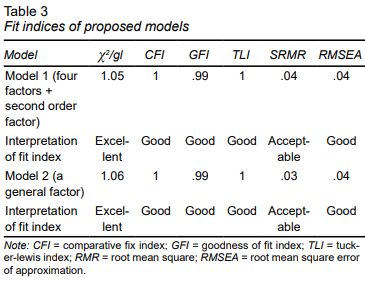
Based on the ULS estimator, the goodness of fit of the models was evaluated by Chi-square (χ²) with its degrees of freedom (df) and significance. For this index, a statistically null value of χ² was considered excellent. In the CFI and TLI approximate fit indices, values equal to or greater than .90 were considered acceptable. SRMR and RMSEA values between .05 and .07 were considered acceptable and below .05 were considered good (Hu & Bentler, 1999). Regarding reliability, scores above .7 on McDonald’s Omega coefficients (σ); were considered adequate (Viladrich et al., 2017).
Finally, the relationship between psychological capital and anxiety symptomatology was analyzed using Spearman’s Rho test.
Ethical considerations
The following study was approved by the graduate academic board of the Universidad Autónoma de Coahuila Faculty of Psychology. The ethical guidelines corresponding to the code of ethics of psychologists were followed (Sociedad Mexicana de Psicología, 2009), providing informed consent forms for the directors of the centers attended. All participants signed informed consent forms, in addition to meeting the inclusion criteria, which involves the absence of cognitive impairment as assessed by the MMSE scale (De Beaman et al., 2004; Instituto Nacional de Geriatría, 2004).
RESULTS
Three hundred and fourteen of the 411 individuals assessed met the criteria. The mean score of MMSE was 26.42 (SD = 2.010) meaning that not all of them had cognitive impairment. The mean age of participants was 75.46 years (SD = 8.382). Regarding socio-demographic data, 74.2% of the sample were female, while 28.7% had completed elementary school and 26.4% middle school. A total of 45.9% of the sample were widowed, and 44.6% were homemakers while 32.5% were paid workers; 37.9% lived in a residence and 23.2% (n = 73) suffered from depression.
Construct validity
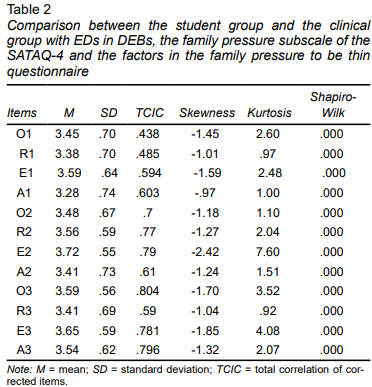
A descriptive analysis (Table 2) of the twelve items comprising the scale was conducted to obtain the mean, standard deviation, total correlation of items corrected, skewness and kurtosis of the scale. The results indicate negative skewness and positive kurtosis. These data suggest a distribution of sample responses above the mean, showing a sharp, rather than a flat, curve. In a total of five items, the kurtosis was greater than two, including one in the Skewness data. Normality testing was performed by exploring the shape of the data distribution with the Shapiro-Wilk test, the results of which rejected the null hypothesis of normality with a probability level of p < =.10 for all items.
Since the data followed a non-normal distribution, the matrix of polychoric correlations of the instrument items was estimated (Viladrich et al., 2017). Correlations fluctuated between .57 and .94 and two concurrent measurement models were analyzed using the ULS estimator (Table 3). In Model 1, fit indices were χ²/df = 1.05; GFI = .99; CFI = 1, TLI = 1; RMSEA = .04 and SRMR = .04; whereas in Model 2, fit indices were χ²/df = 1.06; GFI = .99; CFI = 1, TLI = 1; RMSEA = .04 and SRMR = .03.
While both models showed good or adequate fit indices, in Model 1, the loadings of the self-efficacy and hope factors showed multicollinearity, which, following the recommendations of Farooq (2022), was corrected using an inequality constraint to avoid implausible values (Figure 1).
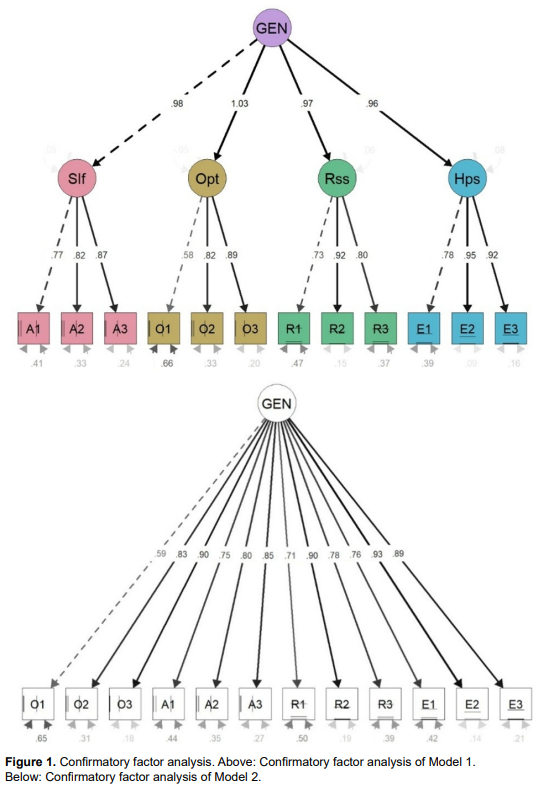
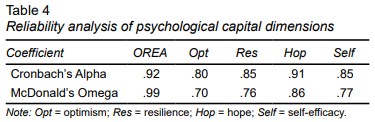
Table 4 shows the reliability analysis performed on the twelve items comprising the psychological capital scale, yielding adequate McDonald’s Omega and Cronbach’s Alpha internal consistency coefficients, all of which were ≥ .70.
Descriptive statistics of OREA-Mx and association with depression
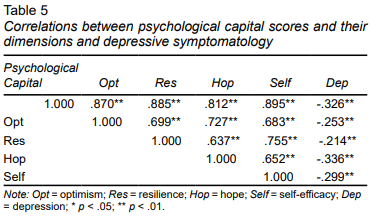
In terms of psychological capital, participants scored M = 42.11 (SD = 5.74) on the overall OREA scale; M = 10.54 (SD = 1.53) in optimism; M = 10.35 (SD = 1.64) in resilience; M = 10.96 (SD = 1.55) in hope and M = 10.22 (SD = 1.74) in self-efficacy. In depression, measured through the ENASEM, they obtained a mean score of M = 2.75 (SD = 2.35). At the same time, an analysis of the correlations of psychological capital scores, their dimensions and depression was performed (Table 5). Results showed a positive correlation between all dimensions and psychological capital. However, with regard to depression, results showed a significant, negative correlation between clinical depression and psychological capital, self-efficacy, hope and optimism, and to a lesser but significant extent resilience.
DISCUSSION AND CONCLUSION
The aim of this study was to evaluate and validate the psychometric properties of the OREA psychological capital scale (Meseguer-De Pedro et al., 2017) applied to older adults in a city in the north of Mexico.
The reliability analysis and internal consistency coefficients were determined by using McDonald’s Omega (.99) and Cronbach’s Alpha (.92), indicating that the internal consistency of the scale is adequate, and that there is an intercorrelation between test items. The internal consistency data for each of the dimensions were also adequate, ranging from .70 to .91. The kurtosis and skewness results are similar to the scores in the original instrument (Meseguer-De Pedro et al., 2017), with a tendency to show above-average responses.
The analysis of the scores obtained in the scale shows that Model 2, which conceptualizes psychological capital as a higher order integrating all its dimensions, presents solid, adequate adjustment indexes. Conversely, Model 1 also suggests that the dimensions of optimism, resilience, hope, and self-efficacy explain the construct of psychological capital, with consistent adjustment rates. In addition, in Model 1, multicollinearity problems were observed in the loads of the factors of self-efficacy and hope, which were adjusted through inequality restriction, following the recommendations of Farooq (2022), to avoid implausible values. The fact that the dimensions of self-efficacy and hope are highly correlated suggests that they are very similar to each other and should possibly be merged, given that they explain similar content. These findings support Model 2 as the optimal approach for understanding psychological capital as an integral resource encompassing various dimensions.
The second objective of this study was to evaluate the correlation between psychological capital, with its four dimensions (optimism, resilience, hope and self-efficacy), and depression. The results show a negative, significant correlation between psychological capital and depression, indicating that, as psychological capital improves, depression symptoms tend to decrease. This finding suggests that psychological capital, understood as a higher order construct, plays a protective role in mental illness. This higher-order characteristic has significant advantages in both prediction and intervention, since it makes it possible to approach psychological capital in an integrated way and focus intervention efforts on a set of interrelated strengths, which together enhance emotional well-being.
As an integral construct, psychological capital offers a structure that not only identifies specific areas of improvement (such as self-efficacy or optimism), but also facilitates holistic interventions covering all dimensions, thereby promoting a broader, lasting effect on well-being. In addition, these results are aligned with other studies confirming the positive impact of strengthening these resources on mental health and well-being, particularly in older adults (González-Celis & Lima-Ortiz, 2017; Ortiz et al., 2021; Rivera-López et al., 2023). It is therefore suggested that promoting psychological capital in this population could be an effective strategy for reducing vulnerability to depression and improving quality of life. Implementing intervention programs focused on psychological capital could have a significant impact on preventing and managing depression, thereby offering a protective, proactive approach to mental health care in older adults in Mexico.
In short, this research provides psychometric evidence of the validity of the OREA scale in a sample of Mexican older adults, extending its applicability beyond the Spanish population for which it was originally designed. In fact, the authors of the OREA scale (Meseguer-de Pedro et al., 2017) proposed cross-cultural or cross-national studies to determine whether results are similar in other countries. The results obtained in this research constitute a first approach to evaluating its psychometric properties in a different cultural context. This initial analysis suggests that the adapted version of this instrument maintains a coherent structure and adequate properties. However, one limitation of this correlational study is its inability to establish casual relations. Although the scale can be administered in the Mexican population with preliminary guarantees, it would be important to increase the sample.
The study presented here has further limitations. First, the adaptation and validation process was conducted with a specific sample of older adults in a city in northern Mexico. Caution is therefore recommended when generalizing the results to other regions of the country or to different cultural contexts. In addition, the procedures implemented, such as confirmatory factor analysis, were limited to a single sample, which prevents cross-sectional or longitudinal comparisons that could enhance the understanding of the psychometric properties of the instrument. It is also important to consider that self-reported data may be subject to response biases, which could influence the consistency of results. Future research expanding the sample and replicating the study in other cultural contexts could provide greater robustness and enable findings to be generalized.
This study shows a preliminary scale that is suitable for measuring psychological capital in a Mexican context, specifically in a city in the north of the country, which supports its use for future research and in clinical or social contexts serving older adults. Moreover, the negative and significant relationship between psychological capital and clinical depression highlights the potential of this scale to identify risk levels and psychological strengths in this population. These findings could be particularly useful for the design of preventive programs focused on the mental health of older adults, since they reinforce the importance of promoting psychological capital as a protective factor against depression. Incorporating the OREA-Mx scale into routine evaluations or intervention programs would not only make it possible to identify the risk of depression more accurately, but also to structure interventions enhancing optimism, resilience, hope and self-efficacy to improve the emotional well-being and quality of life of this population.