INTRODUCTION
The concept of quality of life has been extensively studied in scientific literature for many years. Schalock and Verdugo (2013) characterize it as a desired state of individual well-being comprising various fundamental aspects affected by both personal and environmental factors. It is worth noting, as Costa et al. (2021) observe in their research findings, that there is considerable diversity in the way quality of life is defined and measured, posing challenges for the comparison of results across studies. Nonetheless, although the core dimensions of quality of life remain consistent across individuals, their significance and perceived value may vary from person to person. Assessing these dimensions relies on culturally and contextually sensitive indicators.
Well-being has recently been compromised by the impact of the COVID-19 pandemic, which wreaked havoc on society at large, leading to psychological, social, occupational, and economic repercussions (Mercader Rubio et al., 2022; Vancappel et al., 2023). While the pandemic itself was a significant stressor, its effects were not uniformly distributed. Individuals who lost their jobs and experienced financial decline were particularly vulnerable to adverse health outcomes, including negative impacts on their psychological well-being and overall quality of life (Brenner & Bhugra, 2020). It is also essential to consider the concept of hopelessness, as defined by Beck et al. (1974), representing a set of pessimistic expectations regarding the future. Throughout the pandemic, feelings of hopelessness triggered psychological distress, characterized by the internal turmoil of negative emotions (Ordóñez-Carrasco et al., 2022). Research findings indicate elevated levels of depression, anxiety, and stress among individuals who experienced job loss in the wake of the pandemic (McDowell et al., 2021;Valencia et al., 2022). These effects potentially endured even after the direct impact of COVID-19 declined.
Regardless of their access to treatment, individuals with a mental health diagnosis are likely to have been among the demographic groups most susceptible to a range of emotional symptoms, impairing their quality of life during the pandemic (Liu et al., 2020). Conversely, maintaining optimal emotional intelligence and having a strong social support system can mitigate stress during times of crisis, suggesting that both factors can serve as potential protective measures (Molero et al., 2020).
Exploring the connection between hopelessness and quality of life in individuals facing loss is of significant scientific and clinical interest. Hopelessness, previously linked to a higher prevalence of depression, anxiety, and suicidal tendencies (Mavrogiorgou et al., 2025), is a psychological factor characterized by the perception that current or future negative circumstances are inmutable. This belief can lead to a decline in quality of life and increase the risk of developing disorders such as depression and anxiety (Beck & Steer , 2020). Conversely, quality of life, encompassing an individual’s physical, psychological, and social well-being, is severely impacted by loss and prolonged crises (World Health Organization [WHO], 2022). This study explores how variables such as age, gender, educational attainment, and medication use influence the quality of life and hopelessness of those who have lost loved ones.
Age is a crucial factor in both quality of life and mental health, directly affecting how individuals cope with loss and grief. Research indicates that older adults often experience increased hopelessness due to the loss of social support networks coupled with physical health issues (Domènech-Abella et al., 2017). Likewise, younger individuals have shown a rise in hopelessness, potentially related to disruptions in their academic and social lives (Smith & Victor, 2020). A study by Wu et al. (2021) found that advanced age was associated with higher levels of hopelessness and reduced emotional resilience in response to the loss of loved ones during the pandemic.
Gender differences also play a significant role in the experience of hopelessness and quality of life after loss. Women tend to experience a greater emotional impact due to the cultural and social factors encouraging emotional expression and help-seeking (Zhou et al., 2021). This can facilitate better trauma processing and the development of normative grief (Macia et al., 2024).
Educational attainment influences the ability to cope with adverse situations. Those with higher education often possess better coping strategies, access to mental health services, and a greater sense of control over their lives (Conceição et al., 2019; Cui, 2019). Conversely, individuals with lower educational attainment face barriers to accessing health services and emotional support, exacerbating feelings of hopelessness and negatively affecting their quality of life (Smith & Victor, 2020).
Medication use significantly increased during the pandemic, particularly among those coping with the loss of loved ones (Tiger et al., 2024; Domènech-Abella et al., 2021). Understanding how hopelessness affects quality of life in this context will help identify risk factors and develop more effective psychological interventions to support the grieving process and promote emotional well-being. Moreover, this knowledge can contribute to the design of public health policies that will provide better psychosocial support for individuals experiencing grief after the pandemic.
The present research adds to our understanding of the sociodemographic factors linked to quality of life and hopelessness during the COVID-19 pandemic. It focusses on individuals who lost a loved one, as such losses during the pandemic often occurred suddenly, depriving many of the opportunity to say goodbye and commemorate their loved ones with family and friends. This abrupt loss can result in disorganized grief, feelings of hopelessness, and a decline in quality of life (Holland et al., 2021), leading to emotional distress and hampering the grieving process (Breen et al., 2021; Eisma & Boelen, 2023; Tang et al., 2021). It is worth noting that bereavement due to COVID-19 tends to be more severe than that due to natural causes of death (Eisma et al., 2021). Despite the constraints imposed by public health measures, personalized care can still be provided through effective communication between professionals and families, potentially facilitating meaningful time spent with the loved one before their passing. These measures can enhance coping mechanisms, potentially reducing the impact on quality of life (Mayland et al., 2021).
Understanding how to address the needs of individuals post-pandemic holds immediate and lasting significance for clinical practice (Hanna et al., 2021). Given that for every COVID-19 fatality, approximately nine individuals were impacted by bereavement (Verdery et al.,2020), this translates to over 60 million people globally who experienced loss due to COVID-19, based on worldwide death tolls.
The quality of life and hopelessness of individuals who have lost loved ones are influenced by several variables, such as age, sex, educational attainment, and medication use (Eisma & Boelen, 2023). The present study therefore aims to identify individual characteristics (including sociodemographic, clinical, and bereavement-related aspects) correlating with either reduced quality of life or increased levels of hopelessness in individuals who experienced the loss of a loved one during the COVID-19 pandemic. Given the exploratory nature of the study, we did not posit specific hypotheses.
METHOD
Study design
The present cross-sectional study was part of a larger research/intervention project exploring multiple clinical factors of Mexicans who accessed a free online platform designed to provide emotional support for those experiencing grief during the COVID-19 pandemic (Dominguez-Rodriguez et al., 2021).
Participants
For this cross-sectional study, data were gathered from individuals who registered on the Duelo COVID platform, a free online resource designed to provide emotional support for those experiencing grief during the COVID-19 pandemic. Participants were primarily recruited through social media channels, enrolling on the platform between December 22, 2020, and November 17, 2021.
Individuals had to meet several criteria to be eligible for participation . Firstly, they needed to be 18 or older. Other requirements including having internet access, a valid email address, and basic digital literacy. Participants were required to be fluent in Spanish and have experienced the loss of a loved one within the previous six months.
The Duelo COVID platform, accessible through computers, smartphones, and tablets at https://www.duelocovid.com, required participants to create an account to access the intervention materials. On registration, individuals received an email confirming their account and providing access to the website, which included an informed consent form and the intervention resources. The evaluation process was integrated and automated within the platform. Information regarding external psychological services, with a focus on free options, was also available on the platform.
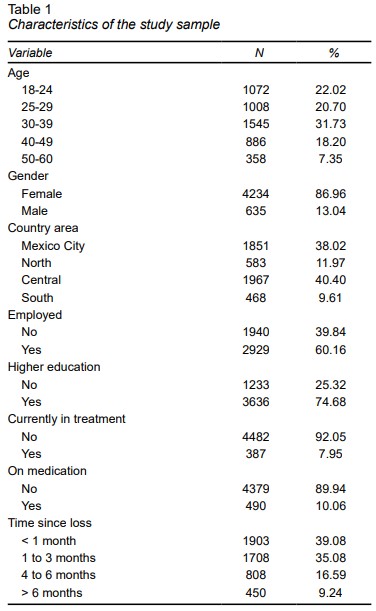
Using non-probability sampling, 4,869 participants, with a mean age of 33.10 years (SD = 9.69), were included in this study Most of them were employed females, who had completed higher education. In addition, most respondents had lost their relatives or loved ones in the three months prior to data collection. Detailed information on the sample is given in Table 1.
Measurements
Sociodemographic variables. Participants were asked to report their sex, employment status, current treatment (psychological and pharmacological), and whether they had made a suicide attempt in the past three months. They were also asked to provide their age in years, area of the country where they lived, educational attainment, and the time that had elapsed since the loss. The area of the country was coded using four large geographical categories following an existing classification (Rivera-Rivera et al., 2020).
Beck’s Hopelessness Scale. This scale comprises 20 true or false questions, with scores ranging from 0 to 20, with higher scores indicating a higher level of hopelessness (Beck et al., 1974). This scale has been widely validated and used, and for this study, the version validated in the Mexican population was administered (Córdova Osnaya, 2011).
World Health Organization Quality of Life (WHOQoL)-BREF Spanish version. This instrument is composed of 26 items, two broad questions (global quality of life and general health), and 24 questions providing a profile of the four dimensions of the respondent’s quality of life: physical health, psychological health, social relationships, and environment. It focuses on their degree of satisfaction with various situations in their daily life. Each item has five Likert-type response options (1–5). The scale was validated in the Mexican population, showing partial evidence of validity in clinical settings (Acosta Quiroz et al., 2013).
Procedure
The study was conducted from December 2020 to April 2021, through a self-administered intervention platform, Duelo COVID. Detailed information on the recruitment process is available elsewhere (Dominguez-Rodriguez et al., 2021). Participants were recruited through social networks such as https://www.facebook.com/DueloCovid and articles on the news media. Potential participants were not sent emails to invite them to participate in the study.
To receive the intervention, participants were required to provide informed consent. Only adults aged 18 or older were allowed to register, and they were guaranteed that their data (such as e-mail addresses) would be protected. No confidential data such as names, addresses, or telephone numbers were requested.
Statistical analysis
First, bivariate associations between the sociodemographic variables and each of the study outcomes were examined with a set of ANOVA tests. Only statistically significant variables (p < .05) were selected as potential predictors for multiple regression analysis. This procedure was repeated for each of the outcome variables (hopelessness, physical QoL, psychological QoL, social QoL, and environmental QoL).
Ethical considerations
The study was approved by the Research Ethics Committee of the Universidad Autónoma de Ciudad Juárez, Mexico (Approval ID: CEI-2020-2-226), and is registered in Clinical Trials.
Before answering the questionnaires, participants were required to read and sign a consent form.
RESULTS
Bivariate analyses
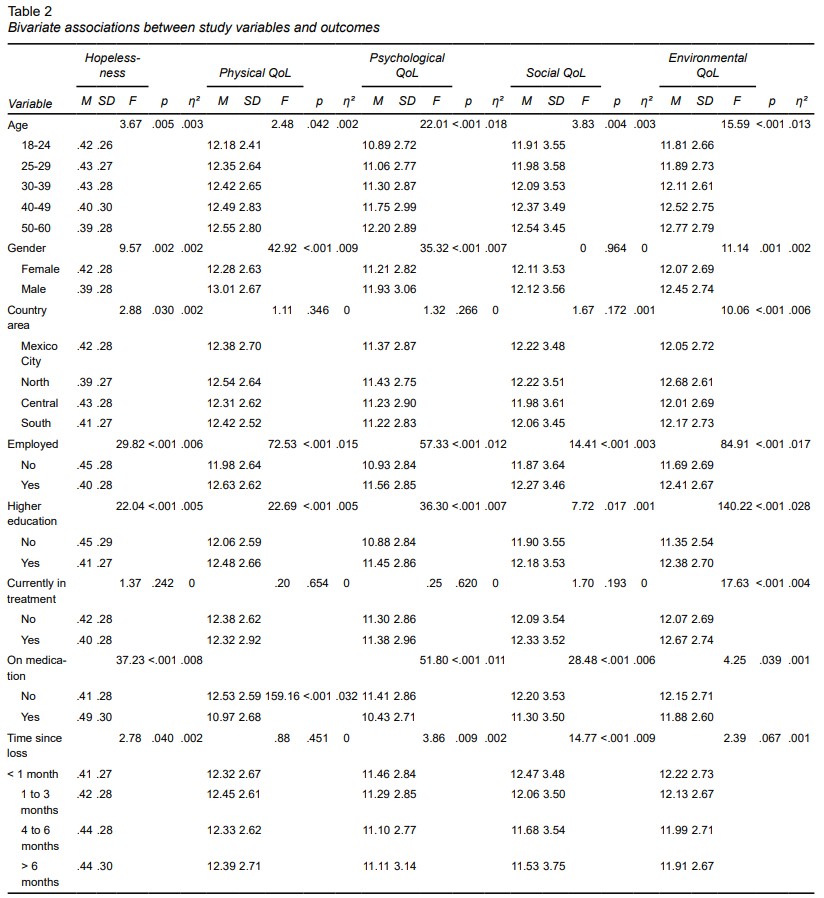
As can be seen in Table 2, hopelessness was significantly associated with all study variables except for being under psychological or psychiatric treatment. This variable was also non-significant for all QoL domains except environmental QoL. The country area variable was only significantly associated with hopelessness and environmental QoL. Conversely, time since loss was significantly associated with hopelessness, psychological QoL, and social QoL, but not with physical or environmental QoL. It should be noted, however, that although the results were significant, the effect size was small in all cases (the largest being 3.2% of explained variance). Detailed results of the bivariate ANOVAs are given in Table 2.
Multiple linear regressions
Five multiple regression analyses were conducted (Table 3). First, all study variables remained associated with hopelessness even after controlling for each other. Being male, living in the northern area of Mexico, and having completed higher education were associated with less hopelessness, whereas taking psychiatric medication and having experienced the loss of a loved one four to six months prior to the evaluation were linked to greater hopelessness. Where age is concerned, the results suggest a nonlinear pattern. A slight increase in hopelessness occurs for adults aged between 25 and 39 years, after which it decreases.
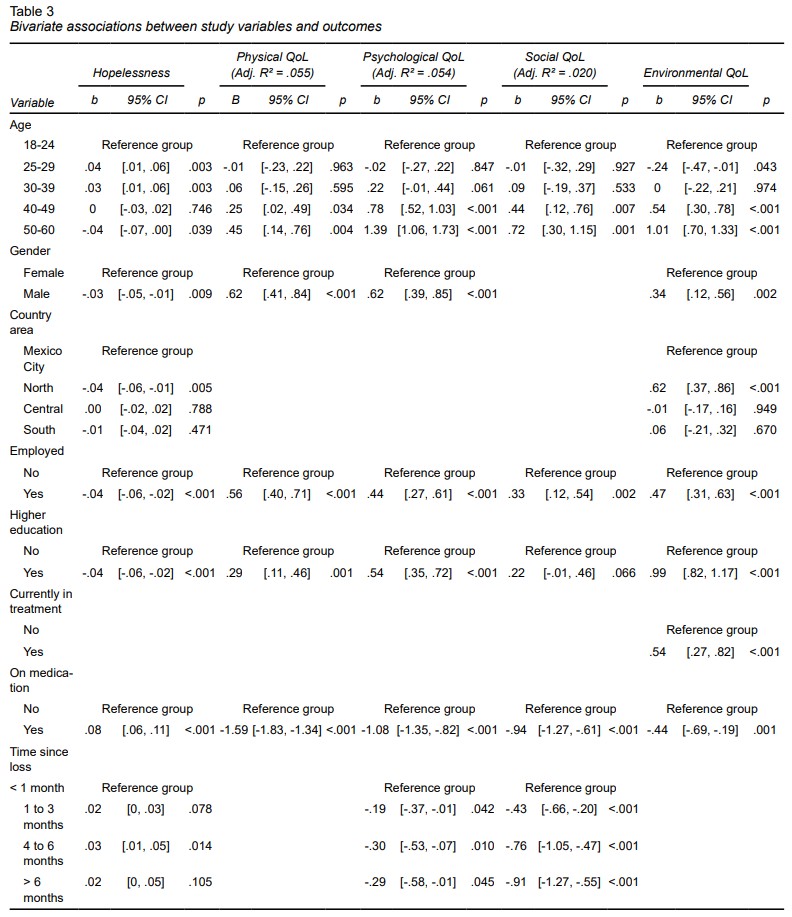
Second, all study variables also showed a significant association with physical QoL. Higher scores were observed in males, those who were employed, and had completed higher education, whereas lower physical QoL was found for people who took psychiatric medication. In regard to age, an upward trend was observed from the age of 40 onwards.
Third, psychological QoL was positively related to being male, employed, and having completed higher education.Conversely, taking medication was associated with lower psychological QoL. As with physical QoL, a positive association was observed between age and psychological QoL among those aged 40 or older. Time since loss was also related to psychological QoL. Those whose loss had occurred more than a month before evaluation showed lower levels of psychological and social QoL.
Fourth, higher levels of social QoL were associated with age (beginning at 40) and having a job. Conversely, lower QoL was observed among those taking psychiatric medication. Moreover, the more time had elapsed since the loss, the lower social QoL levels tended to be.
Fifth, better environmental QoL was associated with being male, living in the Northern area of the country, having a job, having higher education, and being currently under psychological or psychiatric treatment. On the other hand, taking psychiatric medication was related to lower environmental QoL. Finally, it should be noted that all the models explained a fairly low percentage of the variances of their outcomes. Only 2% of the variance in hopelessness and QoL was explained by their respective models, as opposed to between 5 and 6% of the variance in physical, psychological, and environmental QoL.
DISCUSSION AND CONCLUSION
Profound societal shifts in the wake of the pandemic have significantly altered people’s daily experiences, particularly in regard to grieving, confronting mortality, and coping with loss (Eisma & Tamminga, 2020). As Eisma and Tamminga (2020) note, most individuals who have experienced bereavement typically adapt and normalize their circumstances over time. However, the pandemic introduced a unique set of circumstances in which the grief experienced by those who lost loved ones to COVID-19 was intensified by risk factors such as social isolation, financial strain, health concerns, worry about family members or friends, and other related factors. This produced detrimental effects on the mental health and overall quality of life of individuals bereaved as a result of COVID-19 (Salisbury et al., 2022). At the same time, these same researchers suggest that help-seeking had the most significant impact on mitigating the effects of bereavement on individuals’ quality of life.
The current study reveals correlations between all the examined variables and feelings of hopelessness. Being male, residing in northern Mexico, and higher educational attainment were linked to lower levels of hopelessness, whereas the use of psychiatric medication was associated with higher levels of hopelessness. These findings align with those of Hacimusalar et al. (2020), who assert that state anxiety levels rise during stressful situations like the pandemic, intensifying feelings of hopelessness. They argue that uncertainty catalyzes anxiety, ultimately leading to increased feelings of hopelessness among individuals. Regarding gender, our findings indicate that being male was associated with lower levels of hopelessness and higher scores in certain quality of life dimensions. This may be attributable to male gender norms requiring men to control and limit their emotions (Berke et al., 2018), potentially reducing awareness of their own emotional lives and therefore limiting descriptions of the latter in self-reports. Moreover, our results align with previous studies demonstrating lower depression rates among men than women (Valencia et al., 2022). Further research is required to explore these gender-related dynamics in bereavement. However, it is important to note that this interpretation requires further investigation for it to be confirmed within this specific context. Concerning residence in the north of the country, Mexicans in the north have been shown to report up to 0.05% higher levels of happiness than those in the rest of the country (Martínez-Sermeño et al., 2025). This could potentially explain why living in the northern area was associated with lower hopelessness in our study. Nevertheless, more specific studies are needed to explore these regional dynamics in greater detail.
Expanding on our findings, experiencing loss within the timeframe of four to six months before the assessment was associated with higher levels of hopelessness, a trend that mirrors the findings of Chen and Tang (2021). Regarding age, our results indicate a non-linear pattern. There is a slight increase in hopelessness among adults aged 25 to 39, followed by a decreasing trend thereafter. This aligns with studies focusing on younger populations, typically aged between 18 and 30, who have reported grappling with negative emotions (Brooks et al., 2020) and concerns regarding their professional future (Wang et al., 2020). These factors, in turn, contribute to psychological issues such as hopelessness, highlighting the need for a thorough examination and reflection on the current situation.
It is worth underlining the fact that all the variables examined in our study displayed significant correlations with physical quality of life. Males, employed individuals, and those with higher educational attainment exhibited better physical quality of life. In this regard, Andrei et al. (2022)suggest that the loss of employment negatively impacts quality of life, with hopelessness playing a partial mediating role in this relationship. Additional research indicates that job loss can intensify symptoms of depression, anxiety, and stress, and reduce positive mental health levels compared to individuals who remain employed (McDowell et al., 2021; Rossi et al., 2020; Valencia et al.,2022). Individuals taking psychiatric medication reported lower physical quality of life. This is consistent with the study by Wu et al., (2021) finding that the use of antidepressants and anxiolytics was associated with a temporary decrease in depressive symptoms. However, it was also linked to an increase in long-term dependence and a reduction in the perceived quality of life.
Regarding age, a progressive increase in physical quality of life was observed from the age of 40. Likewise, psychological quality of life displayed positive associations with being male, employment status, and higher educational attainment. Conversely, individuals taking medication reported lower levels of psychological quality of life. Consistent with findings on physical quality of life, there was a positive correlation between age and psychological quality of life among individuals aged 40 and over. Moreover, time since the loss was linked to psychological quality of life. Those who had experienced a loss more than one month before the assessment reported lower psychological and social quality of life. Exploring this aspect of psychological well-being, Breen et al. (2021) suggest that it may heighten the risk of impaired quality of life. Specifically, individuals bereaved due to COVID-19 may struggle to process their loss, particularly if they experience separation distress, dysfunctional grief, and/or post-traumatic stress.
Higher levels of social quality of life were linked to individuals aged 40 and over, as well as those who were employed. Conversely, individuals taking psychiatric medication reported lower social quality of life. Additionally, social quality of life tended to decrease as more time elapsed since the loss. However, contrasting findings were reported by Ham et al. (2021), who found no discrepancies in social quality of life scales, suggesting that the pandemic did not significantly impact the well-being of bereaved family members. Environmental quality of life was associated with being male, living in the northern region of the country, employment status, higher educational attainment, and receiving psychological or psychiatric treatment. However, taking psychiatric medication was linked to lower environmental quality of life.
The findings of this research suggest that individuals with robust mental health are better equipped to navigate and employ effective coping strategies in response to challenging circumstances, such as the recent pandemic. However, given that adverse effects may persist for an extended period, even beyond the pandemic itself (Forte et al., 2020), it is essential to contemplate various coping mechanisms. These measures include providing affected individuals with access to specialized psychological interventions (Eisma & Boelen, 2023). Moreover, efforts should be made to identify psychological variables such as emotional intelligence (Andrei et al., 2022), which can act as protective factors, enhancing overall quality of life and reducing the emotional toll of the pandemic on both physical and psychological well-being.
The COVID-19 pandemic presents an opportunity for organizations and services to adapt, innovate, and enhance their usual practices. It is essential to identify psychological factors that either protect against or pose risks to quality of life, as this knowledge is crucial for designing interventions aimed at alleviating the emotional impact of the pandemic and its adverse real-world effects. Nonetheless, the pandemic has also presented society with challenges in terms of coping with grief and loss, requiring diverse approaches (Mayland et al., 2020; Stroebe & Schut, 2021).
As for limitations, it is important to note that this study provides insights into how hopelessness impacts quality of life. However, future research should explore how hopelessness is affected by other factors such as depression. Additionally, all data were collected cross-sectionally, capturing a specific moment during the pandemic. To better understand the long-term effects of this unprecedented event, future studies should adopt longitudinal designs. It is also essential to underscore the significance of incorporating measures of quality of life beyond self-report, such as objective indicators related to socioeconomic factors. It is important to acknowledge that our sample consisted of individuals who actively sought online psychological support after a loss, which may create a selection bias. Those who did not seek help or lacked access to online resources may have different experiences, limiting the generalizability of our results to the bereaved population as a whole. Another limitation is the absence of a comparative group distinguishing between types of death (due to COVID-19 versus other causes). We were unable to determine whether the type of death influenced the degree of hopelessness and quality of life. Future research could benefit from including this variable to obtain a more comprehensive understanding of the impact of bereavement.
In conclusion, this study reveals significant correlations between various sociodemographic factors and both hopelessness and quality of life among those bereaved during the COVID-19 pandemic. Being male, living in northern Mexico, and having completed higher education were associated with lower hopelessness, whereas psychiatric medication use correlated with higher hopelessness. Physical, psychological, and social quality of life were positively associated with being male, employment, and higher education, and negatively associated with psychiatric medication. Age showed a non-linear relationship with hopelessness and a positive association with quality of life from the age of 40. These findings suggest that bereavement experiences are not uniform and that pre-existing inequalities influence how individuals cope with loss. Targeted interventions should address specific risk factors, such as medication use and time since loss, while leveraging protective factors such as education and employment. Future research should employ longitudinal designs to understand long-term impacts and further refine interventions to reduce the emotional toll of the pandemic on physical and psychological well-being.