INTRODUCTION
Psychological wellbeing is a construct studied in psychology, conceptualized as an optimal state of mental health in medical terms (Pethtel & Chen, 2010). Psychological wellbeing allows a subject to be aware of their abilities, cope with stress, be more productive and efficient in society, reduce their levels of anxiety and depression and achieve better academic results (Vences Camacho et al., 2023).
It has been documented that psychological distress negatively affects students’ learning, in addition to making it difficult for them to concentrate and participate in university life. Education authorities must therefore understand students’ experience, and the stressors to which they are exposed, to improve their wellbeing (Baik et al., 2019; Fichardt et al., 2023).
Although psychological wellbeing has been extensively studied in the university context, especially in health sciences students, particularly medicine, there is a dearth of studies on undergraduate students of physiotherapy and their wellbeing. At UNAM, physiotherapy students are affected by factors such as stress and constant anguish.
Like doctors, at the start of their training, they have a high academic load and begin their practices at hospitals in the early stages, and continuously during the fourth year of training. In addition, they are required to decide on an area of in-depth physiotherapeutic study as part of the final stage of their professional training.
Psychological wellbeing is a complex, multifaceted construct that has spawned various conceptualizations, from hedonic to eudaimonic (Lee & Carey, 2013).
According to the eudaimonic conceptualization, the model of wellbeing proposed by Ryff & Keyes (1995) and based on what is described by Waterman (1993) involves the realization of the unique nature of each human being, through the search for perfection, and involves the fulfillment of one’s potential.
The multifactorial conceptualization proposed by Ryff & Keyes (1995) comprises six inter-related dimensions, including the following:
Personal growth: characterized by interest in the acquisition of knowledge and continuous training with an innovative, professional vision, designed to consolidate life skills in the context of the discipline.
Self-acceptance: acceptance of one’s physique, personality and interaction with others, and identification of one’s positive and negative traits.
Self-control: managing one’s impulses, way of being and behaviors in situations requiring interaction in an unfavorable or complex context.
Personal interaction: the ability to establish interpersonal relationships and the identification of associated personal traits.
Professional relationship and future plans: defined by positive interactions and the establishment of relationships with one’s colleagues and directing efforts towards the fulfillment of one’s goals.
Purpose in life: focused on the definition of a future life plan to guide one’s goals and the actions required to achieve them in an organized, planned way.
Developing scales to evaluate psychological wellbeing is essential for empirical research because there are reports in the literature of scales with diverse psychometric properties with varying reliability and validity (Springer et al., 2011; Topp et al., 2015). Furthermore, studies conducted in different cultures and contexts suggest that the six dimensions proposed by Ryff & Keyes (1995) do not always identify high levels of psychological wellbeing. Others have suggested inconsistency in the latent structure of the scales due to the excessive reduction of items, compromising the internal consistency coefficients (García et al., 2023).
One of four representative studies of the development of scales to determine psychological wellbeing in the Latin American context is the study by Díaz et al. (2006). These authors adapted van Dierendonck’s (2004) version and reported good internal consistency with Cronbach’s alpha values of .83 in self-acceptance and .68 in personal growth (Díaz et al., 2006). However, they also reported not having found a satisfactory level of adjustment after confirmatory factor analysis in the six-dimensional model (self-acceptance, positive relationships, autonomy, mastery of the environment, purpose of life, and personal growth) (Díaz et al., 2006). These same authors eventually proposed an abridged version to improve the psychometric properties with Cronbach’s alpha values from .84 to .70 (Díaz et al., 2006).
For their part, Aranguren & Irrazabal (2015) analyzed the psychometric properties of Ryff’s psychological wellbeing scales in Argentinean students, finding, through several exploratory factor analyses, a scale with good reliability and fit indices, limited to three main factors: autonomy, positive relationships with others, and competence.
A study of Mexican students examined an instrument with a brief, unidimensional structure of 19 items, through exploratory and confirmatory factor analysis and modeling using structural equations, with acceptable indicators of its internal structure and reliability. These same authors used the structure of the version proposed by van Dierendonck (2004) already adapted to Spanish (Díaz et al., 2006; Dominguez-Lara et al., 2019).
In health sciences, in the bachelor’s degree program in medicine in Mexico, the psychometric properties of Ryff’s Psychological Wellbeing scale were adapted after administering the scale to students at two universities (Flores Hernández et al., 2023). Exploratory and confirmatory analysis yielded a four-dimensional instrument (purpose of life, personal rejection and self-acceptance, personal control, and personal growth), with robust structure, satisfactorily explained variance, internal consistency (with a Cronbach’s alpha of .89) and appropriate discrimination.
In light of what has been reported in the literature, it is useful to recall that the measurement of wellbeing varies according to the cultural context. The factor structure of certain scales is affected by aspects such as gender, urban and rural differences in specific populations and age of respondents (Sasaki et al., 2020).
In this regard, it has been reported, for example, that age is a key factor in groups of young people such as university students, whose psychological wellbeing has been shown to be affected by high levels of mental fatigue (Browne, 2017).
Other studies, conducted at universities in various parts of the world, have reported high levels of generalized psychological distress and severe depression symptoms in students compared to the general population. This has primarily been attributed to the transition from secondary to higher education (Larcombe et al., 2016; Stallman, 2010).
Although the factors affecting the psychological wellbeing of university students, particularly physiotherapists in training, have been identified, there are no studies evaluating them in this population in Mexico. Moreover, existing wellbeing scales have varying reliability and validity in medical students, in addition to jeopardizing their internal consistency by reducing the number of items they contain. The main objective of the present study was therefore to validate the Ryff Wellbeing Scale (Flores Hernández et al., 2023) in physiotherapy students.
METHOD
Study design
This is a cross-sectional analytical study, designed to validate the proposed psychological wellbeing scale (Flores Hernández et al., 2023).
Participants
We included a sample of 196 students in the bachelor’s degree in physiotherapy at the Faculty of Medicine of the National Autonomous University of Mexico (UNAM), obtained through convenience sampling of consecutive cases from June to November 2023.
Measurements
We requested permission from the coordination office of the bachelor’s degree in physiotherapy to send a link to the scale in Google Forms through the WhatsApp groups of students enrolled in the degree course. We also asked for permission to send the link by email, the usual communication channel between students and the bachelor’s degree coordination office. The questionnaire included 29 items in Likert-type format with four response options: 1= Little or never, 2 = Sometimes, 3 = Frequently, 4 = Almost always or always.
Procedures
To encourage participant response, infographics were created and placed at the degree headquarters so that students could access the questionnaire through a QR code. Students were invited to participate and those who accepted were asked to authorize a privacy notice for their data, which were kept confidential since we worked with global data to adapt the scale. Information was extracted from the Excel format file generated by the system and exported to SPSS and AMOS 21 for analysis.
Statistical analysis
The psychometric structure of the scale was determined through exploratory and confirmatory factor analysis, enabling us to obtain the adjustment values, explained variance, structure, and discrimination of the instrument. To determine the internal consistency of the instrument, we used Cronbach’s Alpha and one-way ANOVA to discriminate between the items and dimensions as regards their diagnostic criteria and the scale as a whole.
Ethical considerations
The study is part of the protocol approved by the ethics and research committees of the Research Division of the National Autonomous University of Mexico (UNAM) Medicine Faculty, registration number FM/DI/114/2020. Students were asked to authorize their participation through a data management privacy notice according to the regulations established by UNAM.
RESULTS
One hundred and ninety-six students from the four years of the bachelor’s degree program in physiotherapy were evaluated, 155 of which were women (79.0%), and 41 (20.91%) men, with a mean age of 20.79 ± 2.42 years. The sample was mainly concentrated in the first two years of the degree, with first year students accounting for 38.2% and second year students accounting for 27.0% of participants.
The reliability of the instrument was determined by the Cronbach’s alpha coefficient, which obtained a value of .76 for the instrument as a whole. The structure of the instrument was developed through an exploratory factor analysis of principal components with Oblimin rotation, with KMO adjustment values of .86 significant at .000.
The variance explained by item identified in the communities was located within a range of .43 to .86, except for statement 22, “to achieve what I want, it is important to make plans.” This item obtained a value of .36, and was therefore eliminated from the adapted version of the instrument. The Global Explained Variance of the instrument was 66% for the six dimensions obtained.
Table 1 presents the structure obtained by dimension with the factor loading for each item, the explained variance and factor consistency, as well as a comparison with the original structure of the instrument for medical students.
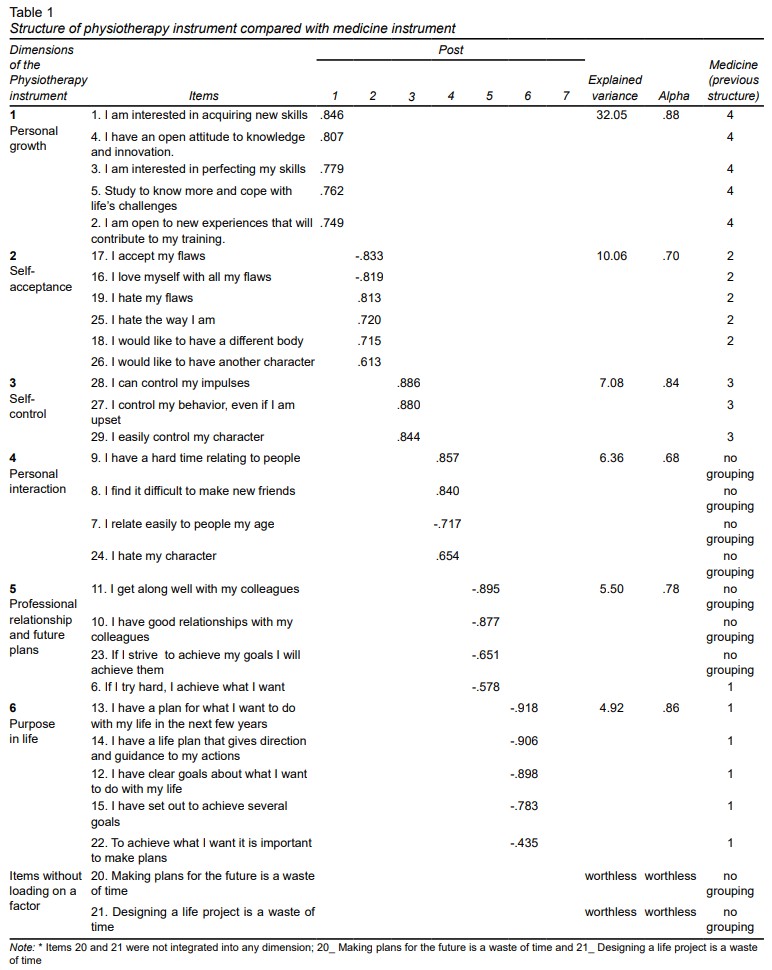
Items 20 and 21 were eliminated since they were not grouped into any factor.
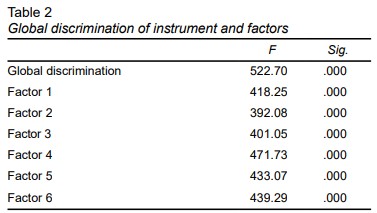
The discrimination of the instrument was determined by establishing cut-off points at the .33 and .67 percentiles; discrimination for the global scores and by factor were shown in Table 2. Significant discrimination was identified through a one-way ANOVA with significant differences at all the intervals of the scale (low, lower middle, upper middle, and high) with a significance of p < .001, determined using Tukey’s post hoc test.
Confirmatory factor analysis was obtained through a structural equation model, with a Chi2 value of 4.14 (p < .01). The items associated with each factor reported significant standardized regression weights, ranging from .563 to .914 with a root mean square error of approximation (RMSEA) value of .036 and a normal fit index (NFI) of .921.
DISCUSSION AND CONCLUSION
The objective of this study was to validate the Ryff Wellbeing Scale in physiotherapy students. The main finding obtained was the six dimensions in its structure scale: personal growth, self-acceptance, self-control, maintaining positive relationships with others, personal interaction, professional relationships and future plans, and purpose in life.
The instrument developed in this study is consistent with the scale adapted by Díaz et al. (2006), where the author reported good internal consistency with self-acceptance and personal growth. The present adaptation to the degree in physiotherapy undertaken as a result of the analysis produced an instrument with an adjustment level consistent with the proposed theoretical model of six dimensions. It included adjustments in the grouping of the items of each dimension, unlike what was reported by Díaz et al. (2006).
In Spain, a study evaluated dimensions such as self-acceptance, positive relationships, autonomy, environmental mastery, personal growth, and purpose in 149 university students (Morales-Rodríguez et al., 2020). This is congruent with the structure of the instrument obtained in the physiotherapists evaluated in this study. We established six dimensions of psychological wellbeing in the same way as in the study by Díaz et al. (2006), with slight variations in their grouping.
In Mexico, this same scale was adapted for medical students, 1,974 of whom were evaluated. However, the reported structure only identified four dimensions: purpose in life, personal rejection and self-acceptance, personal control, and personal growth, with solid psychometric values (Flores Hernández et al., 2023).
The structure of the aforementioned instrument was the main reference for the proposed adaptation to the physiotherapy degree. The grouping of factors was largely maintained by varying their order and two additional dimensions were consolidated in the present instrument by items with no loading as regards the medical structure.
Despite the similarities between medical and physiotherapy students, it is necessary to have specific instruments for each population. The use of a generic instrument for both groups could cause bias or even lead to inaccurate interpretation due to the lack of specificity.
Unlike what was reported by Flores et al. in 2023 (Flores Hernández et al., 2023), physiotherapy students showed that they had a more defined life plan, as well as knowledge of the goals they wished to achieve, as a good correlation was found between the subscales.
The relevance of the present study is borne out by previous studies in countries such as Pakistan (Afridi & Fahim, 2019), Sweden and the Netherlands (Hodselmans et al., 2018), Australia and the United Kingdom (Tucker et al., 2006), and Israel (Jacob et al., 2013). These studies report that physiotherapy students present moderate to high stress levels related to academic and interpersonal aspects with a direct bearing on their wellbeing. However, reports of the use of psychometrically robust instruments to evaluate psychological wellbeing in this group of students remain scarce (Walsh et al., 2010).
Among the strengths of this study are the psychometric characteristics of the scale with its high levels of validity and reliability. One of its weaknesses is that we surveyed fewer than half the students enrolled in the degree course. Morever, the cross-sectional nature of the study only enabled us to determine the emotional state of the students at the time they were being evaluated, which may differ at other times.
The present instrument adapted for physiotherapy students has adequate psychometric properties, coupled with high statistical evidence of validity and reliability to evaluate psychological wellbeing. However, it would be advisable to conduct further studies to evaluate the temporal consistency of the results obtained.