INTRODUCTION
Sleep is an essential component of life, required for learning, undertaking physical activity, and maintaining both physical and mental health (Jalali et al., 2020). It is a crucial physiological function, the quality of which depends on a variety of environmental and intrinsic factors interacting with each other (Toscano-Hermoso et al., 2020).
The functions of sleep have been summarized in theoretical models from various areas of study, underlining its importance for neurodevelopment, neuronal synaptic plasticity, memory consolidation, metabolic functions, immune system regulation, general well-being, and survival (Miletínová & Bušková, 2021). These theories work together to explain the ultimate purpose of sleep and suggest that insufficient or interrupted sleep can affect health. Poor sleep quality is associated with physical and psychological consequences such as mood disorders, anxiety, aggression, cognitive impairment, attention deficit disorder, autism, Prader-Willi syndrome, and Smith-Magenis syndrome (Clement-Carbonell et al., 2021; Garbarino, 2020).
The term “sleep quality” in sleep medicine refers to various metrics, including total sleep time, sleep latency, efficiency, maintenance, disturbances, and total wakefulness. It can be assessed objectively through polysomnography and actigraphy, or subjectively through sleep journals and retrospective questionnaires (Fabbri et al., 2021).
Prevalence of poor sleep quality varies by sociodemographic characteristics, with reports indicating that 22% to 65% of the general population experiences some form of sleep disorder (Yassin et al., 2020). In Mexico, the 2016 National Health and Nutrition Survey (ENSANUT) was the first to reveal a high prevalence of various sleep disorders among the adult population. It found that 28.4% of adults had short sleep duration, 18.8% suffered from insomnia, and 27.3% were at risk for obstructive sleep apnea (Gaona-Pineda et al., 2021). The 2018 National Survey on Health and Aging in Mexico (ENASEM) reported that 46.6% of women and 32.4% of men surveyed experienced frequent sleep difficulties, with a 2.2% increase for women in 2021. However, these studies focused primarily on adults aged 53 and older (Instituto Nacional de Estadística Geografía e Informática [INEGI], 2018, 2021).
Anxiety and depression are a significant health problem among university students in general (Mirza et al., 2021). However, several studies have evaluated differences in the prevalence of anxiety and depression between medical and non-medical students, finding that anxiety is significantly more prevalent in medical students (Moreira de Sousa et al., 2018). Findings are mixed for depression, with studies observing either higher or lower prevalence among medical undergraduates (Mirza et al.,2021). Regarding sleep quality, several studies have demonstrated that medical students display more impairments in sleep quality (Corrêa et al., 2017) due to their demanding workloads, experiencing significant stress. This leads to less sleeping time, substance abuse to stay awake, poor sleep maintenance and disturbances, and poor overall sleep quality, which can cause long-term mental health issues (McKinley et al., 2022; Paniagua et al., 2023;Yassin et al., 2020).
Research has shown that poor sleep quality stemming from sleep deprivation negatively affects somatic, cognitive, emotional, and behavioral functions (Suardiaz Muro et al., 2020). A cross-sectional study by Oh et al., (2019) found a link between sleep disorders and psychiatric comorbidities, with individuals at higher risk for insomnia more likely to experience anxiety and depression. Nearly half the participants with insomnia suffered from either anxiety, depression, or both.
These associations between sleep quality and depression have been widely observed, with depression being known to cause poor sleep quality. Recently, however, more emphasis has been placed on sleep quality (Joo et al., 2022). The theoretical model of depression is based on cognitive vulnerability, whereby a self-concept of helplessness and low self-esteem are activated by catastrophic or negative events that interact with stressors to produce the condition (Nima et al., 2013). The same is true of anxiety, which is strongly associated with negative affectivity or the experience of stressors and other negative emotional states (Eysenck &Fajkowska, 2018). Poor sleep quality affects the regulatory mechanisms mentioned previously that enable a person to weather stressors and negative events.
Research has shown that anxiety precedes depression in the elderly, and it has also been demonstrated that poor sleep quality can lead to either depression or anxiety (Chen et al., 2022). However, the association among these three variables remains unclear, especially since poor sleep quality appears to precede both affective disorders, while anxiety predicts the onset of depression. Anxiety is therefore hypothesized to have a mediating effect.
The overall objective of the present research was to analyze the effect of sleep quality as a predictor of depression mediated by anxiety among medical students at the Autonomous University of Quintana Roo (UAEQROO). The specific objectives were to evaluate the prevalence of anxiety and depression in medical undergraduates from the first to fourth semesters, assess their sleep quality of students, and determine whether poor sleep quality can predict the presence of depression or whether it needs to be mediated by anxiety.
METHOD
Study design
A quantitative, descriptive, cross-sectional study was conducted in a Health Sciences Division in the municipality of Othón P. Blanco, Chetumal, in the southern region of Quintana Roo, Mexico from February to November 2023.
Subjects
The study population included medical students from the first to fourth semesters at the Autonomous University of Quintana Roo. Sample size calculation for a finite population was performed with a 95% confidence interval and a 5% margin of error, yielding a total sample of 200 participants selected by non-probabilistic convenience sampling.
Inclusion and exclusion criteria
Inclusion criteria for the study were being medical students of either sex enrolled in the first to fourth semesters, who were willing to participate, and provided their informed consent. Exclusion criteria included being under medical treatment for a mental disorder or having had a prior diagnosis of anxiety or depression.
Measurements
Sociodemographic data
Students were asked about their sex, age, family income, and the semester in which they were enrolled, and whether they had had a prior diagnosis or treatment for mental health conditions. The last two questions were included for exclusion purposes and were not essential for the analysis of this study.
Instruments
Pittsburgh sleep quality index
The Pittsburgh Sleep Quality Index (PSQI) was used to assess sleep quality. This 24-item questionnaire provides information on various aspects of sleep, including sleep duration, latency, and the frequency and severity of sleep problems. It provides seven component scores, each ranging from 0 to 3, which are added to produce an overall score from 0 to 21. Higher scores indicate worse sleep quality. The PSQI evaluates sleep quality in the past month, distinguishing between transient and persistent sleep disorders (Buysse et al., 1989). The instrument has demonstrated adequate reliability, with a Cronbach’s alpha of .83, and has been validated for use in populations with anxiety and Spanish-speakers (de la Vega et al., 2015).
Hamilton anxiety scale
The Hamilton Anxiety Scale comprises 14 items assessing the severity of anxiety symptoms. Each item is rated from 0 (absent) to 4 (severe). A total score ranging from 6 to 14 out of a maximum of 56 points indicates mild anxiety, while scores greater than 15 denote moderate to severe anxiety (Instituo Mexicano de Seguridad Social [IMSS], 2010). The scale has a reliability index ranging from .79 to .86 (IMSS, 2010).
Beck depression inventory
The Beck Depression Inventory (BDI) includes 21 items scored from 0 to 3 based on symptom severity. It evaluates affective, cognitive, somatic, and vegetative symptoms. The total score ranges from 0 to 63 points, with scores over 20 indicating depression. For those with depression, scores are categorized as follows: 0 to 13 (minimal depression), 14 to 19 (mild depression), 20 to 28 (moderate depression), and 29 to 63 (severe depression) (Richter et al., 1998). The BDI has shown an average coefficient alpha of .75, with differences between psychiatric (.88) and non-psychiatric (.82) populations (Jackson-Koku, 2016).
Procedure
Prior to the administration of the surveys, permission was requested from the university authorities. Once the intervention had been approved, students were invited to participate in the survey by asking the professor responsible for the primary health care program to give up an hour of his time during the classes associated with the program.
Data collection took place from April to June 2023 using Google Forms. During that time, a member of the research team spoke to students in their classrooms to request their collaboration. The researcher explained the objective of the research, the potential benefits, the minimal risks associated with the project, and the inclusion, exclusion and elimination criteria. Students were also provided with an informed consent form containing more detailed information and, if they agreed to participate, were asked check the box with the option “Yes, I agree”. If they met the inclusion criteria, they continued filling out the survey under the supervision of a research team member. The survey included the instruments previously mentioned (Pittsburgh Sleep Quality Index, Hamilton Anxiety Scale, and Beck Depression Inventory) and a sociodemographic data form asking about their family income, the semester in which they were enrolled, and their sex. Students were not allowed to participate if they had a prior diagnosis of anxiety or depression made by a medical practitioner, and/or were taking antidepressants.
Once the sample quota had been reached, the survey was discontinued and data management proceeded. The fact that the survey was conducted on Google Forms, made it possible to download the data onto a spreadsheet. The data were downloaded onto a laptop and processed in Excel. The answers were assigned a numerical value so that missing values could subsequently be filled in with the mean scores of a given question. Once the process had been completed, the data were uploaded onto the Statistical Package for Social Sciences where they were analyzed.
Statistical analysis
Descriptive statistics, including minimum and maximum values, arithmetic means, and standard deviation, were calculated using IBM SPSS Statistics 26. Normality of data was assessed using the Skewness and Kurtosis test. Pearson’s correlation coefficient was used to analyze the linear associations between study variables, indicating how changes in one variable relate to changes in another, with values ranging from -1 to +1 (Kirch, 2008).
Structural Equation Modeling (SEM) was performed using EQS 6 to examine the effect of sleep quality on depression, mediated by anxiety.
Practical, statistical, and population goodness-of-fit indicators were used to assess the relevance of the model. For statistical goodness-of-fit, the Chi-Square (χ2) statistic was employed to determine the relationship between nominal variables. The hypothetical model was deemed not relevant due to a significant p-value (p > .05) (Bentler, 2007). However, the efficiency of the theoretical model was compared to a saturated model that includes all possible relationships between variables, as indicated by the Degrees of Freedom (df). Since the χ2 statistic can be influenced by sample size, relative χ2, calculated by dividing adjusted χ² by the degrees of freedom, was used (Field, 2024).
Practical indicators yielded values close to 1.0, suggesting adequate goodness-of-fit for the model. Examples of these indicators include the Bentler-Bonett Normalized Goodness of Fit Index (BBNFI), the Bentler-Bonett Non-Normalized Goodness of Fit Index (BBNNFI), and the Root Mean Square Error of Approximation (RMSEA), which measures the mean population fit with a value ≤ .09.
To further evaluate the impact of sex, a dependent variable on each measured value, a t-test was conducted to analyze statistically significant differences between the groups (Field, 2024).
Ethical considerations
This study was submitted for approval to an institutional ethics committee with registration number CONBIOETICA-23-CEI-001-20231115 and was accepted. It complies with the Mexican General Health Law regarding health research, in accordance with Article 3, Section III, for the prevention and control of health issues. It is also based on Article 13, as it sought to uphold the principle of respect for the dignity and protection of the rights and well-being of every individual participating in this study. Moreover, it aimed to prioritize the benefits for participants over the foreseeable risks of the study, in line with Section IV of Article 14. Additionally, informed consent was obtained, and the purpose of the study was explained to each participant, as required by Section V of Article 14, as well as Articles 20, 21 and 22.
RESULTS
Participants
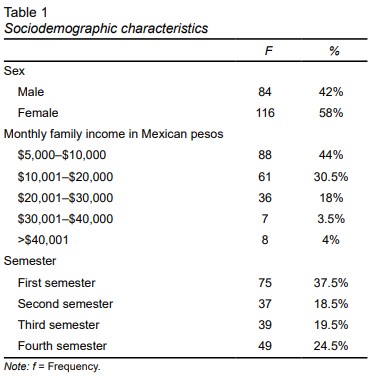
A total of 200 students were surveyed, with a mean age of 19.9 years. Of these, 42% were male (n = 84) and 58% female (n = 116). Distribution by semester was as follows: 37.5% were in the first, 18.5% in the second, 19.5% in the third, and 24.5% in the fourth semester. Regarding family income, 44% of participants had an income ranging from $5,000 to $10,000 pesos, 30.5% had an income of $10,001 to $20,000 pesos, 18% had an income from $20,001 to $30,000 pesos, and 4% had an income of over $40,001 pesos (see Table 1).
Univariate statistics
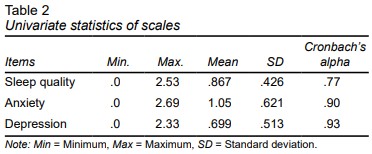
In Table 2, the univariate statistics regarding the minimum and maximum scores obtained are shown as well as the intern consistency acquired on each scale. Every one of them acquired an acceptable reliability according to Kaiser (Kaiser, 1974).
Frequency of students with poor sleep quality
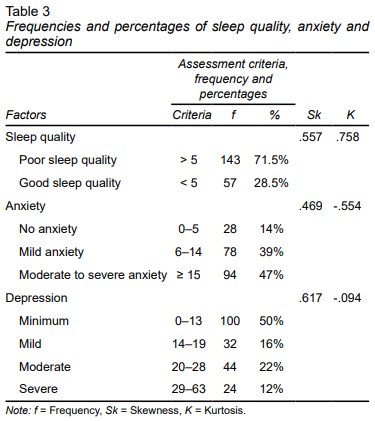
Table 3 presents an assessment of the sleep quality questionnaire, with a threshold value of 5 points established to categorize poor sleep quality. Students scoring above this threshold (> 5) were classified as having poor sleep quality. It was found that 71.5% of medical students in the basic cycles fell into this category, representing 143 of the 200 students surveyed. Conversely, students scoring 5 or less were classified as having acceptable sleep quality, accounting for 28.5% of the sample, or 57 students.
Frequency of students presenting with anxiety
The anxiety questionnaire was analyzed to determine symptom severity. It was found that 14% of students had scores between 0 and 5, indicating no anxiety (n = 28). A score between 6 and 14 was observed in 39% of the sample, classifying these students as having mild anxiety (n = 78). The remaining 47% of students scored 15 or higher, indicating moderate to severe anxiety (n = 94) (see Table 3).
Frequency of students presenting with depression
The depression scores revealed that 50% of students had minimal levels of depression, with scores of 13 or less. The remaining 50% exhibited some degree of depression, with 16% classified as having mild depression, 22% as having moderate depression, and 12% as having severe depression (see Table 3).
Sex differences
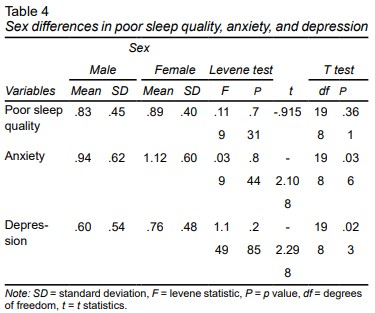
Differences in latent variables, both dependent and non-dependent, were examined by sex. The analysis revealed that there were no statistically significant differences between the sexes as regards sleep quality. However, variables such as anxiety (t = -2.108, p < .05, df = 198) and depression (t = -2.298, p < .05, df = 198) showed statistically significant differences by sex, with higher mean scores being observed for women in both cases (see Table 4).
Pearson’s correlation analysis
A correlation analysis was performed of the scores obtained for sleep quality, depression, and anxiety. Pearson’s correlation coefficients were as follows: for sleep quality and anxiety, r = .75 (p < .01); for sleep quality and depression, r = .64 (p < .01); and for anxiety and depression, r = .76 (p < .01). Results indicate a strong association between variables.
Structural model
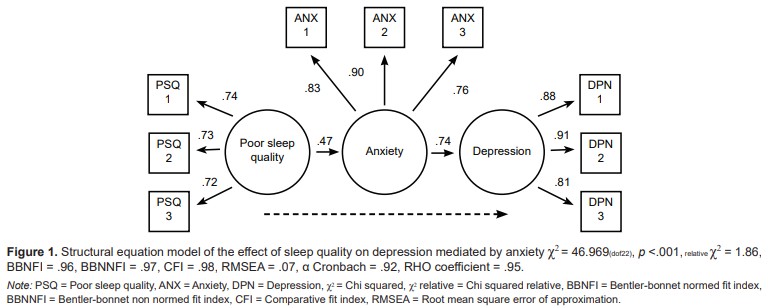
The results of the structural model (Figure 1) indicate that the manifest variables, based on item set plots, exhibit acceptable factorial weights for each of the first-order factors studied (poor sleep quality, anxiety, and depression). The analysis revealed that poor sleep quality has a positive, significant influence on the presence of depression, mediated by anxiety. However, no direct association was found between poor sleep quality and depression in medical students. This suggests that poorer sleep quality leads to increased anxiety, which, in turn, is associated with a higher incidence of depression.
DISCUSSION AND CONCLUSION
Our study enabled us to establish an association between sleep quality, anxiety and depression, not merely as a general interaction but also as a predictor that poor sleep quality leads to depression with anxiety as a mediator. It also made it possible to analyze the prevalence of these disorders in the medical student population in southeastern Mexico, underlining concerns about their high frequency.
This study found that 75% of students reported poor sleep quality, higher than the prevalence reported by Perotta et al.(2021) in Brazil (68.8%), Feng et al.(2005) in China (19%), and Preišegolavičiūtė et al. (2010) in Lithuania (40%). Moreover, 86% of students experienced some degree of anxiety, while 50% had some degree of depression. These findings contrast with those of Elguera et al. (2021) in Peru, where only 56.7% of medical students reported some degree of anxiety and 37.2% reported insomnia.
The high frequencies observed have significant implications, suggesting that many students have sleep and mental health issues that could become more severe over time. Findings by Landeros et al. (2019) from a longitudinal study in Mexico suggest that the prevalence of sleepiness, poor sleep quality, anxiety, and depression increases significantly over time.
Consistent with studies by Moalla et al., (2020) in Turkey, Zhang et al., (2023) in China, and Gregory et al., (2011)in the United Kingdom, poor sleep quality was found to be significantly related to higher anxiety and depression scores among medical students in this study. These associations are well established in psychiatry, where sleep disturbances are recognized as symptoms of anxiety and depression. However, sleep disturbances may also precede these conditions by impairing emotional regulation (Gregory et al., 2011; O’Leary et al., 2017).
The t-test conducted revealed statistically significant differences for anxiety and depression, with higher mean scores being observed for women. This finding is consistent with Chen et al. (2022), who also reported higher mean scores in women for anxiety and depression, although their study identified differences in sleep quality with higher means for women, not found in the present study. Anxiety and depression are known to affect women at higher rates than men, potentially due to biological factors or traditional gender roles (Gaus et al., 2015; McLean et al., 2011). For example, Arcand et al. (2020) found that higher masculinity was associated with lower symptoms of anxiety and depression.
The results of the structural model (Figure 1) indicate that the factor loadings for each of the first-order factors—poor sleep quality, anxiety, and depression—are high and significant (p < .05), demonstrating convergent construct validity. Additionally, the structural coefficients between latent factors were lower than the factor loadings, confirming discriminant construct validity (Corral & Figueredo, 1999). The goodness-of-fit indicators for the statistical (χ²; relative χ2, p < .001), practical (BBNFI, BBNNFI, CFI), and population (RMSEA) measures suggest that the theoretical model fits the empirical data well.
Our study demonstrated that poor sleep quality positively and significantly affects anxiety-mediated depression among medical students at the Health Sciences Division of the UAEQROO. These findings align with those of Zhu et al. (2023), who reported significant paths between sleep quality and anxiety and depression symptoms (a = .704), as well as between anxiety, depression, and students’ self-perceived health status (b = .448). They found that the indirect effect of sleep quality on self-perceived health status through anxiety and depression was greater than the direct effect (.227 and .315 respectively). This means that people with poor sleep quality who tend to experience anxiety and depression often perceive themselves as having lower health status, which affects their quality of life.
This mediation effect is supported by Chen et al., (2022), who used the Sobel-Goodman mediation test, finding that PSQI scores were positively associated with Self-Rating Depression Scale (SDS) scores among medical students. This association was partially mediated by State-Trait Anxiety Inventory (STAI) scores, accounting for 83.79% of the association after adjusting for potential confounders. This suggests that sleep quality impacts trait anxiety (β = 2.480, p < .001), which in turn affects depression (β = .470, p < .001). However, unlike our study, a direct association between sleep quality and depression was also observed (β = .225, p < .001).
The increase in depression and anxiety symptoms appears to be associated with academic years with heavy theoretical loads, which negatively impact sleep quality and contribute to anxiety and depression. Given the high demand for medical degree courses, characterized by rigorous schedules and multiple tasks, it is essential to design and implement interventions aimed at improving sleep hygiene. Effective strategies could include recommendations from the Academy of Cognitive Behavioral Therapy for Insomnia, which focus on modifying pre-sleep habits and optimizing the sleep environment. Other suggestions include engaging in activities that promote better sleep quality such as exercise and following a consistent sleep schedule, mainly in the clinical setting (Altena et al., 2020; Huang & Sullivan, 2021).
The results of this study highlight the prevalence of mental disorders among medical students. They underline the need for the timely referral of students experiencing significant distress to university psychology clinics for counseling and, if necessary, further medical evaluation and treatment.
However, it is important to acknowledge the limitations of this study. Firstly, the small sample size restricts the generalizability of the findings on poor sleep quality, anxiety, and depression to the broader population of medical students. Nonetheless, the study highlights a significant increase in the prevalence of these mental health disorders over time, particularly in comparison with studies conducted in other countries.
Additionally, the study excluded students previously diagnosed with and treated for mental health disorders. The presence or absence of mental health symptoms at the time of the survey was not assessed, which may have influenced the high prevalence observed.
Another important consideration is that the cross-sectional design of the study limits the ability to draw causal inferences about the relationship between poor sleep quality, anxiety, and depression. The structural equation model used in the study, while effective for modeling direct dependencies among these variables, does not allow for causal conclusions. A longitudinal study would be beneficial for determining whether students with poor sleep quality are more likely to develop anxiety and depression over time, particularly in clinical settings.