INTRODUCTION
The Chilean prison system faces a series of challenges such as overcrowding and the physical deterioration of its facilities ( Espinoza et al., 2014). This is compounded by the limited prospects for the effective reinsertion of incarcerated individuals, which is not only detrimental to human rights but also public safety (Sanhueza, 2023). In this regard, Chile has signed various international treaties for the proper management of incarcerated people (such as the Bangkok and Mandela Rules). In terms of mental health, all of them recognize that inmates have the right to enjoy as good health as that of the general population. They establish that it is the responsibility of the state to facilitate the detection, prevention and appropriate care of mental health issues in prisons through psychosocial support and access to prescribed psychotropic drugs. In the case of serious crises, prisoners are to be temporarily transferred to psychiatric wards or hospitals (Figueroa, 2018). Nevertheless, mental health problems in Chilean prisons remain largely invisible, since there is virtually no assessment of mental health on admission (Sanhueza et al., 2025), which prevents proper management and administration of treatments (Figueroa, 2018).
Various studies have shown that this is not a new issue. A study by Osses-Paredes and Riquelme-Pereira (2013) conducted at a major prison in southern Chile reported that 45% of the prison population interviewed had a diagnosed illness, with a predomination of mental disorders. Using a different methodology, a large study undertaken at seven prisons in Chile used the Composite International Diagnostic Interview (CIDI) to determine the prevalence of mental disorders in prisons. Substance-use disorder was the most common, with a prevalence of 12.2%, followed by anxiety and affective disorders, with prevalences of 8.3% and 8.1% respectively. These three types of disorders had a higher prevalence in the prison population than the general population. Inmates suffering from major depression also had a high risk of comorbidity with other disorders, particularly illicit drug use and anxiety disorders (Mundt et al., 2013).
A study by Baier et al. (2016) designed to conduct a symptomatic follow-up of inmates with suicide risk (linked to major depressive disorder) determined remission rates and associated variables at a prison in Chile. Findings showed that, a year after being incarcerated, 44% of inmates continued to meet the diagnostic criteria for this disorder and that comorbidity with post-traumatic stress disorder was associated with the persistence of the diagnosis. Moreover, 47% of this population presented a high risk of suicide on admission, with only 14% continuing in this situation after a year, with the risk being concentrated in the first months of admission. Another study reported that suicide accounts for 25.2% of deaths and is the second leading cause of death in this context, followed by acts of violence between inmates (Escobar et al, 2008). Ceballos-Espinoza et al. (2016) reported 132 suicides between 2006–2015 at Chilean penitentiary facilities, with depression being cited as the main trigger (43.2%).
In these studies, length of incarceration was a key factor in the mental health status of inmates. The study by Mundt et al., (2013) determined that those who had been in prison for 12 months or less had higher overall rates of mental disorders. In the case of the study by Ceballos-Espinoza et al. (2016), most suicides occurred during the first year of incarceration (65.15%), coinciding with the findings of Baier et al. (2016).
These figures highlight the importance of disorders that may be less visible, such as major depressive disorder, yet entail significant risk. Having screening tools for diagnoses in the field of mental health can be a step towards guaranteeing the right to mental health in people deprived of liberty. The General Health Questionnaire ([GHQ-12] Goldberg & Williams, 1988) is a screening instrument for detecting non-psychotic or organic mental disorders, widely used in public health (Ministry of Health, 2013). It could be used as a bridge between penitentiary services and health institutions providing a range of health services to inmates.
The psychometric equivalence of an instrument can vary depending on the cultural context and the population due to the meaning and understanding of the construct to be measured (Chahín-Pinzón, 2014). It is a key issue for variables influenced by culture such as mental health (Lewis & Araya, 1995). At the same time, since prisons house a non-representative group of the population, it should not be assumed that the instrument will behave psychometrically in the same way as it does with other populations.
The psychometric properties of the GHQ-12 have been widely studied in various countries around the world and in different populations, with most countries agreeing on the scale’s acceptable reliability. However, there is no agreement on its internal structure, since the number and composition of the factors in this instrument are still under debate. In this regard, two meta-analyses of the factor structure of the GHQ-12 conclude that the instrument is essentially one-dimensional (Gnambs & Staufenbiel, 2018).
The bifactorial structure has received significant empirical support by identifying one factor associated with depression, and another with social dysfunction (Werneke et al., 2000). For example, in Argentina, Burrone and colleagues (2016) studied the psychometric properties and reliability of the GHQ-12 using a probabilistic sample of individuals attended at the primary healthcare system in Cordoba, Argentina, finding that a two-factor structure was a good solution in the studied population. Likewise, in a smaller, hospitalized-patient-based sample in Medellín, Colombia, Villa and colleagues (2013) found that a two-factor solution was a good fit. However, its structure could be seen as two parts of the same component (positive and negative) and one of the items should be removed to make the GHQ-12 suitable for this population as it did not load properly. Others studies have determined that a three-factor structure has the best fit and utility (Campbell et al., 2003; Rivas-Diez & Sánchez-López, 2014). Still others indicate that the four-factor structure makes a better contribution to the study of minor disorders (Griffith & Jones, 2019).
Our aim was to close this knowledge gap by analyzing the psychometric properties of the GHQ-12 in people deprived of liberty at penitentiary centers in Chile. We specifically wanted to evaluate its internal structure through an exploratory and confirmatory factor analysis and subsequently analyze invariance by length of incarceration and determine the reliability of the instrument.
METHOD
Study design
This was a cross-sectional study implemented in the context of a collaborative research and development (R&D) project between [anonymized university] and the Chilean prison service (Gendarmería de Chile), conducted at 20 prison facilities in each of the 16 regions in the country.
Participants
Although the study initially included 1,159 respondents, the analytical sample was ultimately reduced to 1,022 participants, housed in 20 prisons across the country. The facilities were visited between June and November 2022.
Measurements
Once consent had been obtained, each participant completed the General Health Questionnaire [GHQ-12]. If an individual had difficulty reading or writing, they were assisted by a trained interviewer.
Procedure
For this study, we used a two-stage sampling procedure. First, we purposively selected a sample of 20 prison facilities, considering the largest prison in each region as the main selection criteria. We then applied a simple, random sampling strategy to select individuals within each predetermined facility, with 95% confidence. We only considered already-sentenced individuals.
Statistical analysis
Evidence exists of different response patterns across positive and negative items, but also of improved discrimination in Likert vs. dichotomous scoring (Griffith & Jones, 2019). Items were scored using full Likert scoring but reversing positive items so that higher scores always indicated higher symptomatology. All analyses were conducted using a significance level alpha of .05. Data were processed and analyzed in R (Version 4).
To evaluate the factor structure, the sample was split in two. The first subsample (n = 511 incarcerated) was used for exploratory factor analysis (EFA), the solution to which was tested using confirmatory factor analysis (CFA) on the second subsample (n = 511 incarcerated (e.g. Ledesma et al., 2019). Subsamples were matched to include similar number of participants from public vs. private prisons, male vs. female prisons, and regions (northern, central, or southern Chile).
EFA
To check the suitability of running EFA on the collected data, we used Bartlett’s test of sphericity and the Kaiser-Meyer-Olkin (KMO) measure of sampling adequacy. Horn’s parallel analysis, with nonparametric resampling of 10.000 bootstrapped samples, was used to determine the initial number of factors (Horn, 1965; Ledesma et al., 2019). The initial solution was generated using least-squares factor extraction with Oblimin rotation due to potential correlations between factors. This initial solution was compared with those with one additional factor, to obtain a simple structure in which each item ideally loaded substantially on a single factor. The minimum factor loading was considered as .3 (Bruna et al., 2017; Fasce et al., 2011). Items with factor loadings of less than .3 on all factors were considered indicative of poor solutions. Moreover, determining the number of factors to retain considered VSS results and communalities, indicative of the proportion of variance in each item accounted for by the retained factors, to ensure the overall adequacy of the factor solution.
CFA
The second subsample was used to run a CFA with WLSMV estimation (suitable for ordinal data). An exhaustive assessment of the overall fit of the EFA model was conducted, including the comparative fit index (CFI), the Tucker-Lewis Index (TLI), and the root mean square error of approximation (RMSEA) as parameters for fit estimation. CFI and TLI values of .95 or higher were considered acceptable, while RMSEA values of less than .05 were considered good and those lower than .08 as acceptable (Cova et al., 2019; Hu & Bentler, 1999). Finally, modification indices were examined to refine the model if necessary. Reliability indicators were calculated based on the final solution using Cronbach’s alpha and McDonald’s omega.
Measurement invariance (factor structure equivalence)
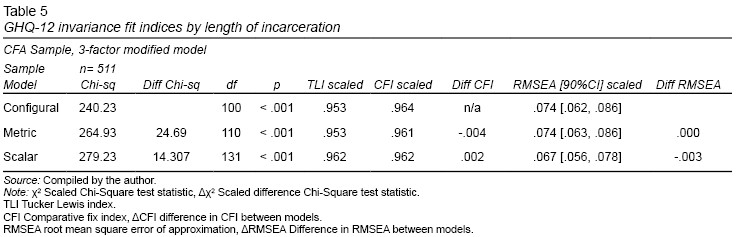
Metric invariance was assessed for configural, metric, and scalar models. Using the criterion defined by Chen (2007), metric and scalar non-invariance would be indicated by changes in CFI greater than -.10, together with a change in RMSEA > .015.
Ethical considerations
Preselected candidates were asked about their voluntary participation in the study. Once they had provided their informed consent, they were given the GHQ-12 to be self-administered in rooms equipped for this purpose in the prisons, with only the research team present, who helped participants in case of doubt. The study was approved by the Ethics Committee of the University of [anonymized], code #25-36/2021.
RESULTS
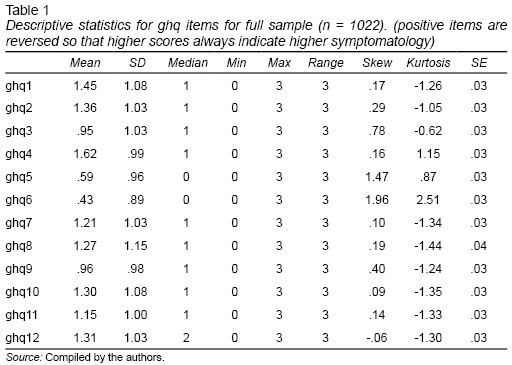
Table 1 gives the descriptive statistics for each item from the GHQ-12, whose values range from 0–3 with the following response options: no, never; average; more than average; much more than average. The highest mean was for item ghq4: “I have felt unhappy or depressed”.
Exploratory factor analysis
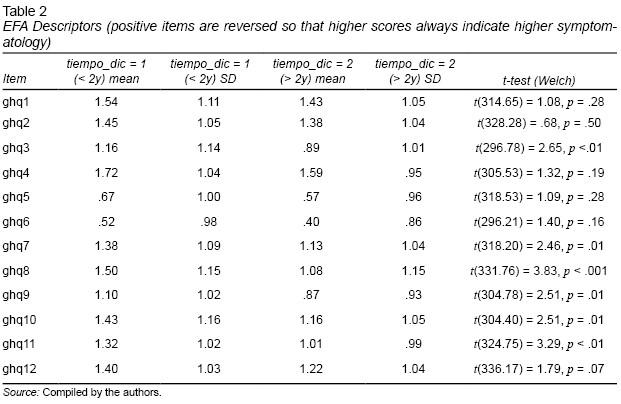
An overall KMO value of .83 (range for individual items: .75–.89) showed good (“meritorious”) sampling adequacy, and Bartlett’s test of sphericity was significant (Chi-square (66) = 2209.46, p < .001), indicating adequacy of the correlation matrix. Together they confirmed the appropriateness of the dataset for factor analysis. Details are available in Table 2.
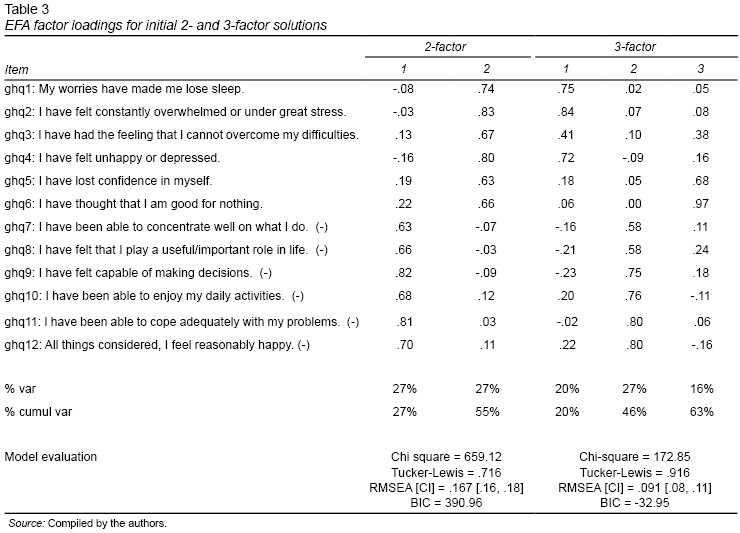
Depending on the criteria, EFA yielded adequate models when two or three factors were retained. Horn’s parallel analysis with 1000 iterations, using a 95th centile estimate, suggested retaining two components or three factors. The Very Simple Structure (VSS) analysis yielded a Velicer MAP minimum of .033 with two factors, with the Velicer MAP value for three factors at .036.
Given the equivocal results regarding the VSS and parallel analyses, we conducted analyses on both 2- and 3- factor solutions, using a polychoric correlation matrix, weighted least squares, and Oblimin rotation. The two-factor solution explained 55% of the variance. There were no items showing cross-loading above .3, and the correlation coefficient for the two factors was .22. Although the 3-factor solution explained 63% of the variance, the solution included some cross-loadings [ghq3]. Factor correlation coefficients were .12 (factors 1 / 2), .41 (factors 1 / 3), and .30 (factors 2 / 3). The item loadings for both solutions, the proportion of variance explained, and model evaluation criteria are shown in Table 3.
Confirmatory factor analysis
The following models were compared: a 1-dimensional model, which assumes that all scale variance can be explained by a single factor. We then tested the fit for two- and three-factor models using CFA. As can be seen in Table 4, CFI and TLI values, as well as the RMSEA, suggested that both models were inadequate, with the three-factor solution providing a marginally better fit. We therefore used the modification indices of the 3-factor model to attempt to improve the model, by allowing item 3 to split across factors 1 and 3, yielding an acceptable solution.
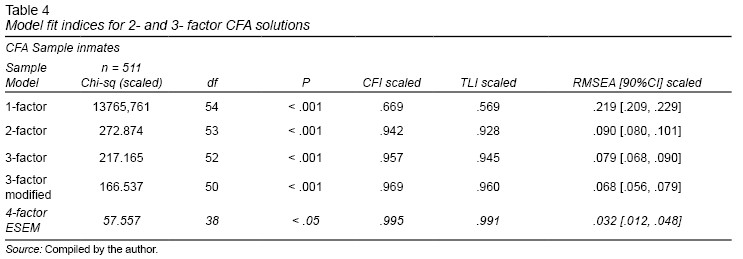
We then tested a recent model from the literature using ESEM on a large sample (Griffith & Jones, 2019) to see how our solutions compared. This model showed improved goodness-of-fit indices. However, it provided a complex and therefore impractical solution with many items loading on more than one factor. Accordingly, we determined that the modified three-factor solution was the best solution.
The reliability of the modified 3-factor solution showed acceptable alphas and omegas for all subscales (f1: α = .82, ω = .82; f2: α = .81, ω = .81; f3: α = .73, ω = .74).
Measurement invariance
Results for measurement invariance for the modified three-factor model are given in Table 5. The baseline model showed an acceptable fit, with RMSEA = .074 and CFI = .964, thereby corroborating configural invariance. Although the absolute metric and scalar invariance were rejected using scaled difference chi-square tests, both were supported using the relative indices of differences in CFI (-.004 and .002, respectively) and RMSEA (.000 and -.003, respectively).
DISCUSSION AND CONCLUSION
Our main goal was to analyze the psychometric properties of the 12-item version of the Goldberg General Health Questionnaire (GHQ-12) in Chilean prisoners. The GHQ-12 showed a better solution by retaining three factors, with good internal consistency with Alpha and Omega greater than .7 for each of these, in the Chilean prison population. The three factors explained 63% of the variance. However, this solution includes a cross-loading in factors 1 (anxiety) and 3 (loss of confidence) of item ghq3: “I have had the feeling that I have not been able to overcome difficulties.”
The results are in line with several authors reporting the multidimensionality of the instrument. The factors themselves are similar in structure to those reported in other studies (Graetz, 1991; Rivas-Diez & Sanchés-López, 2014). Factor 1 contains six positive items and includes elements of anxiety and depression. Factor 2, with four negative items, includes aspects of anhedonia and social dysfunction, while Factor 3, with just two items, is related to loss of confidence or self-esteem. We can therefore summarize the three factors as anxiety, social dysfunction, and loss of confidence.
Authors have attributed the diversity of factors obtained to methodological decisions such as the criteria for factor retention (Daradkeh, et. al. 2001; López-Castedo & Domínguez, 2010), and the inadequate treatment of variables measured with interval scales (Rivas-Diez & Sanchés-López, 2014). This study used the Likert score, inverting the positive items, so that higher scores always indicate greater symptoms. It has also been attributed to the particular characteristics of the sample, as in the case of this study, corresponding to inmates.
The invariance demonstrated by the scale considering the length of incarceration factor, more or less than two years, provides evidence of the relevance of using the GHQ-12 considering this factor, since prevalence studies have shown a greater presence of mental disorders, particularly during the first months of incarceration (Mundt et al., 2013; Baier et al. 2016).
We argue that Chilean prisons should have higher standards of dignity and effectiveness, including various measures to improve their approach to mental health. A critical step here is the timely detection of cases. This requires suitable instruments that will allow screening processes, given the high prevalence of mental health disorders found in various studies on the prison population in Chile (Osses-Paredes & Riquelme-Pereira, 2013; Mundt et al., 2013). In this regard, the GHQ-12 is a brief, simple and inexpensive instrument that could be used as a reliable screener for identifying potential cases of mental disorders for subsequent referral and clinical treatment, as well as for prevalence studies of minor mental disorders.
One of the strengths of this study is its suitable sample size for achieving the proposed objectives. It provides evidence of the validity of the instrument for screening a population as specific as that found in the context of incarceration, and for serving as a bridge between health services providing care to people deprived of liberty. At the same time, the instrument proved to be invariant over time, in view of the evidence showing that mental health is more severely affected during the first months in prison.
Limitations include the fact that given the high prevalence of mental health problems in prisons reported in national studies, both clinical and non-clinical populations may have been included, which could have influenced results. Nevertheless, the GHQ-12 has demonstrated psychometric invariance between these two types of populations in previous studies (Ruiz et al., 2017). This study does not provide information on test-retest reliability, which could be important in the prison population, given the alterations in mental health that occur during the first year of incarceration (Baier et al. 2016; Ceballos-Espinoza et al., 2016).
However, this instrument has proven to be consistent and reliable in annual application periods in the general population (Pevalin, 2000), with our findings indicating that the instrument is invariant regardless of the length of incarceration. Future studies could explore test-retest reliability by applying repeated measures in this population. Moreover, in Chile, it was reported that the GHQ-12 detected a higher number of false positive cases the lower the educational attainment of a population (Araya et al., 1992). Determining a cut-off score for this instrument through an appropriate diagnostic accuracy study, including the use of gold standard measures, could contribute to more accurate, contextualized care referrals. This is particularly true if the majority of this population has lower educational attainment than the national average (Ministry of Justice and Human Rights, 2024). International studies using this instrument to determine the prevalence of symptoms and psychopathological risk have used different cut-off scores. However, none of them have empirically examined the diagnostic accuracy of the instrument in this population, instead using a generic recommendation from the authors of the questionnaire (Boothby et al., 2010; Smith & Borland, 1999; McGilloway & Donnelly, 2004).
This manuscript explored an often-overlooked issue of mental health among inmates in a large sample in Chile to contribute to the literature in both the criminological and mental health fields in the region. By evaluating the psychometric properties of the GHQ-12 we sought to provide a novel, meaningful contribution to raising awareness about mental health conditions in the Chilean prison system. In addition, we used both exploratory and confirmatory factor analyses, together with invariance testing, to add methodological rigor to this important discussion.