INTRODUCTION
Depression is a significant public health issue and considered the primary risk factor for disability and suicide (World Health Organization [WHO], 2023). Experiencing depressive episodes during adolescence is linked to functional impairment in school or work performance, as well as in interactions with family and peers, which can negatively impact development. Moreover, major depressive disorder during adolescence is strongly associated with recurrent depression in adulthood, as well as other mental disorders. It is also linked to a higher risk of suicide, one of the leading causes of death in these age groups (US Preventive Services Task Force, 2022).
Worldwide, depression is estimated to affect more than 300 million people, equivalent to 5% of the population (WHO, 2023). Depression prevalence is increasing annually, particularly among adolescents. Psychosocial factors can exacerbate the intensity of depression, exponentially increasing its consequences (Corea, 2021). A review published in 2019 evaluated the association between experiencing depression in adolescence and psychosocial outcomes in adulthood. It reported that adolescent depression was associated with failing to complete secondary education, unemployment, and pregnancy/parenthood. It also observed a lower likelihood of being employed or in tertiary education and accessing post-secondary education in adulthood (Clayborne et al., 2019).
Depression is estimated to affect approximately 5% of the global population aged 15 to 19 (WHO, 2023). In Mexico, at least 3.6 million people experience a major depressive episode before the age of 18 (Secretaría de Salud Subsecretaría de Prevención y Promoción de la Salud, 2022). Although it is challenging to compare the prevalence of depression due to the range of measurement instruments used, recent years have seen an increase in this mood disorder. According to data from the National Health and Nutrition Survey (ENSANUT 2018-19), 6.1% of adolescents showed depressive symptoms. ENSANUT 2022 reported that 31.1% of adolescents showed one depressive symptom, and 7.1% showed two (Rivera-Rivera et al., 2020;Vázquez-Salas et al., 2023).
To effectively address depression and its consequences, it is crucial to implement a prevention policy based on accurate, up-to-date estimates of the population affected. Using validated measurement tools for depressive symptoms is essential for achieving this goal (WHO, 2023).
The Center for Epidemiological Studies of Depression Scale (CES-D; Radloff, 1977) is one of the most widely used scales globally. It is a self-report tool designed to measure depressive symptoms in the general population. The scale comprises questions on symptoms associated with depression, drawn from previously validated full-length instruments, with evidence supports their reliability and validity. The original scale included 20 items organized into four factors: depressed affect, positive affect, somatization, and interpersonal relations. However, revised versions with seven, ten and 35 items are also available (Sánchez-García et al., 2014).
Various studies have demonstrated the psychometric properties of the scale in the adolescent population of Mexico. Below are some examples organized by the version they used:
The 20-item CES-D version showed adequate reliability (Cronbach’s Alpha > .82), demonstrating evidence of construct validity with a factor structure matching the original in a sample of 1,167 children and adolescents aged 9 to 14 from Mexico City (Benjet et al., 1999). This was also achieved in a sample of 57,403 middle- (10–12 years) and high- school students (13–17 years) from Mexico City (González-Forteza et al., 2011). The 20-item version demonstrated adequate internal consistency reliability (Cronbach’s Alpha > .84), albeit with a four-factor structure differing from the original one in a sample of 310 adolescents aged 11 to 14 in rural communities in central Mexico (Aguilera-Guzmán et al., 2004).
The 35-item CES-D version displayed good internal consistency (Cronbach’s Alpha > .80), yielding a six-factor structure, and achieving significant discrimination between extreme scores. It also provided evidence of concurrent validity with the Roberts Suicidal Ideation Scale in a sample of 1,549 students from Mexico City with an average age of 14 (González-Forteza et al., 2008).
The 7-item version of the scale, widely used in Mexico, has been included in the National Health and Nutrition Survey since the 2018-19 edition (Romero-Martínez et al., 2019). However, no information is available on its psychometric properties in adolescents since it has only been validated in adult samples. Salinas-Rodríguez et al. (2013) analyzed 301 adults residing in Morelos, Mexico, who were initially interviewed for the 2012 National Health and Nutrition Survey. The authors found that the scale has high or adequate sensitivity and specificity values, with both the ICD-10 diagnostic criteria and the DSM-IV. In a separate study, Salinas-Rodríguez et al. (2014) studied the properties of the scale in a group of 229 older adults residing in the states of Morelos and Tlaxcala in Mexico. These adults were part of the 2012 National Health and Nutrition Survey sample. The authors found that the sensitivity and specificity with both the ICD-10 and DSM-IV diagnostic criteria were adequate.
This study therefore aimed to examine the psychometric properties of the 7-item version of the Center for Epidemiological Studies Depression Scale (CES-D7) in Mexican adolescents.
METHOD
Study design and study population
This cross-sectional study used data from the National Health and Nutrition Survey (ENSANUT) conducted in 2022. The survey, known as ENSANUT Continua 2022-204, is the third in a series and adopted a probabilistic, stratified sampling procedure based on clusters providing representation at both the state and national level (Romero- Martínez et al., 2022).
Sampling involved visiting 14,240 households distributed across eight regions of the country: Pacific-North, Border, Pacific-Center, Center-North, Center, Mexico City-State of Mexico, Pacific-South, and the Peninsula. A total of 20,605 individuals were interviewed, including 57.82% (11,914) adults aged 20 to 60, 20.15% (4,152) adolescents aged 10 to 19, and 22.03% (4,539) children aged 0 to 9.
For this study, we only analyzed responses from adolescents aged 10 to 19, with an average age of 14.32 years (SD = 2.88). A total of 48.68% (2,028) of these adolescents were male and 51.32% (2,124) female. Moreover, 3.37% (140) reported a previous diagnosis of depression (40% women, n = 56 and 60% men, n = 84), 5.63% (234) had experienced suicidal ideation (64.95% women, n = 152 and 35.05% men, n = 82), and 5.36% (223) had attempted suicide (62.33% women, n = 139 and 37.67% men, n = 84).
Measurements
The 7-item version of the Center for Epidemiological Studies Depression (CES-D7; Romero-Martínez et al., 2022) assesses the frequency of depressive symptoms in the past week. It uses a four-point Likert-type scale with the following response options: 1) rarely or never, 2) sometimes, 3) often, and 4) all or most of the time. Only four response options were kept because we followed the validated version of the Scale proposed by Salinas-Rodríguez et al. (2014), despite the fact that few response options do not allow for variability in the data. The decision was made because this version was intended for all the population groups.
The following question was used for the diagnosis of depression: “Has a doctor or another health professional ever told you that you suffer or have suffered from depression?” Response options were yes/no.
Two questions were used for the Suicidal Ideation and Attempt variables: “Have you ever thought about committing suicide?” Response options were yes/no. “Have you ever purposely injured, cut, poisoned, or harmed yourself to end your life?” Response options were yes, once; yes, two or more times; and never.
Statistical analysis
Information was obtained on four psychometric properties: distribution, discrimination, reliability, and validity (Edwards & Wirth, 2009). To understand the distribution of responses, a frequency analysis was conducted in terms of percentages, together with the Anderson-Darling Normality Test for each of the items and the Henze-Zirkler MultivariateNormality Test (Ebner & Henze, 2020).
Confirmatory Factor Analysis (CFA) was conducted using the Diagonally Weighted Least Squares (DWLS) method to understand the discrimination and factorial structure. This method, based on polychoric correlations, is considered suitable for handling ordinal data with a lack of normality (Li, 2016; West et al., 2012). A unidimensional model explaining the seven items was specified. Identification was completed by setting the loading of the first item at one, which defined the metric of the latent variable (Kenny & Milan, 2012).
To determine whether an item had sufficient discriminatory power, it was required to have a lambda value > .40 (Ventura-León, 2019). The overall fit of the model was assessed using four indices: Standardized Root Mean-Square Residual (SRMR) and Root Mean Square Error of Approximation (RMSEA) with values ≤ .08, and Comparative Fit Index (CFI) with a value ≥ .95 (Li, 2016). The factor scores of the scale were then calculated using the regression method and converted into standardized T scores with a mean of 50 and a standard deviation of 10. This was achieved using the R software with the LAVAAN package (Rosseel, 2012). The internal reliability of the items was analyzed using the ordinal Omega coefficient, which is suitable for this type of data (Kalkbrenner, 2023).
To assess criterion validity, we used the contrasting groups method (Richards et al., 2017). We compared means using the Student’s t-test for independent samples, considering the factor scores between groups with and without a previous diagnosis of depression by medical personnel, as well as suicidal ideation and suicide attempts. We considered evidence of construct validity if there were significant differences with higher means for the groups with these conditions.
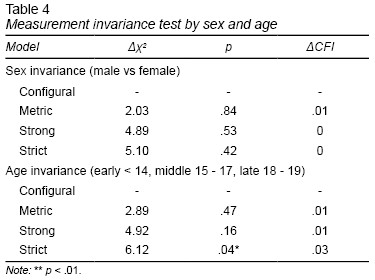
A test of measurement invariance by sex and another by age were conducted using the procedure proposed by Milsap and Olivera-Aguilar (2012), which evaluates four nested models, each more restrictive than the previous one. First, the configural model was tested to determine whether the factorial structure was the same across groups. Next, metric or weak invariance was tested (in which factor loadings are constrained to be equal), followed by the strong invariance model (in which both factor loadings and intercepts are constrained to be equal). Finally, the strict invariance model (in which factor loadings, intercepts, and item residual variances are constrained to be equal) was tested and model fits compared. Invariance is assumed if there is no significant difference in the chi-square test and changes in the CFI are less than .01, (Kline, 2016). Achieving strict invariance implies that observed differences result from the latent variable rather than measurement bias (DeShon, 2004).
Ethical considerations
The Research Ethics Committees of the National Institute of Public Health (INSP) approved all questionnaires, interview procedures, and consent forms with reference numbers 1807 for bioethics and 1798 for biosecurity. The interviewers obtained informed consent from the respondents before their participation. For participants under 18, permission and informed consent from parents or the responsible adult in the household were obtained.
Personal and sensitive data collected in the study were protected by removing any variables that could identify participants from the public dataset, such as locations and postal codes. Data management, the person responsible, and the procedures for participants to exercise their ARCO rights regarding handling their information were outlined in a general privacy notice on the official website of the survey.
RESULTS
Response distribution
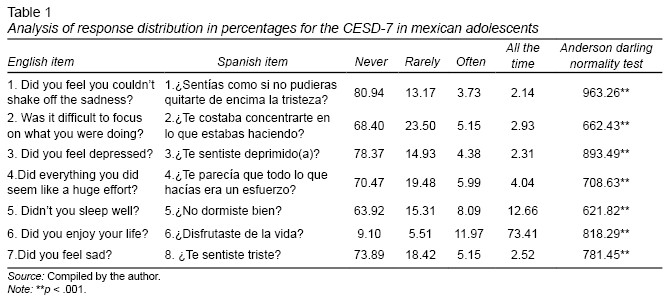
The frequency analysis in percentage shows that all options had the highest concentration in the option “Rarely or never,” except item CESD7_6, “I enjoy life,” which displayed an inverted pattern. The normality tests showed that the responses were not normally distributed individually or as a group (HZ = 424.64, p < .001) (see Table 1).
Discrimination and factor structure
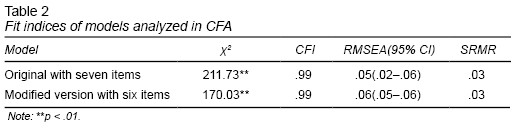
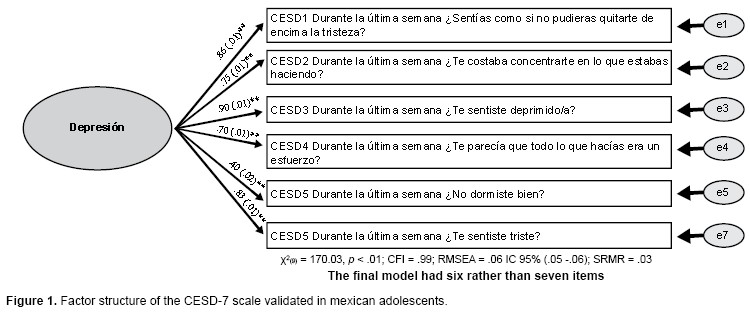
The confirmatory factor analysis results showed an adequate global fit to explain the data [χ2(14) = 211.73, p < .01; CFI = .99; RMSEA = .05 (95% CI .02–.06); SRMR = .03]. However, since item CESD7_6, “I enjoy life,” was not correctly related to the latent variable, explaining it [λ = .26 (.02)], it was decided to eliminate it and respecify the model. The modified model had adequate global fit to explain the data [χ2(9) = 170.03, p < .01; CFI = .99; RMSEA = .06 (95% CI .05–.06); SRMR = .03], and the items had adequate factor loadings (λ ≥ .40). The final structure is shown in Table 2 and Figure 1.
Reliability
The value of the ordinal Omega coefficient showed adequate reliability for the internal consistency of the six items (ordinal Omega = .91).
Criterion validity evidence by contrasted groups
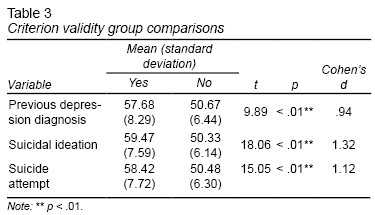
Significant differences were found (t(144.94) = 9.89, p < .001) between adolescents with a previous diagnosis of depression by medical personnel (M = 57.68, SD = 8.29) and those without one (M = 50.67, S D = 6.44), with a large effect size (Cohen’s d = .94). Significant differences (t(251.79) = 18.06, p < .01) were also found between adolescents with suicidal ideation (M = 59.47, SD = 7.59) and those without (M = 50.33, SD = 6.14), with a large effect size (Cohen’s d = 1.32). Moreover, significant differences (t(239.08) = 15.05, p < .01) were found between adolescents who had had one or more suicide attempts in their lifetime (M = 58.42, SD = 7.72) and those who had not (M = 50.48, SD = 6.30), with a large effect size (Cohen’s d = 1.12) as shown in Table 3.
Measurement invariance tests by age and sex showed that the scale is suitable for comparing groups comprising these variables since we found strict invariance by sex and strong invariance by age group, as shown in Table 4.
DISCUSSION AND CONCLUSION
We obtained a brief version of the Center for Epidemiological Studies Depression Scale (CES-D), which is reliable and has evidence of construct validity in its adjusted structure. It also has criterion validity with previous diagnoses of depression, suicidal ideation, and suicide attempts for measuring self-reported symptoms of depression in Mexican adolescents. This is consistent with results from other versions of the scale in the same population (Aguilera-Guzmán et al., 2004; Benjet et al., 1999; González-Forteza et al., 2011; González-Forteza et al., 2008). In all previous studies, internal consistency values were similar to the one found in this study, and the factor structure was also consistent with the one found for this version of the scale, validated by Salinas-Rodríguez et al. (2014).
The confirmatory factor analysis with the original seven items showed adequate global fit. Since one did not correctly relate to the rest of the scale items, it was removed to modify the scale. Further studies in samples of Mexican adolescents are recommended, however, to ensure that the lack of relationship between this item and the others is not due to the idiosyncrasies of the sample involved (MacCallum et al., 1992). The removed item was CESD7_6 “Enjoyed life.” This could be explained by the fact that anhedonia or loss of the capacity to experience pleasure does not always occur in the same way, as in some cases, pleasure may be absent in any circumstance. Conversely, in others, the problem is limited to specific aspects, such as appetite for food, sexual relations, social relationships, and leisure activities (Organización Médica Colegial de España, 2008).
This six-item version makes the scale even briefer and could facilitate its application. This is essential for the early detection of mental health disorders in adolescents as well as timely intervention to prevent severe consequences in the future (Organización Panamericana de la Salud [OPS], 2018).
Measurement invariance tests by age and sex showed that the scale is suitable for comparing groups formed by these variables, since we found strict invariance by sex and strong invariance by age group. This adheres to the recommendations of DeShon (2004) and Kline (2016).
It is important to note that although the brief version of the Center for Epidemiological Studies Depression Scale (CES-D) is reliable and valid for measuring depressive symptoms in Mexican adolescents, it has certain limitations. These include its cross-sectional design and reliance on self-reporting. Moreover, it has a significant lack of validated information on prior clinical diagnoses of depression and suicide-related behavior.
However, we consider it essential to have reliable, valid instruments within national health surveys that are suitable for different age groups. Further research is required to determine whether screening positively impacts these outcomes in adulthood. Although screening tools can effectively detect depression, this indirect evidence should not be used to suggest that they are automatically beneficial or necessary in all contexts. It is essential to consider the potential benefits and harms of screening in the specific population and context and carefully evaluate the implications of implementing a population-level screening program (Clayborne et al., 2019).
It is therefore crucial to determine whether screening will be used to provide information on population-level initiatives (such as ENSANUT in Mexico) or for clinical diagnoses. In the event of the latter, it is essential to recognize that depression screening tools cannot make diagnoses, which is a task for qualified professionals. Moreover, it is crucial to acknowledge the ongoing controversy over whether depression screening programs should be implemented. There is as yet insufficient evidence to recommend screening for depression in child populations (US Preventive Services Task Force, 2022; Clayborne et al., 2019;Roseman et al., 2017).
There is also concern that universal screening could lead to overdiagnosis, excessive medication use, and if individuals receive unnecessary treatment, a waste of already scarce resources (Flaherty, 2020). Although there is a Grade B recommendation for depression screening in adolescents aged 12 to 18, emphasis should be placed on accurate diagnosis, effective treatment, and appropriate follow-up (Patra & Kumar, 2023). From a public health perspective, it is essential to have tools that will provide reliable data to understand the health conditions and trends of the population and health service utilization and perception.
Adolescence constitutes a critical period of development. Having valid, reliable instruments for this age group can yield information on their mental health status that can subsequently be used to develop vital preventive and care interventions. The information obtained from the proposed adapted version of the CES-D can provide an overview of the mental health status of Mexican adolescents and enable better comparisons between groups of interest to guide population-level health programs.
This article is relevant because it contributes to the National Health and Nutrition Survey (ENSANUT). It validates one of the instruments in its battery in a sample of adolescents aged 10 to 19 with national representativeness, thereby enhancing the validity of the conclusions and public policy decisions based on this survey (Romero-Martínez et al., 2022).