INTRODUCTION
Substance abuse and mental health disorders have gained attention, particularly due to the increase in their incidence in the wake of the COVID-19 pandemic. Public measures implemented to curb the spread of the virus led to a rise in mental issues such as domestic violence, unplanned pregnancies, loss of loved ones, suicide, anxiety, depression, and increased drug abuse (Carrascoza et al., 2022). Although social, economic, and political crises in Mexico have affected the mental health of its population, the mental health response has been insufficient.
According to a National Survey of Psychiatric Epidemiology conducted in 2001, approximately 28.6% of the Mexican population had presented at least one of the 23 ICD disorders at some point in their lifetime. This figure was equivalent to approximately six out of every 20 individuals. Anxiety disorders were the most common (14.3%), followed by substance use (9.2%) and affective disorders (9.1%) (Medina-Mora et al., 2003). According to a recent study, 15.7 million people were affected by some form of mental disorder in Mexico in 2019, rising to 18.1 million in 2021, a 15.4% increase (Medina-Mora et al., 2024).
Mexico’s 2020-2024 Mental Health and Addictions Program (PAE-SM20-24) is facing delays in meeting service demand due to insufficient infrastructure and staff shortages (Vargas et al., 2023). Efforts have focused on hospitals, overlooking prevention and mental health promotion. Despite the severity of addictions, efforts remain limited. Mexico is now beginning to treat addictions as a public health issue, however, developing targeted, gender- and age-specific treatment programs.
In Mexico City, the Diagnosis and Evaluation of Mental Health Services (2018–2022) highlights the work overload and lack of resources, negatively impacting service quality, despite high user ratings. The Mexican Ministry of Health has implemented a network of 334 Specialized Addiction Units (UNEMES), also known as Primary Care Addiction Centers (CAPA), providing an evidence-based early intervention model (Martínez-Martínez et al., 2020).
Since 1984, Youth Integration Centers (CIJ) and the Temazcalli Institute for Prevention and Rehabilitation in San Luis Potosí have provided long-term addiction treatment services. In 2002, the Temazcalli Institute created the Child and Adolescent Health Department to provide mental health treatment for youth with behavioral and emotional problems (Hernández Blanco et al., 2014). The Temazcalli Institute prioritizes patient autonomy and voluntary treatment, upholding human rights. Since 2009, the Mexican government has regulated addiction treatment centers through the Official Mexican Standard (NOM-028-SSA2-2009), which sets certification standards for addiction centers across professional, mixed, and mutual aid care models (Rafful et al., 2020).
The Temazcalli Institute implements a multidisciplinary approach focused on patients with dual pathology, establishing a biostatistics unit to gather and analyze the data collected (Ponz Martínez, 2023). While national surveys provide prevalence estimates at the population level and global reports offer broad comparisons, there is a dearth of center-specific analyses to inform evidence-based clinical protocols and public health policies. Moreover, previous research, both in Mexico and internationally, relies on cross-sectional snapshots or limited samples, without incorporating methods to examine temporal and correlational dynamics among key variables.
By applying rigorous cross-sectional, descriptive, and retrospective techniques, incorporating nonparametric tests, correlation analyses, and frequency distributions, this study seeks to address existing gaps in the scientific literature. It also seeks to provide valuable insights into the demographic and diagnostic landscape of patients at the Temazcalli Institute. The findings contribute to the epidemiological understanding of substance use and mental health comorbidities in Mexico and inform biostatistical approaches in similar healthcare settings worldwide.
METHOD
Study design
A cross-sectional, descriptive, and retrospective study was conducted.
Participants
The sample includes 1,520 male and female patients, aged 1 to 77, whose data were collected from two databases provided by the Temazcalli Institute. These databases include all currently active users from January 2021 to May 2024, meaning that the user is currently receiving treatment and has not missed any of their appointments or therapies for at least six months. It comprises patients treated at any of the clinical and paraclinical areas of the Institute, as well as all first-time users. The latter include patients who come to the Temazcalli Institute for the first time and receive a diagnosis under the classification of mental, behavioral, and neurodevelopmental disorders described in the ICD-10 and DSM-5.
Measurements
Data were obtained from two databases provided by the Temazcalli Institute for Prevention and Rehabilitation:
Outpatient medical records database: every user included in the Daily Outpatient Register
First-time diagnoses database: includes every first-time user in a separate database
These databases collect information through daily forms created by the Institute’s biostatistics department and completed individually by each therapist (both psychiatrists and psychologists) during consultations. These forms include demographic information on patients, such as age and sex, as well as the diagnoses provided by the therapist, including ICD-10 codes.
Procedures
The cooperation of the Temazcalli Institute was formally requested through a letter addressed to the research committee. Access to the databases of the biostatistics department was granted after the project presentation.
Statistical analyses
All statistical analyses were performed using R statistical software (version 4.3.1). Continuous variables are presented as medians with ranges or standard deviations (SD). Age differences between men and women were evaluated using a two-sided, unpaired Mann-Whitney U test (α = .05). The association between age and number of diagnoses was assessed with a Spearman’s rank correlation, given the non-normal distribution of the data, as confirmed by Shapiro-Wilk tests. Data visualization included frequency tables and graphical representations of patient distribution by age and sex, population characteristics, diagnosis frequency by age group, sex-stratified prevalence of common diagnoses, and relationships between diagnostic categories.
The study population was stratified into four age groups: children (0–11 years), adolescents (12–17 years), adults (18–59 years), and elderly adults (≥ 60 years). For the analysis focused on initial diagnosis, the first approach taken by the psychiatrist or psychologist to identify the cause of the patient’s illness or health condition events, the population was further stratified into two groups: youth (≤ 18 years) and adults (≥ 18 years).
For the analysis of diagnoses, cases were categorized according to the DSM-5. Cases lacking assigned diagnoses were excluded. Additionally, for the examination of associations among diagnostic categories, single-diagnosis patients were excluded.
Ethical considerations
This study was approved by the Ethics Committee of the Temazcalli Institute with code ITPR-EEI-PI-001-24 on May 31, 2024, and by the Ethics Committee of the Universidad del Valle de México, San Luis Potosí campus, with registration number CSUVM072024 on August 12, 2024.
RESULTS
Analysis of daily patient records from the outpatient medical records database
First, we analyzed the outpatient medical records database with a sample of 1,520 users. Average patient age was 20 years (SD = 14.4; range: 1–77). Most of the patients treated were male, representing 64.1% [975 out of 1520]. A Mann-Whitney U test revealed a statistically significant difference in age distribution between the sexes (W = 208,674; p < .001). Female patients were older on average (mean age: 23.7, SD = 16.3; range: 1–77) compared to male patients (mean age: 17.9, SD = 12.8; range: 1–72).
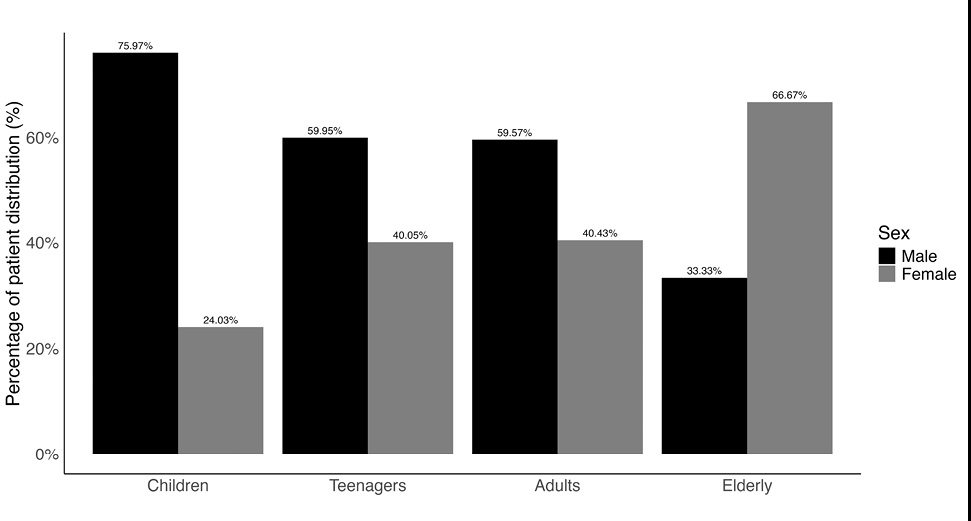
Children and adolescents constituted the largest demographic segment, accounting for 58.2% of the total population at the Institute. A total of 76% of the children and 60% of the adolescents and adults were male. Conversely, 67% of the elderly patients were female, although this group only included 30 patients (Figure 1, Table 1).
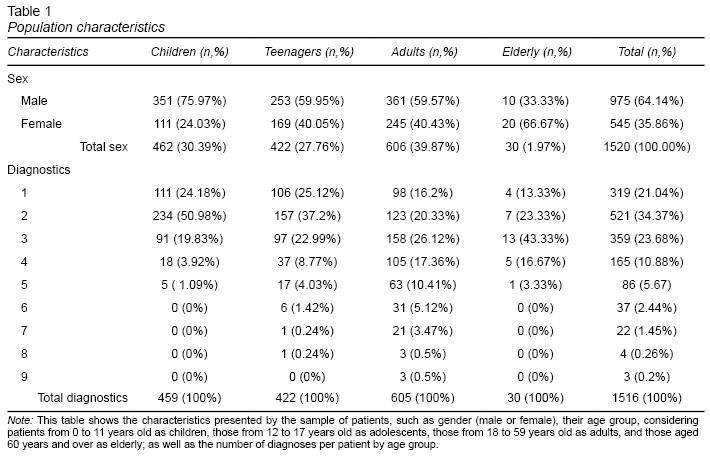
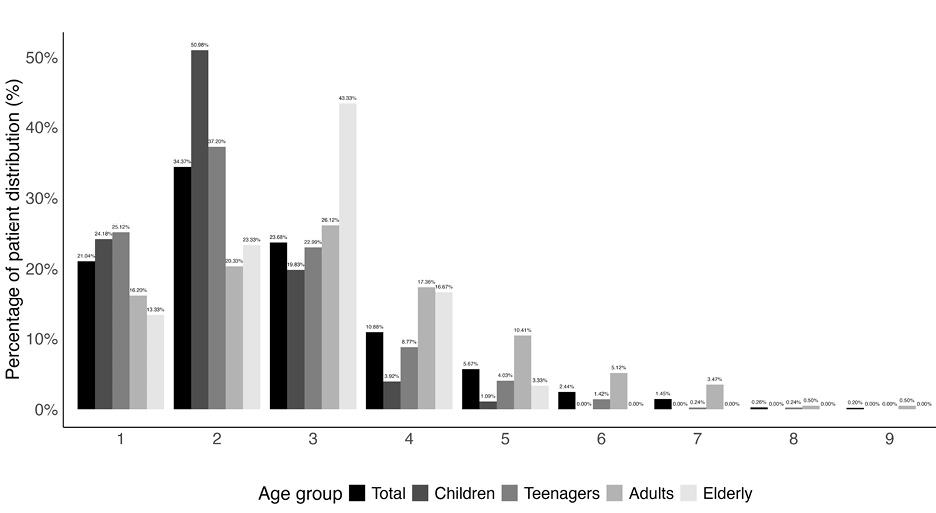
An analysis of the diagnoses per patient (Table 1) was conducted, excluding four cases without assigned diagnoses (likely new patients). Among the remaining 1,516 patients, the mean number of diagnoses per patient was 2.6 (SD = 1.4; range: 1-9). A positive correlation between age and number of diagnoses was identified, using the Spearman’s rank correlation coefficient (ρ = .31, p < .001), indicating an increase in diagnostic burden with advancing age. An analysis by age group showed that children had an average of 2.07 diagnoses (SD = .83; range: 1–5). Adolescents had an average of 2.36 diagnoses (SD = 1.20; range: 1–8), while adults had an average of 3.20 diagnoses (SD = 1.65; range: 1–9). Notably, only .5% of adults had nine diagnoses. Finally, elderly adults had an average of 2.73 diagnoses (SD = 1.01; range:1–5) (Figure 2).
Analysis of diagnoses extracted from the daily updated outpatient medical records database
Second, we analyzed the first-time diagnoses database containing a total of 432 patients with 87 different diagnoses. A summary of findings is given in Table 2.
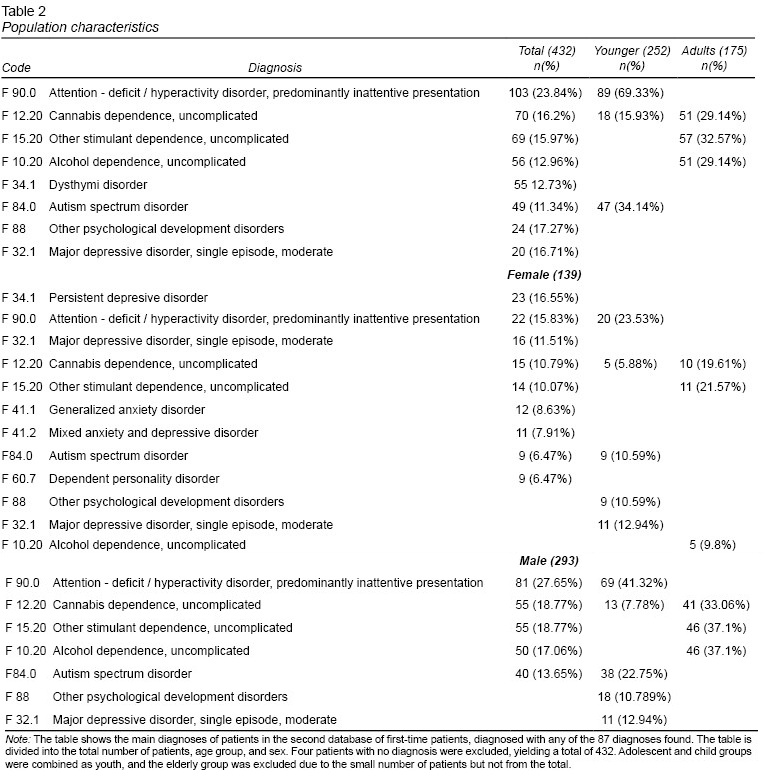
In Table 2, the most common diagnoses are presented in general and by age group. Attention deficit hyperactivity disorder (ADHD), predominantly the inattentive type (F90.0), accounted for 23.8% of cases. This disorder was also among the six most common diagnoses, together with cannabis dependence without complications (F12.20), with 16.2%, other stimulant dependence without complications (F15.20), with 16%, alcohol dependence without complications (F10.20), with 13%, persistent depressive disorder (F34.1), with 12.7%, and autism spectrum disorder (F84.0), with 11.3%.
Among the total of 432 patients, almost a third (139) were female, with the most frequent diagnosis being persistent depressive disorder (F34.1), with 16.5%. Of the 293 male patients, the most frequent diagnosis was ADHD, predominantly the inattentive type (F90.0), with 27.6%. Regarding age, due to the sample size and the Institute’s focus on child and adolescent mental health, children and adolescents were grouped together as the youth category. Within this group, the two most common diagnoses were ADHD, predominantly the inattentive type (F90.0), with 69.3%, and autism spectrum disorder (F84.0), with 34.1%. Among adults, the two most common diagnoses were other stimulant dependence without complications (F15.20), with 32.6% and cannabis dependence without complications (F12.20), with 29.1%. The elderly adult group consisted of just five patients, making this dataset insufficient for statistically significant inferential analysis.
DISCUSSION AND CONCLUSION
Age constitutes an important factor in both databases. The results suggest that the younger population, comprising children and adolescents, accounts for 58.2% of the total population and receives the most attention. The WHO (2021) estimates that one in seven adolescents aged 10 to 19 suffer from some mental disorder. A large-scale epidemiological meta-analysis indicates that the first mental disorder appears around age 14 in a third, in nearly half [48.4%] by age 18, and in half the population before age 25, with an average age of onset between 14.5 and 18 years (Solmi et al., 2021). These findings align with this research, where more than half the population treated at the Temazcalli Institute are 20 years old or younger.
The results show a predominance of males in both databases: 64.1% (975 out of 1520) in the outpatient medical records database and 67.9% (293 out of 432) patients in the first-time diagnoses database. Is this consistent with findings from other studies? The literature shows that some research supports this trend, with other studies suggesting different patterns. According to Wu et al. (2023), the incidence of mental disorders has increased in recent decades, with a higher prevalence of men than women. In a National Survey conducted in 2001, although the sample interviewed was predominantly female, with 54%, men generally had higher overall prevalences of any disorder compared to women [30.4% and 27.1%, respectively] (Medina-Mora et al., 2003). However, in a study conducted on adolescents (aged 12 to 17) in 2009, it was observed that girls have a higher number of mental disorders and a higher prevalence of any mental disorder (Benjet et al., 2009). Likewise, in a comparative study between 2019 and 2021 in Mexico, the same pattern was observed, with women having a higher incidence and prevalence of mental disorders (Medina-Mora et al., 2024).
This disparity may be because, unlike our sample, respondents were outpatients at treatment institutions. This perhaps suggests that, in San Luis Potosí, men are more likely to seek treatment or receive diagnosis, which could be partly due to the reduced stigma associated with mental illness in recent years. Conversely, research conducted by Águila-Morales and Clua-García (2024) at an outpatient treatment center for drug users identified barriers to access for women, such as stigmatization, lack of support, and lack of care tailored to women’s needs. As a specialized addiction treatment institution, the Temazcalli Institute may well reflect a similar pattern. Further research is required to understand the underlying reasons for these differences.
Despite the pattern observed in sex and age distribution in this study, the elderly population showed the opposite results, with 67% being women. This phenomenon can be attributed to several factors, one being the higher prevalence of elderly women in Mexico (Collazos Marín et al., 2023). In San Luis Potosí, life expectancy is approximately 72 years for men and 78 for women (National Institute of Statistics, Geography and Informatics [INEGI], 2024). Other influencing factors likely include the stigma associated with health problems in older generations and the Institute’s specialization in treating addictions, particularly alcohol and tobacco, social acceptance of which has changed over time.
Another interesting finding was the number of diagnoses per patient. Using the Spearman’s rank coefficient, we observed a correlation between the number of diagnoses per patient and age. It was found that the number of diagnoses increased with age, peaking in adulthood and declining in old age, as in the study conducted by Wu et al. (2023). We consider that this increased number of diagnoses in adults is likely due to underdiagnosis. In other words, despite existing since childhood, some of these disorders are not diagnosed until adulthood. Another example could be the range of experiences we have while growing up, as with substance use. In addition, disorder onset periods vary widely, with some disorders tending to develop at an early age, and others extending into adulthood (Medina-Mora et al., 2003). In short, age does not necessarily result in the emergence of additional disorders.
In the second database, shown in Table 2, the most frequent diagnosis was F90.0 [23.8%] or Attention-Deficit/Hyperactivity Disorder (ADHD), predominating in men [27.6%] and the second most common disorder in women [15.8%]. Moreover, it was the most prevalent diagnosis among the younger category of patients [69.3%]. According to the DSM-5, ADHD can present in three forms: combined, predominantly inattentive, and predominantly hyperactive/impulsive. This disorder begins in childhood and requires that several symptoms be present before the age of 12 and persist for at least six months. ADHD is more common in males, with a ratio of approximately 2:1 in children and 1.6:1 in adults, with females being significantly more likely to present with inattentive ADHD (American Psychiatric Association [APA], 2014). In 2021, this disorder affected 3.1% of adolescents aged 10 to 14 years and 2.4% of those aged 15 to 19 years worldwide (WHO, 2021). We assume the predominance of this diagnosis is because it is the disorder currently attracting the most attention, probably because health systems and diagnostic tools have evolved to identify it. It could also reflect an increase in cases for unknown reasons that may be worth exploring.
Among adults, the most common diagnoses were related to addictions, consistent with the primary mission of the Temazcalli Institute, which focuses on treating patients with drug dependence. The most commonly abused substances were cannabis, stimulants (amphetamines and methamphetamines), and alcohol, in that order. In 2022, cannabis remained the most commonly used drug globally, with an estimated 228 million users, followed by opioids (60 million), stimulants (30 million), cocaine (23 million), and ecstasy (20 million) (United Nations Office on Drugs and Crime [UNODC], 2024). According to the National Commission against Addictions in Mexico, the use of psychoactive substances increased by 26% between 2010 and 2020, with 284,000 adults reporting having used a substance in 2020, mostly men. Cannabis and amphetamine use also experienced a significant increase (National Commission against Addictions, 2022). Regarding substance abuse, men represented the majority, both overall and in terms of age distribution. This may also explain why there is a higher proportion of male users at the Temazcalli Institute, since, as mentioned above, it specializes in addictions.
In Table 2, the female population showed a higher incidence of depression diagnoses, with the most frequent diagnosis among women being persistent depressive disorder [16.5(%)]. According to the World Health Organization, depression and anxiety are 50 times more common in women than in men, since men are more likely to present with some form of substance abuse (Kestel et al., 2022).
The second most common diagnosis in children was autism spectrum disorder (F84.0). This neurological disorder is one of the most common among children and young adults, affecting one in 200 children under five years of age (Kestel et al., 2022). Autism spectrum disorder is generally considered hereditary and heterogeneous, with underlying cognitive characteristics and frequent comorbidity with other conditions. Epidemiologically, it is more common in males than females, with a ratio ranging from 2:1 to 5:1 (Lord et al., 2020). Globally, it is estimated that one in 100 children has autism, although prevalence varies across studies, with some reporting significantly higher figures (WHO, 2023). Although there are no official statistics on the incidence of autism, it is estimated that approximately 6,200 people are born with this disorder in Mexico every year. According to Carol Ajax, founder of the Spectrum Therapy Center in Mexico, one in 115-120 people in Mexico has some form of autism spectrum disorder (National Council for the Development and Inclusion of People with Disabilities, 2019).
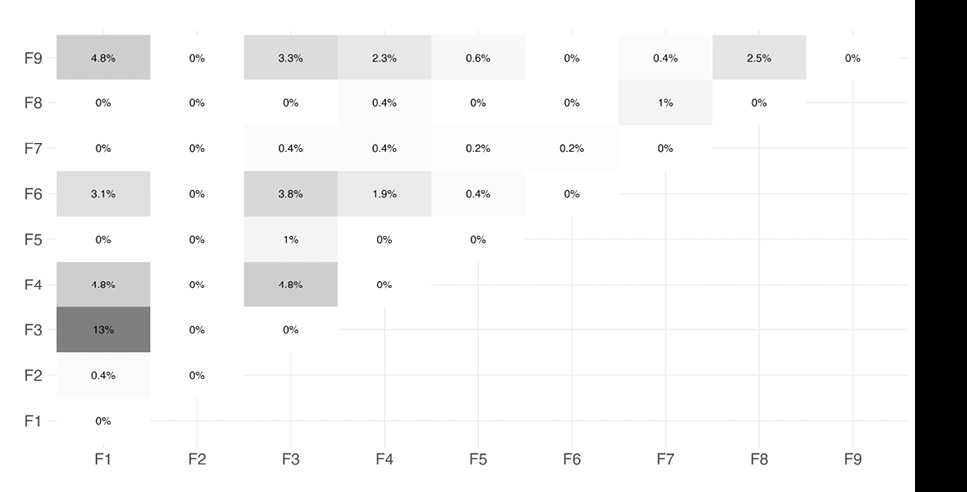
Given that the Institute addresses dual pathology, involving the presence of both an addiction and a mental disorder, we expected a higher correlation between mental disorders from groups F2 to F9 and diagnoses from group F1. However, the relationship found between these diagnoses was minimal, even when compared by groups. The combinations showing the greatest tendency to correlate were F1 and F3, albeit with a low percentage, followed by F1 and F4, and finally F1 and F9. Since there was a high incidence of diagnoses from group F9, particularly F90.0, a higher correlation with F1 was expected, but instead a greater association was identified with bipolar and depressive diagnoses. Several studies indicate that depression and addictions have high comorbidity, with people with addictions being at a greater risk of developing depression and vice versa (Xu et al., 2020). It is estimated that a person with a substance use disorder has a 32% likelihood of developing major depressive disorder, with evidence suggesting that simultaneous treatment achieves the best outcome for these conditions (Carey, 2018).
The results of this study cannot be extrapolated to the general Mexican population or even to the population of San Luis Potosí, mainly because the sample was drawn from a single specialized institution, limiting its external validity. Despite its limitations (such as sample representativeness), the study’s generational, gender, and diagnostic diversity, supported by its substantial sample size, offer critical data on public mental health service utilization and prevalent disorders. Several studies in Mexico, such as national surveys, and global reports, document the state of mental health in the country, from its epidemiology to the follow-up provided for specific disorders. Nevertheless, when conducting this study, we realized the lack of specific analyses of specialized care centers, with the few existing ones having been conducted outside Mexico. Our study is the first attempt to undertake a retrospective, cross-sectional, descriptive analysis to examine the interrelationships among the variables under consideration. These include topics that have hitherto remained unexplored or unverified, specifically, the correlation between age and the number of diagnoses per individual, as well as the relationship among these diagnoses.
The results underscore the importance of prevention and treatment of mental disorders in the state of San Luis Potosí. Accurate statistical data on mental health cases will shed light on the trends observed at the institute that can inform evidence-based clinical protocols and public health policies. It is essential to promote education for both the general public and primary care physicians for the early detection of these disorders, and to increase funding for specialized centers. This study highlights the importance of conducting similar studies at other institutions as well as comparative studies of the latter to obtain more extensive information we could extrapolate. This will encourage researchers to establish accurate incidence rates and population indicators both nationally and regionally. A data-driven approach will improve mental health outcomes and strengthen the healthcare system in San Luis Potosí and Mexico, in addition to making government institutions aware of this public health problem.