INTRODUCTION
Women living with HIV (WLWH), particularly Latina and Black women, experience gendered social, and structural inequalities that shape their health, mental health, and access to care in specific ways. These include limited access to financial, educational, social, and health resources (Caballero-Suárez et al., 2017; Marg et al., 2020) and exposure to gender-based and sexual violence (Erickson et al., 2021; Rice et al., 2019). They are also exposed to HIV-related stigma (Sangaramoorthy et al., 2017; Seffren et al., 2018); and cumulative losses that can affect mental health and antiretroviral treatment adherence (Brown, 2020; Norcini-Pala et al., 2025; Owusu, 2020). Comorbidities, HIV stigma, ageism, poverty, and disability stigma intersect as systems of oppression, creating barriers in the HIV care cascade (Manalel & Brennan-Ing, 2023; Rosenfeld & Anderson, 2020; Solomon et al., 2014).
Intersectionality makes it possible to analyze how axes of inequality—gender, class, ethnicity, race, sexual orientation, disability, age, and health status—operate simultaneously, exacerbating health inequities (Cantero-Sánchez, 2023; Cruz-Cruz et al., 2023). These axes are sustained by systems of oppression that work synergistically (Couto et al., 2019; Yang et al., 2022).
Recent protocols and reviews on aging women living with HIV (AWLWH) adopt an intersectional perspective, showing that gender, age, race/ethnicity, migration, and socioeconomic position co-produce later-life health inequities (Kokorelias et al., 2024; Kokorelias et al., 2025; Ojukwu et al., 2022; Sommer & Barroso, 2023). However, this evidence is heavily concentrated in North America and Europe, leaving major gaps in Latin America.
AWLWH face HIV-related stigma, ageism, sexism, and structural barriers to services adapted to aging, including limited integration of menopause and HIV care and geriatric follow-up. Although their experiences vary by race/ethnicity, migration status, and socioeconomic context, many report a sense of invisibility and exclusion from HIV priorities (Kokorelias et al., 2025). However, studies of AWLWH also frame community, advocacy, and the radical act of caring for others as forms of resistance and re-authoring their life stories (Sommer & Barroso, 2025; Stevenson, 2022). Successful aging has been linked to social support, self-efficacy, and resilience (Psaros et al., 2023; Rubtsova et al., 2021; Suárez-García et al., 2021). However, comparative guidelines and cohorts show that health systems rarely address their specific needs regarding menopause, multimorbidity, and migration (Arsuffi et al., 2025; Scofield et al., 2024).
In Mexico, these dynamics of oppression are especially relevant. According to the National Center for HIV and AIDS Prevention and Control (Centro Nacional para la Prevención y el Control del VIH y el Sida [CENSIDA]), by November 2025, Mexico had reported 187,596 people living with HIV. This figure includes 29,172 women, accounting for approximately 15.55% of all registered cases. Moreover, between 2014 and 2025, 3,769 women aged 50 or older were reported as living with HIV in Mexico ( CENSIDA, 2025). This shows that women remain a minority within official HIV surveillance data, even though their experiences require specific attention since gender, age, socioeconomic inequality, and access to care shape their trajectories in different ways.
WLWH in Mexico tend to report lower educational attainment, limited access to formal employment, greater exposure to gender-based violence, restricted access to condoms, and sexual violence, In many cases, they acquired HIV from their steady partners (Bautista-Arredondo et al., 2015; Uribe et al., 2018). Despite this, qualitative research on aging Mexican women living with HIV (AMWLWH) remains scarce, often failing to consider how gender intersects with age, class, ethnicity, and other axes of inequality (Amuchástegui & Evangelista, 2022). Previous research has addressed aging with HIV in relation to quality of life, support networks, and mental health. However, fewer studies have examined intersectionality, self-care, and the complexities of health needs among AWLWH (Marg et al., 2020; Plach et al., 2005; Rosenfeld & Anderson, 2020).
A qualitative approach is especially useful for addressing this gap since it reveals how participants interpret, narrate, and negotiate structural conditions in everyday life. Narrative-informed qualitative analysis does not treat interviews as mere reports of events. Instead, it explores how participants organize their experiences, values, losses, hopes, and preferred identities through language. This makes it possible to not only examine the forms of inequality AMWLWH encounter, but also how they make sense of these conditions and respond to them through agency and care.
Narrative therapy understands people not as passive recipients of harm but instead as authors of their lives through values, beliefs, hopes, and commitments (Marsten & Howard, 2006; White, 2015; White & Epston, 1993). Despite structural oppression and traumatic experiences, people take steps to achieve their preferred ways of living (Beaudoin, 2022, 2023). Narrative conversations seek to visibilize these responses, reinforcing personal and relational agency rather than deficit-based understandings.
Narrative therapy is also a politically engaged, socially located practice. Its post-structuralist foundations and social justice1 commitments invite practitioners to examine how problems are produced. They are encouraged to examine the discourses of gender, race, class, sexuality, colonialism, and age, rather than locating problems within individuals (Combs & Freedman, 2012; White, 2015). Recent research emphasizes that externalizing conversations and re-authoring practices may be informed by intersectional feminism, postcolonial thought, and community-based knowledge, foregrounding people’s resistance to oppression and their survival skills (Jagatdeb et al., 2024). According to this point of view, agency is relational, collective, and embedded in sociocultural and historical contexts, rather than being reduced to individual strength or willpower.
These ideas are relevant for AWLWH, whose lives are shaped by the intersection of HIV-related stigma, gendered and racialized inequalities, poverty, violence and ageism. Qualitative studies show that women report both stigma and resistance, including boundary-setting, health-care advocacy, peer care, treatment adherence, spirituality, and community support (Rosenfeld et al., 2021; Subramaniam et al., 2017).
In this study, agency refers to women’s situated sense of themselves as being able to make decisions, sustain care, negotiate relationships, protect their health, claim their rights, and pursue their preferred identities despite structural constraints (Beaudoin, 2022, 2023; Combs & Freedman, 2012; White, 2015). Care refers to both self-care practices, such as attending appointments and adhering to treatment, and relational or collective practices, such as supporting peers, sharing knowledge, and sustaining meaningful family and community ties (Medeiros et al., 2022; Plach et al., 2005; Sommer & Barroso, 2025). This study conceptualizes participants’ narratives as accounts of women exposed to intersecting forms of oppression who also respond through everyday acts of agency and care (Rosenfeld et al., 2021; Subramaniam et al., 2017). Attending appointments, adhering to treatment, protecting mental health, and performing mothering and grand-mothering roles are some of the agentic practices that reconfigure what it means to age with HIV in Mexican contexts. Other routines include contributing to household economies, participating in support groups, and exercising the freedom to make decisions across the spaces where they live and relate to others. These practices also enable women to imagine and move toward preferred futures for their lives, asserting dignity, autonomy, and the right to define their own trajectories in later life (Kisvetrová et al., 2022; Pageau et al., 2024).
This study seeks to analyze the life experiences of AMWLWH to highlight their needs, resources, and responses to oppression produced by structural inequalities in education, socioeconomic position, and access to health care. The guiding question was: How do AMWLWH enact agency and care while aging with HIV under intersecting systems of oppression? By visibilizing these responses, the study seeks to inform women-centered HIV and aging care and increase its sensitivity to gender, age, and social context.
METHOD
Study design
This qualitative study was grounded in an interpretive paradigm, a relativist ontology, and a constructivist epistemology (Denzin & Lincoln, 2005, 2011; Urcia, 2021). This approach assumes multiple realities shaped by women’s positions in terms of gender, age, class, ethnicity, and HIV status, and understands knowledge as being co-constructed through the interaction between researchers and participants. A qualitative approach was appropriate because the study sought to understand how participants gave meaning to aging, HIV, oppression, care, and agency in their own words within their social contexts. Semi-structured interviews and reflexive thematic analysis were used to examine how women interpret oppression and enact agency and care across their life course.
Participants
The study was conducted between July 2024 and March 2025 at a specialized clinic in Mexico City offering comprehensive HIV care to people without social security, including infectious disease, gynecology, and mental health services. Mental health and gynecology services invited women who met the following criteria: identifying as a cisgender woman, being 50 or older, and receiving HIV care at the clinic. Transgender women were excluded because the study focused on cisgender women’s aging trajectories and forms of gendered inequality linked to their life histories as cisgender women. This decision does not imply that transgender women’s experiences are less relevant, but rather that they require specific research designs tailored to their histories, needs, and structural conditions. Exclusion criteria were identifying as a transgender woman or being under 50. Thirty-eight women were invited, of whom 27 participated and 11 failed to attend the scheduled interview. Reasons for non-participation were not systematically recorded, and no monetary or material incentives were provided. Convenience sampling was used to ensure heterogeneity in age, time since diagnosis, education, and life circumstances.
Procedure
The first author conducted a face-to-face Spanish-language interview with each participant in a private mental health office inside the clinic. Only the interviewer and participant were present during the interviews, which lasted 60–90 minutes. With the participants’ permission, the interviewer audio-recorded the interviews using Microsoft Teams. The research team transcribed them verbatim, de-identified them, managed them in ATLAS.ti v22, stored the recordings for two weeks, and subsequently deleted them. For publication, the first author translated the quotations into English, which the team reviewed to ensure they preserved the original meaning and sociocultural nuances. Brief field notes documented the context, emotional tone, initial analytic impressions, and reflexive observations. Although participants were not given transcripts, during the interviews, the interviewer summarized and clarified key points to ensure accurate understanding.
The topic guide explored three areas: (a) HIV diagnosis, including situations, needs, challenges; (b) aging with HIV, including perceived changes, meaningful relationships, and identity; and (c) preferred future, including desires, commitments, and resources. Interviews began with the open question: Could you tell me what your life has been like since you received your HIV diagnosis? The interviewer followed the guide flexibly, according to the narrative of each participant. Recruitment was guided by data richness rather than by a positivist notion of saturation. The team documented these decisions through analytic notes and team discussions, noting when new interviews no longer generated substantially new insights for the study aims and when the themes were sufficiently rich and coherent for interpretation.
Analysis
Data were analyzed using reflexive thematic analysis following Braun and Clarke’s (2006) six phases. First, the first author read the transcripts and analytic notes several times. Second, she generated initial codes both deductively, using the topic guide as a sensitizing framework, and inductively, allowing meanings to emerge from the narratives. Third, codes were collated within and across cases to identify candidate themes related to HIV diagnosis, aging, and preferred futures. Fourth, themes were compared with coded extracts and the dataset. Fifth, the team defined and named themes by focusing on how they shed light on intersectional dimensions such as age, gender, class, ethnicity, and HIV status, as well as narrative reconstruction of identity. Finally, themes were woven into an analytic narrative interpreted through intersectionality.
The first author conducted primary coding. A second researcher reviewed the evolving codebook, discussed a subset of coded transcripts, and challenged interpretations in analytic meetings to enhance credibility through reflexive dialogue rather than inter-rater calculation. The coding tree developed iteratively from descriptive to interpretive codes and higher-order thematic groupings aligned with women’s agency and care under structural oppression. Examples included work/economic survival, self-care practices, collective care, re-signifying aging, and preferred futures. Themes were primarily derived from the data, while intersectionality and agency served as sensitizing frameworks. COREQ reporting guidelines informed the manuscript (Tong et al., 2007).
Ethical considerations
The study was approved by the Ethics Committee of the Mexico City Public Health Services (No. 009820/2024). Participants signed written informed consent forms after receiving information on the objectives, confidentiality, and voluntary nature of participation, and the possibility of receiving psychological care if they experienced emotional distress. Only de-identified transcripts were analyzed. As the first author was also a psychologist in the clinic’s mental health program and had previously met most participants for clinical history-taking, power dynamics were treated as a central reflexive issue. Participants were informed that their willingness or refusal to participate would not affect their care, while the interviewer emphasized the confidentiality and voluntary nature of the study, and the option of stopping or dropping out. Reflexive memoing and team debriefings examined how feminist, social-justice, clinical, and research commitments could shape framing and interpretation.
RESULTS
Sample characteristics
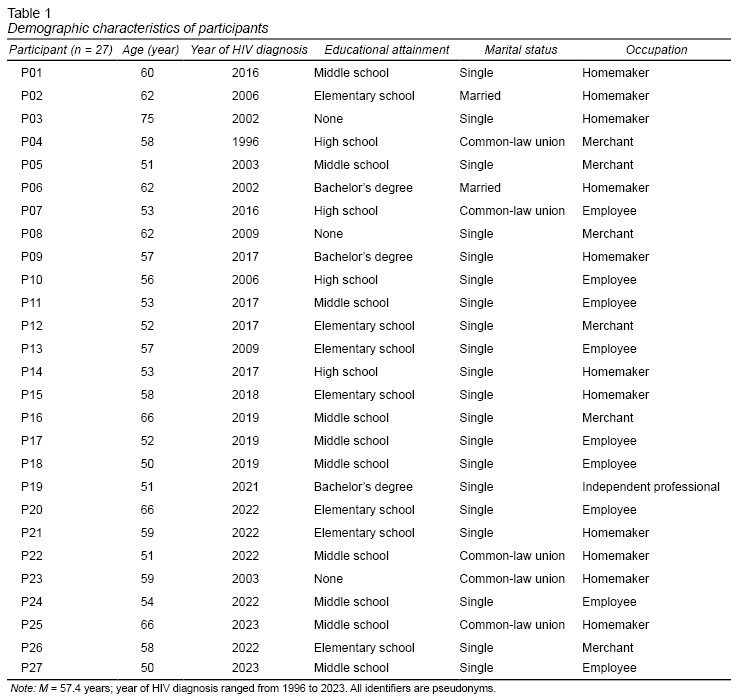
The study included 27 cisgender women, with a mean age of 57.4. Time since HIV diagnosis ranged from two years (diagnosed in 2023) to 29 years (diagnosed in 1996). Educational attainment, marital status, and employment patterns reflected marked socioeconomic disadvantage, and long histories of informal labor. These characteristics were not only treated as descriptive background but were also interpreted as social locations shaping participants’ narratives of work, care, aging, autonomy, and access to HIV services.
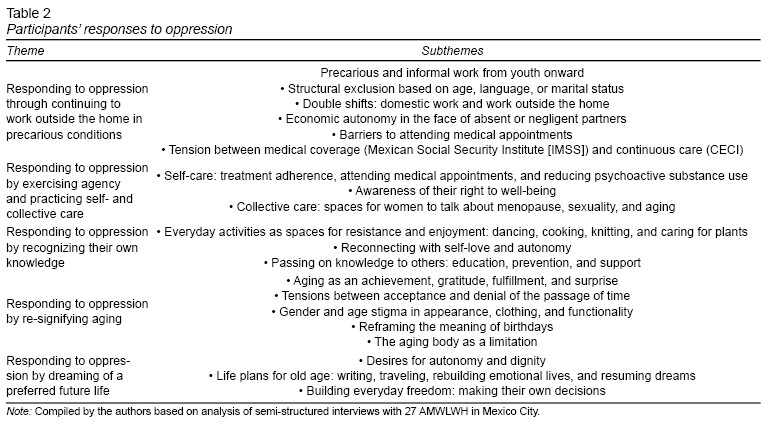
Findings are organized into five themes.
Repetition of the phrase responding to oppression reflects an analytic decision guided by the data and the sensitizing frameworks of intersectionality and agency. Each theme is presented as an overarching pattern, with subthemes being summarized in Table 2, and quotations being used as illustrative examples that preserve the complexity of participants’ narratives.
(a) Responding to oppression by engaging in work outside the home in precarious conditions
Participants described the precarious work conditions, age discrimination, and difficulties they experienced attending medical appointments. Most had worked outside the home since adolescence or after widowhood/separation, generally in informal and poorly paid jobs such as domestic work. One participant practiced law, showing the heterogeneity of the group. Some women had migrated from Indigenous or rural contexts and faced language barriers limiting their social and work opportunities. P03, from Teotitlán, Oaxaca, whose dominant language is Mazatec, recalled that when she arrived in Mexico City, she had been unable to speak Spanish. For the women in her village. “there is nothing there, you fetch firewood, and that’s it (…) there is no work there.”
Work was also described as agency and economic survival in the narrations. P27 said she had worked “all [her] life.” P08 described working “behind [her husband’s] back” because she did not want to depend on anyone. P16 recalled that when her husband disappeared or left her with no money, she “had to figure it out” to feed her children, pay the rent, and cover household expenses. At the same time, HIV care created work dilemmas: attending appointments entailed missing work or requesting time off. P14 said HIV “took away my freedom,” because she could no longer work 12-hour days, and explained that jobs with social security could jeopardize her clinical care. P27 also described age as a limit: “right now it’s hard to accept that maybe because of my age it’s not so easy anymore.”
Some participants experienced the dilemma of looking for a job that would provide medical care through the Mexican Social Security Institute. This could mean that they would no longer be eligible for care at the specialized clinic where they were currently receiving treatment. Participants did not wish to lose their right to this specialized care, and the possibility of being forced to do so caused them sadness and distress.
(b) Responding to oppression by exercising agency and practicing self and collective care
Participants expressed their commitment to self-care through clinic attendance, antiretroviral adherence, dietary changes, hypertension and diabetes management, and early detection of breast cancer. For two participants, their HIV diagnosis marked a turning point that had encouraged them to reduce their alcohol, inhalant, and cocaine use. P12 described stopping inhalant use after years of heavy use while P07 credited her diagnosis with stopping crack, alcohol, clonazepam, and marijuana use and P11 referenced her alcohol use prior to diagnosis. These decisions were not framed as individual willpower but rather as practices of survival and care within constrained lives.
Collective care was equally important. P07 wanted spaces to discuss menopause, sexuality in aging, and reclaiming their bodies as a response to stigma and invisibility. She proposed conversations about menopause “so that we can see how we can help each other” and emphasized that sexual life can continue in aging: “until you die, until you’re 80 (…) there are other ways to do it, not just penetration.” Agency also appeared in difficult decisions to prioritize their health over family demands. After years of taking care of her father, P16 said: “I must be strong and look for myself (…) It hurts me to leave my dad, but I left that responsibility to others, because I said to myself, who’s going to be there for me? My siblings aren’t going to look after me, I must look after myself.”
(c) Responding to oppression by recognizing their own knowledge
Participants described enjoyment, autonomy, and self-knowledge through solitude, dancing, cooking, music, plant care, knitting, and friendships. These activities created spaces where women reclaimed their bodies, time, and pleasure. P16 said “I’m enjoying the moment (…) I was there for others, now I’m there for myself.” Reconnecting with self-love also emerged as knowledge: P08 described “loving ourselves (…) not relying on anyone else and recognizing that I was braver.” Several women shared what they had learned about sexual self-care with youth, relatives, friends, and recently diagnosed women. P08 emphasized the need to be informed about HIV because “sometimes we as partners don’t know who they’re with (…) we trust them[their husbands]” while P18 told newly diagnosed women to “be brave” because HIV “no longer [means] death, there is treatment (…) which helps us.”
(d) Responding to oppression by re-signifying aging
Aging involved interwoven meanings: joy, gratitude, celebration, loss, and functional limitation. Some participants valued reaching ages they had not previously imagined. After turning 63, P06 linked her survival to family environment, culture, self-love, and motivation. P13 stopped celebrating birthdays after diagnosis but later asked herself why she would “shut [herself] away” and began celebrating again as part of learning to live with HIV. P19 acknowledged the pain of realizing “I am no longer young,” while also feeling strong despite the diagnosis. Gendered age norms appeared in comments about clothing and attractiveness, with P09 criticizing how clothing is segmented by age. Physical limitations were also present: P01 noted that housework took longer, while P03 wanted to sell things outside her home but felt limited by back problems. Nevertheless, birthdays became occasions to imagine change, such as P01’s wish “for a change in myself and to let go of many things that I still carry with me, you know? (…) Like the guilt of having HIV (…) and saving up for my mariachis for next year.”
(e) Responding to oppression by dreaming of a preferred future life
Participants imagined futures organized around independence, physical and emotional wellbeing, financial security, dignity, and personal development. Several wanted to continue working, one dreamed of writing a book or forming a new romantic relationship, while others wanted a peaceful old age. Aging with dignity meant maintaining functional and emotional independence, through exercising, reading, walking, and having a social life, and pursuing long-term goals such as owning a house, accessing health services, and not needing to work out of financial necessity. P18 associated dignity with learning and living “a day at a time.”
Preferred futures also involved refusing what they no longer wanted. P15 did not want another partner after a difficult life and hoped for a “more dignified” old age. P01 wondered whether becoming a nurse might still be a possibility, although she had doubts about her confidence. P05 described her preferred future as freedom. In deciding what to eat, drink, do, and whether to be with someone; she concluded, “I don’t need a man to feel happy, I am happy with myself.” Others wanted to keep working to meet their basic needs and enjoy their families. P05 hoped to build her house and achieve “some stability” and quality of life. Minor themes such as professional work, Indigenous migration and Mazatec language, spirituality, dancing, and plant care were retained analytically to avoid presenting a uniform narrative.
DISCUSSION AND CONCLUSION
This qualitative study examined how AMWLWH navigate intersecting structural oppression and respond through agency and care practices of agency. Its main contribution is to show how aging with HIV in the Mexican context is not only experienced as clinical vulnerability or cumulative disadvantage. It is also regarded as a field of everyday negotiation in which women continue to work, protect their access to care, share situated knowledge, and imagine dignified futures. Participant narratives showed how gender, age, socioeconomic position, and, in some cases, Indigenous origin intersect to shape access to health services, financial and sexual autonomy, and social support (Amuchástegui & Evangelista, 2022; Erickson et al., 2021; Manalel & Brennan-Ing, 2023). At the same time, women’s financial strategies, health advocacy, boundary-setting, and mutual care served as forms of resistance to support wellbeing in later life (Marg et al., 2020).
Across themes, participants associated self-care—clinic attendance, antiretroviral adherence, co-morbidity management, and changes in substance use—with collective care, including peer spaces to discuss menopause, sexuality, and mutual support. These findings echo evidence that social support and women-centered models improve engagement and wellbeing among WLWH (Hanass-Hancock et al., 2019; Medeiros et al., 2022). They align with stigma research that understands resilience as active and relational across the life course (Sommer & Barroso, 2025). For some participants, their HIV diagnosis became a turning point. It prompted care practices, consistent with studies describing resilience and agency as protective factors for adherence and psychological wellbeing (Eruotor & Letvak, 2022; Eruotor & Letvak, 2022; Plach et al., 2005).
A central contribution is that participants framed their later life through the lens of dignity and autonomy, which involved having a say over time, relationships, sexuality, care, work, and recognition as valuable people rather than burdens. Dignity appeared less as a static attribute than as a horizon pursued through daily choices and relational negotiations despite chronic illness and economic precarity. This resonates with approaches linking dignity in later life to autonomy, recognition, and opportunities to pursue meaningful goals (Kisvetrová et al., 2022; Pageau et al., 2024), and with perspectives connecting agency, resilience, and self-recognition with people with power (Eruotor & Letvak, 2022; Sommer & Barroso, 2023). Rather than suggesting that suffering itself is dignifying, the findings show how participants narrated painful experiences in ways that allowed them to claim recognition, ethical self-understanding, agency, and continuity in their lives (La Torre-Gentoso, 2024).
The findings support the importance of understanding AMWLWH through interconnected identities and life experiences (Kokorelias et al., 2024). Care models should be sensitive to the intersections of age, gender and the social context of structural inequality (Caballero-Suárez et al., 2017; Celeste-Villalvir et al., 2023; Couto et al., 2019; Hanass-Hancock et al., 2019; Sangaramoorthy et al., 2017). In Mexico, this requires recognizing that some AMWLWH are also forced to navigate language barriers and institutional discrimination. Culturally safe HIV and aging care requires more than translation: it requires cultural mediation, institutional accessibility, respectful communication, and services recognizing linguistic and cultural diversity among AWLWH.
Practical implications can be organized by level of intervention. In clinical encounters, professionals should support agency and dignity by promoting autonomy, decision-making, and continuity of care that respects each person’s identity, personal history, meaningful relationships, and preferred future (Kisvetrová et al., 2022; Pageau et al., 2024). In HIV and aging services, programs should integrate menopause-informed and later-life care, address transportation and appointment barriers, and incorporate culturally safe care for indigenous-language speakers (Medeiros et al., 2022; Plach et al., 2005; Uribe et al., 2018). At the peer and community level, services should strengthen women’s networks for mutual care, stigma reduction, sexuality and menopause conversations, and sharing practical knowledge (Marg et al., 2020). At the policy level, interventions should question the myths of romantic love linked to intimate partner violence and link HIV care with social protection, labor rights, gender-based violence prevention, social development, and human rights frameworks (Amuchástegui & Evangelista, 2022; Eruotor & Letvak, 2022; Ferrer-Pérez, 2025; Lelaurain et al., 2021; Neundorfer et al., 2005;Norcini-Pala et al., 2025).
Study strengths include its focus on an under-researched population in Latin America and an interpretive approach centering women’s voices. Limitations include the fact that participants were receiving care at a specialized metropolitan clinic, which may not reflect the realities of women in rural areas or with less access to services. Future studies should include women from rural and Indigenous contexts, as well as those with limited access to public institutions.
Another limitation is the possible difference in meaning introduced when translating excerpts from Spanish to English. Future participatory and longitudinal research could examine how agency is sustained over time and how community-based proposals for dignity in aging can be co-constructed.
In conclusion, AMWLWH experience intersecting systems of oppression that shape later-life health and wellbeing. However, they also respond through economic strategies, self- and collective-care practices, shared knowledge, re-signified meanings of aging, and imagined preferred futures that sustain dignity and agency. For clinicians, program designers, and policymakers, these findings underscore the value of reducing gendered and age-related barriers, supporting women-centered and culturally safe care, and strengthening peer/community networks. Regarding agency and care as relational practices can shift HIV and aging services away from deficit-based framings toward models recognizing AMWLWH as experts on their own lives.