INTRODUCTION
According to the World Drug Report (United Nations Office on Drugs and Crime [UNODC], 2024), global drug use is rising, with approximately 296 million users in 2022, a quarter of whom are women. A significant treatment disparity exists, since only one in eighteen women with a substance-related disorder receives care, compared to one in seven men. This gap is alarming as women often experience a “telescoping effect,” accelerated progression from use to dependence, and may be more susceptible to cravings and relapse.
Research highlights that women face complex systemic, interpersonal, and individual barriers to treatment. Key obstacles include pervasive stigma, logistical challenges like transportation and childcare, and unique vulnerabilities for specific populations, such as pregnant women (Oni et al., 2022) or those involved in the criminal justice system (Skogseth et al., 2025). These barriers can foster isolation and discourage women from seeking necessary help, underscoring the urgent need for effective, gender-sensitive treatment approaches. Addressing these barriers requires increasing awareness, improving access to resources, and creating supportive environments that empower women to pursue recovery (Vourakis, 2003).
Given the significant increase in women using psychoactive substances and the persistent gender gap in treatment access, a systematic review is essential to synthesize evidence on barriers to accessing treatment for women who use drugs (Page et al., 2021). Women face compounded social rejection, violence, discrimination, and family disruption, with often more severe consequences than those experienced by men (Romero Mendoza et al., 2011). Addressing the multifaceted barriers, including stigma and gender-based violence, and a lack of tailored services, is imperative to narrow the treatment gap and enhance outcomes for women (Shirley-Beavan et al., 2020).
Quitting drugs is only part of the recovery process. When a person begins treatment, addiction has often already had serious consequences on their life and has likely destabilized their health and the way they function in their family environment, at work, and in their community. Because addiction can affect so many aspects of a person’s life, treatment must address all the needs of the individual to be effective (National Institute on Drug Abuse [NIDA], 2020).
The provision of these services requires the integration of a designated framework within national public health systems, accompanied by a deliberate emphasis on addressing the unique needs of women, including pregnant women. A review of the barriers to treatment for women who use drugs provides a comprehensive overview and offers a framework for addressing the underrepresentation of women in drug treatment services (UNODC, 2024).
The primary objective of this systematic review is to identify and synthesize the evidence on the principal social, structural, and personal barriers perceived by adult women who use drugs when seeking treatment. The secondary objectives are:
To categorize the identified barriers into a comprehensive thematic framework.
To examine how barriers may differ across various subgroups of women.
To identify key gaps in the current literature to guide future research.
METHODS
Study design
A systematic review of the published literature was conducted to analyze the barriers women perceive when seeking drug use specific treatment. The report is based on the Preferred Items for Systematic Reviews and Meta-Analyses [PRISMA] guidelines (Page et al., 2021). An intersectional approach was adopted to capture not only the barriers, but also how they intersect with other socioeconomic and psychological factors, focusing on the person and their capacity for agency in a social context.
Inclusion and exclusion criteria
Studies were included if they met the following criteria: a) investigated adult women (18 years or older) who currently use or have a history of using psychoactive substances, or who have a diagnosed substance-related disorder; b) explored barriers to accessing or remaining in substance use treatment from the direct perspective of women; c) were empirical studies, including qualitative, quantitative, and mixed-methods designs; d) were peer-reviewed articles published between 2015 and 2025 in either English or Spanish.
Studies were excluded if they: a) focused on adolescent populations (< 18 years); b) did not include the perspectives or direct experiences of women (e.g., studies focused solely on professional perspective); c) only evaluated the clinical efficacy of a specific treatment (e.g., a drug trial) without discussing barriers to accessing that treatment; d) were non-empirical publications, such as literature reviews or dissertations.
Search strategy
From January 2 to May 20, 2025, a comprehensive electronic literature search was conducted across the PubMed, Scopus and Redalyc (Network of Scientific Journals of Latin America and the Caribbean, Spain, and Portugal) databases. To ensure methodological rigor and minimize selection bias, the entire screening process was executed via a dual, independent reviewer design. The search was limited to peer-reviewed articles published in English or Spanish between 2015 and 2025 to capture literature from the last decade.
To optimize search precision, controlled vocabulary descriptors were selected from the Medical Subject Headings (MeSH) browser of the National Library of Medicine (NLM, 2025). In PubMed, the exact search string utilized was (“Women” [MeSH] OR “women”) AND (“Health Services Accessibility” [MeSH] OR “barriers” OR “access”) AND (“Substance-Related Disorders” [MeSH] OR “drug use” OR “addiction”). This database search yielded 232 records.
The search strategy was subsequently adapted for Scopus using a refined Boolean command string with parentheses to ensure logical grouping: (“barriers” AND (“treatment” OR “care”) AND (“drug use” OR “substance abuse” OR “substance use disorder” OR “addiction”) AND “women”). Maintaining the identical publication year and language filters, the Scopus search retrieved 93 records.
Finally, to incorporate regional literature from Spain and Latin American countries, targeted keywords in Spanish were searched in Redalyc: “barreras” AND “acceso” AND “tratamiento” AND “mujeres” AND “drogas.” The Redalyc query returned 103 records. Across all three database registries, the initial search phase yielded a combined total of 428 articles prior to duplicate removal.
Selection of studies
After the removal of 52 duplicates, 376 unique articles were screened based on their titles and abstracts (273 in English and 103 in Spanish). During this screening, 295 articles were excluded because they failed to meet the inclusion criteria, focusing on different disciplines such as medicine (Dahlman et al., 2021), or other populations or topics, including PrEP and HIV services (Harris et al., 2024b; Metsch et al., 2015).
This left 81 articles for full-text eligibility assessment. A further 62 articles were excluded at this stage mainly because the studies did not report women-specific data, making their experiences indistinguishable from those of men (Harrison et al., 2024; Winiker et al., 2023; Stopka et al., 2024). In some cases, they were omitted because they focused on the perspectives of service providers rather than the women themselves (Baloyi & Khosa, 2025). The reports were retrieved online and reviewed in full by both reviewers independently. Ultimately, 19 studies met all eligibility criteria and were included in the final synthesis.
Data extraction
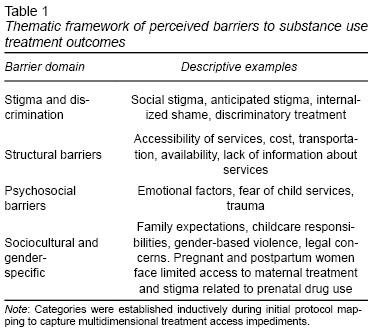
The primary outcomes for which data were sought in each study were barriers to substance use treatment among women. These were defined across the domains presented in Table 1. Both quantitative indicators (e.g., stigma prevalence rates) and qualitative themes (e.g., narrative accounts of emotional distress) were extracted. In instances where multiple outcomes or barrier types were reported under different headings, interpretive judgment was applied based on context, and all were collected.
The research tool SciSpace assisted in summarizing articles during initial full-text screening; however, all data extraction, analysis, inclusion decisions, and risk of bias assessments were conducted manually by two independent reviewers to ensure accuracy.
The Critical Appraisal Skills Program Qualitative Checklist (CASP, 2024) was used to assess the risk of bias in the included studies. This assessment covers aspects such as the appropriateness of the research design, recruitment strategy, reflexivity, ethical considerations, rigor of data analysis, and clarity of findings. Each study underwent independent review by two reviewers, who assessed methodological rigor and transparency of reporting for each domain within the applicable tool. Any discrepancies in the assessments were resolved through discussion and consensus.
No automation tools were used in the risk of bias assessment process. All screening, evaluation, and resolution activities were performed manually to ensure contextual interpretation. The overall risk of bias was classified as low, moderate, or high based on the number and severity of methodological issues identified. While most studies possessed high relevance, variations in design quality and completeness of reporting were considered when interpreting the strength of evidence throughout the review.
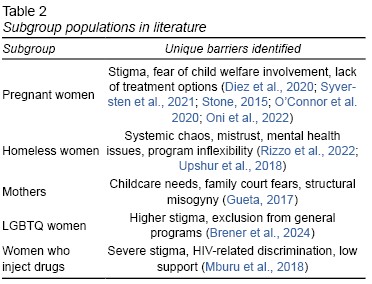
A tabulation of study characteristics was performed, covering factors such as country, design, approach, method, and population. This approach was adopted to assess the compatibility of the studies with the review. Studies were grouped according to analytical categories, including population subgroups (see Table 2).
Data from the included studies were manually extracted using a spreadsheet with a structured extraction form. The review encompassed various components, including citations, design, sample size, setting, data collection method, main findings, and relevance to the review. If a study did not report a specific finding, the column was designated as “not reported” and was subsequently excluded from the subgroup analysis.
RESULTS
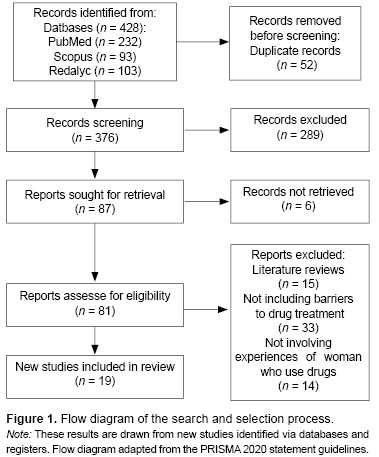
The nineteen included studies revealed a complex, interconnected network of barriers. Stigma, both experienced and anticipated, emerged as a central, pervasive theme influencing almost all other barriers. This stigma was directly related to specific psychosocial barriers, such as loss of child custody, and exacerbated by tangible structural barriers, such as lack of financial and logistical access to services. The study selection flow chart is illustrated in Figure 1 (Haddaway et al., 2022).
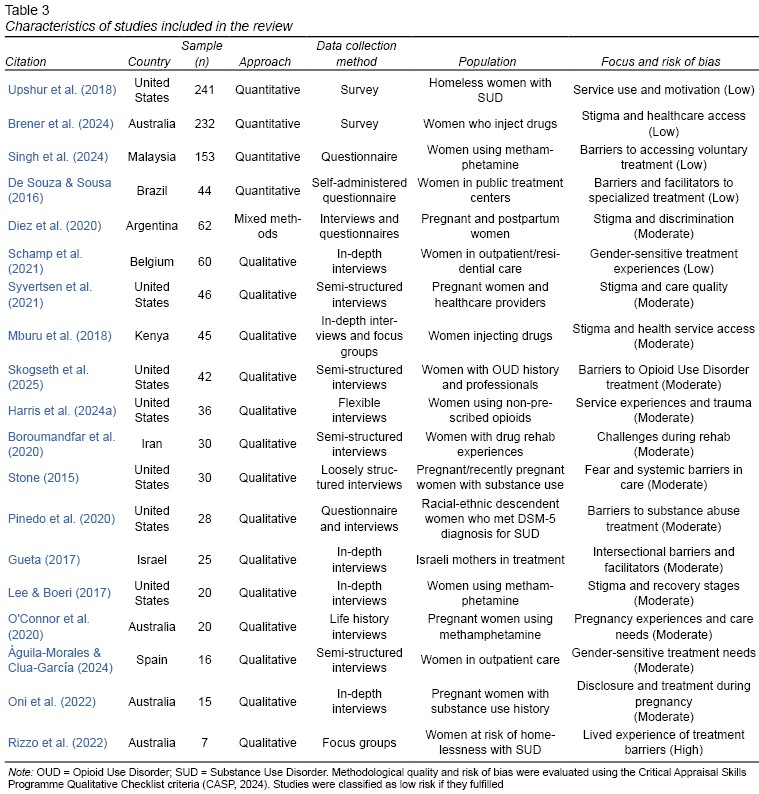
Most studies focused specifically on marginalized or high-risk subgroups, including pregnant women, women experiencing homelessness, and women who use opioids or methamphetamine. The inclusion of diverse populations and methodological perspectives strengthens the collective findings, providing a comprehensive foundation for the development of gender-responsive and accessible treatment interventions tailored to women’s unique experiences and needs.
Across these investigations, the central focus remained consistent: to identify, understand, and contextualize the barriers women face in accessing effective substance use treatment, providing a comprehensive foundation for developing gender-responsive interventions (see Table 3 for study characteristics and risk of bias assessment).
Stigma from healthcare providers and internalized stigma
The phenomenon of stigma, as experienced by individuals within the healthcare system, can be further categorized into two distinct types: that which is imposed by healthcare providers, and that which is internalized by the individual. Anticipated and experienced stigma emerged as one of the most persistent barriers to substance use treatment for women.
As Syvertsen et al. (2021) noted, structural stigma undermined access to and the quality of care for women with opioid misuse. This is further compounded by anticipated stigma, the mechanism that translates societal disapproval into individual avoidance. The fear itself becomes the barrier. This finding is consistent with the observations of Mburu et al. (2018), who underscored the social exclusion and low self-esteem experienced by women who inject drugs in Kenya. These women face multiple stigmas, contributing to delayed or denied access to health services. Several studies have emphasized the compounding nature of societal and self-stigma, underscoring the need for trauma-informed and nonjudgmental approaches in care delivery (e.g., Oni et al., 2022; Brener et al., 2024).
Emotional and psychological barriers
Another commonly cited barrier is the fear of child protection involvement, a sentiment particularly prevalent among pregnant or parenting women. Stone (2015) and Oni et al. (2022) both reported that women feared detection and the subsequent involvement of child protective services, which discouraged disclosure and help-seeking. This apprehension was exacerbated by the perception of limited treatment options and inadequate provider support. Similarly, Gueta (2017) and Schamp et al. (2021) found that the threat of custody loss fostered mistrust in social and medical institutions, hampering treatment access and retention.
Psychosocial and emotional challenges emerged as both barriers and outcomes of substance use. O’Connor et al. (2020) reported domestic violence, mental health concerns, and childhood trauma issues among a sample of pregnant methamphetamine users. In such cases, stigma was closely intertwined with legal and familial consequences, thereby reinforcing a cycle of avoidance and secrecy. In addition, depression has been identified as an internal barrier that is as powerful as financial barriers (Upshur et al., 2018).
Structural and system-level barriers
Structural barriers also featured prominently in the data. Skogseth et al. (2025) identified financial constraints, transportation difficulties, and limited treatment availability as key obstacles to accessing medications for opioid use disorder. Singh et al. (2024) found that women using methamphetamine often lacked knowledge of how to seek treatment and cited long enrollment times as a deterrent. Furthermore, logistical and geographic issues, such as the limited availability of treatment centers for pregnant women (Stone, 2015), underscore the persistent challenge of physical access as a significant barrier. These findings were echoed by Rizzo et al. (2022), who observed limited program availability and low health literacy among homeless women.
Similarly, although women with substance use disorders have high rates of psychiatric comorbidity, the primary care system consistently fails to detect these needs. Research indicates an alarming gap: while a majority of women express a willingness to discuss their substance use problems with general practitioners, fewer than half are asked about them by their providers (Upshur et al., 2018).
Sociocultural and family dynamics
The treatment pathways of women were also influenced by cultural and familial factors. In the study by Águila-Morales & Clua-García (2024), women reported vulnerabilities such as exposure to violence and stigma, while also expressing motivation for change. Singh et al. (2024) reported family rejection as a key barrier. Likewise, De Souza & Sousa (2016) underscored the significance of psychological support, observing that women frequently initiate treatment on the encouragement of their families and subsequently experience changes in self-esteem post-treatment. However, cultural taboos (Diez et al., 2020) can obstruct self-care and reinforce discrimination, especially among expectant and new mothers. Pinedo et al. (2020) found that compared to Black and White women, Latinas reported more cultural and attitudinal barriers, including fear of judgment by family members. According to Boroumandfar and colleagues (2020), familial rejection and intrafamily conflict represent significant obstacles to sustainable rehabilitation. These challenges frequently coincide with structural and emotional barriers, thereby impeding the recovery process.
DISCUSSION AND CONCLUSION
This literature review aimed to understand the treatment access and engagement experiences of female drug users from their own perspectives, focusing on social, structural, and personal factors. After systematically reviewing 19 empirical studies from around the world, this study confirms that the barriers women face are not isolated incidents, but rather a systemic constellation of factors. The findings consistently identified three main categories of barriers: (1) pervasive stigma at the structural, healthcare, and internalized levels; (2) critical psychosocial fears, primarily and overwhelmingly the fear of losing custody of their children; and (3) a network of structural impediments, including lack of childcare services, costs, and transportation logistics. Our findings demonstrate that these barriers intersect and reinforce each other. For example, structural stigma in health services reinforces women’s fear of disclosure, preventing them from overcoming structural barriers.
The research therefore underscores the importance of promoting gender-sensitive, trauma-informed care, as well as accessible institutions and supportive family networks. Comprehensive treatment requires recognizing and addressing women’s unique needs and experiences. To achieve this, specific strategies must be implemented. Substance abuse treatment for women must be personalized as much as possible. All-female treatment groups tend to be more responsive to the needs of women as parents and partners (Wang et al., 2023).
Women could benefit from accessible treatment models that address their unique experiences, especially those related to caregiving, parenting, self-esteem, trauma, relationships, and social vulnerability. All interventions must detect and address co-occurring mental health disorders, such as depression, anxiety, and PTSD, and provide integrated care approaches that attend to women’s substance abuse and mental health issues simultaneously (Marsh et al., 2021).
At the same time, structural factors, including poverty, financial stress, and inadequate or unaffordable housing, pose significant obstacles to accessing care. Rizzo et al. (2022) suggested addressing these barriers by providing women with knowledge of systems and services to enable them to make informed choices. For their part, Skogseth et al. (2025) proposed transportation support and flexible treatment delivery. Syvertsen et al. (2021) stated that coordinated drug treatment, prenatal care, and wraparound services can break down these barriers.
To make treatment more accessible for women, an additional strategy is to provide childcare or support services for mothers to enable their participation in programs. Harris et al. (2024a) stated that services were neither safe nor designed to accommodate children. Similarly, Schamp et al. (2021) found that nearly all female substance users view the lack of outpatient and residential facilities offering childcare as a significant obstacle to substance abuse treatment. This is particularly relevant for women, as most of them are primary caregivers.
Female drug users face greater stigmatization than their male counterparts (Lee & Boeri, 2017). Creating a supportive, nonjudgmental treatment environment validates women’s experiences, reducing feelings of stigma and shame. Gueta (2017) recommended non-judgmental referral procedures to improve access to services, and Wang et al. (2023) suggested training healthcare providers in trauma-informed care to reduce stigmatization. Brener et al. (2024) recommended co-designing anti-stigma campaigns with women who use drugs to ensure cultural relevance. Open dialogue about gender-related issues and education on the biological, psychological, and social factors contributing to addiction are crucial to reducing the barriers women face when seeking treatment.
Singh et al. (2024) suggested addressing women’s perceptions of their drug use and increasing family support to enhance participation in voluntary programs. Engaging families, partners, and other support systems in the treatment process by offering family therapy and support groups while recognizing their potential roles in supporting recovery could help loved ones understand addiction and develop healthy coping strategies.
The most important contributions of the reviewed papers are their proposed strategies to reduce barriers. Qualitative studies also underscore the need for policies prioritizing social determinants of health. These policies should create safe, supportive environments, understand the impact of trauma on behavior, and provide interventions that promote healing and empowerment, especially for women. Future research should explore the long-term outcomes of integrated care models and amplify underrepresented voices.
In conclusion, this systematic review demonstrates that, for women who use drugs, barriers to treatment are not a reflection of personal shortcomings but rather or systemic failures. The findings show that stigma, structural deficiencies, and psychosocial fears intersect, creating an almost impenetrable wall to access care. To move forward, effective intervention cannot focus solely on substance use but must dismantle the stigma and systems that punish women for seeking help. This requires a paradigm shift from a punitive public health model to one that is genuinely supportive, trauma-informed, and gender-sensitive.
Limitations
Although this systematic review provides a comprehensive synthesis of barriers to treatment, its findings must be interpreted within the context of limitations, of both the included primary studies and the review process itself. A primary limitation is the predominant use of self-reported data, since, as noted by several authors (e.g., Skogseth et al., 2025; Brener et al., 2024), this method is susceptible to social desirability biases. Many studies had limited generalizability due to their small, non-representative samples and recruitment bias. Participants were often sourced from treatment centers or support groups (e.g., Mburu et al., 2018; Lee & Boeri, 2017). This methodology systematically excludes the most marginalized women with no access to care, likely underestimating the severity and scope of barriers for the general population.
This review is also subject to its own constraints. The final sample of studies was heavily concentrated in high-income settings (e.g., the United States and Australia) with specific healthcare and harm-reduction infrastructures. This limits the generalizability of the findings to low- and middle-income countries (e.g., Mexico), where structural and cultural barriers may differ substantially and health services are limited.
The search was restricted to articles in English and Spanish, potentially omitting relevant research published in other languages. Despite these limitations, the strong consistency of core themes across diverse geographic and methodological boundaries strengthens the overall conclusions. This review identifies critical gaps for future research, which should prioritize intersectional frameworks and longitudinal designs to better capture the experiences of underrepresented women.