INTRODUCTION
Severe psychiatric disorders (SPD) are conditions that affect thinking, cognition, mood, emotion regulation, and behavior as well as the ability to establish healthy interpersonal relationships and develop functional abilities in key aspects of daily life. These include personal hygiene, self-care, autonomy, learning, leisure/entertainment, and economic self-reliance (López & Ots, 2017). The International Classification of Diseases 11th Revision (ICD-11) includes schizophrenia, schizotypal and delusional disorders, mood and bipolar disorders, neurotic disorders, stress-related disorders and somatoform disorders in the SMD section (Organización Mundial de la Salud [OMS], 2019).
According to the World Health Organization (WHO), during the period 2019-2020, one in eight people worldwide suffered from an SPD, affecting nearly 450 million people. In Mexico, there are reported to be approximately 15.7 million people with a mental disorder (Medina-Mora et al., 2023).
Moreover, when assessed with neuropsychological tests, patients with SPD present significant deficiencies in the domains of attention, memory, executive function, and social cognition (SC), the set of cognitive skills required for social interaction. The latter include the perception, interpretation, and generation of responses required to determine one’s own and other people’s intentions, disposition, and behaviors (Frith & Frith, 2007; Kim & Hommel, 2019). Researchers have also reported difficulties in the emotional processing, attributional style, and theory of mind domains of social cognition in patients with SPD. These are evaluated with tests such as the MSCEIT, Reading the Mind in the Eyes Test and Faux Pas Recognition Test (Kittel et al., 2022; Knight & Baune, 2019;Vlad et al., 2018).Despite advances in the measurement of social cognition, core domains such as social perception and knowledge remain underexplored due to the limited availability of standardized, validated tools. It was therefore proposed to evaluate the aforementioned components in the social cognition construct with tests containing items with social content as in the Wechsler intelligence scales (Wechsler, 1955; Wechsler, 1997). The Wechsler subscales of Comprehension and Picture Arrangement are designed to assess aspects of common sense, knowledge of conventional norms of behavior, sequential thinking and interpretation of socio-affective situations (Ramírez & Rosas, 2007). Neuroanatomical correlates of these subtests have even been found in neuroimaging studies of the orbitofrontal region in individuals with and without SPD (Nestor et al., 2010; Nestor et al., 2013).
Exploratory factor analyses of the Wechsler scales have identified the Full-Scale IQ and indexes of Verbal Comprehension (VC), Perceptual Organization (PO), Working Memory (WM), and Processing Speed (PS). These scales yield valuable information on intellectual abilities and cognitive information processing in various populations and clinical settings. However, confirmatory factor analyses (CFA) have also been undertaken to identify an additional index associated with social cognition (SC). Allen and Barchard (2009) conducted a confirmatory factor analysis (CFA) of the 14 subtests in the WAIS-III and the 11 subtests in the WAIS on the standardization sample of the instrument in the United States, comprising 2450 subjects. The results of this research demonstrated a good fit of the data to the five-factor model that includes the social cognition factor together with the verbal comprehension, perceptual organization, working memory, and processing speed factors. The social cognition factor consisted of the Pictures Arrangement (PA), Picture Completion (PC), and Object Assembly (OA) subtests when the 14 WAIS-III subtests were analyzed. When the 11 WAIS subtests were examined, the CFA yielded a model consisting of four factors including the social cognition factor comprising the picture arrangement and picture completion subtests. These results supported the construct validity of the social cognition factor measured using the Wechsler scales. Allen et al. (2007) administered the WAIS to 169 men with schizophrenia, performing a CFA to determine the presence of the four-factor model that included the social cognition factor and the typical indices of verbal comprehension, perceptual organization and working memory. The social cognition factor in this study consisted of the picture arrangement and picture completion subtests, which in turn showed significant correlations with the negative symptoms of this condition. Finally, Goldstein et al., (2008) conducted a CFA of the 11 subtests of the WISC and WAIS on 137 children and 118 adults with high-functioning autism spectrum disorder (ASD). The aim was to determine whether factor models with the social intelligence or social cognition factor could be found in those with ASD and a group of healthy subjects. The results of this study confirmed that the four-factor model incorporating the social intelligence or social cognition factor provided the best fit for both the ASD and healthy subjects groups.
The studies mentioned above corroborate the existence of the social cognition construct in healthy subjects, and patients with schizophrenia and or ASD. However, it is still necessary to evaluate the stability and sensitivity of this factorial model in other clinical populations with various forms of brain dysfunction and complications in social interaction. To our knowledge, no research has been conducted to identify the social cognition factor in SPD using the Wechsler scales. The present study aimed to evaluate the factorial validity of a social cognition construct using the WAIS and WAIS-III subtests in patients with severe psychiatric disorders through confirmatory factor analysis (CFA). Additionally, verbal comprehension, perceptual organization, working memory and social cognition factors in various SPD groups were compared. The WAIS and WAIS-III are validated, standardized instruments with appropriate psychometric properties widely used in the neuropsychological evaluation of patients with psychiatric conditions. We therefore consider that assessing the factor structure of these instruments including the social cognition factor could enhance understanding of cognitive functions in SPD.
METHOD
Study design
A non-experimental, quantitative, cross-sectional study was conducted with a non-probabilistic sample of 291 SMD patients and 37 control subjects ages 18 to 47.
Participants
A non-probability sample of 291 SPD patients was evaluated. Seventy-one had had been diagnosed with schizophrenia (SZ), 98 with Bipolar I and Bipolar II disorder (BD), 67 with major depressive disorder (MDD) with and without psychotic symptoms and 55 with obsessive-compulsive disorder (OCD). The control group comprised a sample of 37 healthy subjects without neurological or psychiatric conditions. Participants in the SPD sample were patients from a mental health institute in the south of Mexico City. Diagnoses were established by psychiatrists according to DSM-IV (American Psychiatric Association [APA], 1994) and DSM-5 (APA, 2014) diagnostic criteria and patients were symptomatically stable and adherent to pharmacological treatment at the time of evaluation. Diagnoses were cross-verified to ensure comparability across DSM-IV and DSM-5 criteria. Subjects in the control group were recruited by invitation to participate in this research and did not present neurological or psychiatric conditions.
Measurements
The Wechsler Adult Intelligence Scale (WAIS) (Wechsler, 1973) and the Wechsler Adult Intelligence Scale-III (WAIS-III) (Weschler, 2003). These scales were designed to measure the intelligence quotient (IQ) of adults aged between 16 and 80. They consist of two scales (verbal and performance), each containing more specific subtests which, in turn, comprise items organized by increasing level of difficulty. Both scales share verbal and performance subtests. The verbal subtests are 1) Information, which explores the subject’s general knowledge; 2) Comprehension, which evaluates the subject’s logical and conventional judgment in solving hypothetical social problems and is related to the ability to appraise and understand social situations and norms; 3) Arithmetic, which measures concentration and numerical skills as well as problem-solving through numerical operations; 4) Digit Span, which assesses attention-concentration as well as immediate memory; 5) Similarities, which measures the ability to abstract, conceptualize, and generalize, as well as the type of thinking: concrete, functional, or abstract; and 6) Vocabulary, which measures the subject’s linguistic repertoire and general language proficiency. The performance subtests are 1) Picture Arrangement, which evaluates visual organization, sequential thinking, common sense, and causal relationships in hypothetical socio-affective situations; 2) Picture Completion, which assesses visual organization and concentration as well as the ability to discriminate between essential and non-essential elements; 3) Block Design, which measures visuomotor coordination, visuospatial perception, and the ability to analyze and synthesize visually; 4) Object Assembly, which measures visuomotor coordination, planning, and visual synthesis ability; and 5) Symbol Search, which evaluates learning ability, visual memory, visuomotor coordination, and psychomotor speed. Both the WAIS and WAIS-III were used based on their shared core of 11 subtests, which formed the basis of the factorial model analyzed in this study.
Procedure
For the SPD group, the assessment instruments were administered and scored by neuropsychologists specializing in the evaluation of patients with psychiatric disorders during the period 2014-2024. The control group was evaluated by seventh semester psychology students from a university in Mexico City. The evaluations were conducted during four weekly one-hour sessions for the patients and two weekly one-hour sessions for the control group. They were conducted on the days the patients attended the outpatient clinic at the mental health institute. The tests were scored, and the standardized test scores tabulated in Excel for subsequent statistical analysis.
Statistical analysis
All statistical tests were performed using the Statistical Package for Social Sciences (SPSS),version 22.0 (IBM Corp., 2013). The normal distribution of the sample was analyzed using the Kolmogorov-Smirnov test and Levene’s test of homogeneity of variance. Frequency analyses and descriptive statistics were also performed for the sociodemographic data. The 4-factor model as reported in the Allen and Barchard (2009) study was evaluated with a CFA using AMOS SPSS version 22.0 (IBM Corp., 2013), including the 11 subscales shared by the WAIS and WAIS-III. This 4-factor model included the factors of verbal comprehension, perceptual organization, working memory and social cognition. Confirmatory factor analysis (CFA) is a statistical technique used to analyze the degree to which a set of theoretically organized factors matches the data (Martínez & Sepúlveda, (2012). The following fit indicators were analyzed: a) chi-square (χ²) less than 5, b) a comparative fit index (CFI) equal to or greater than .95, c) a goodness-of-fit index (GFI) equal to or greater than .90, and d) a root mean square error of approximation (RMSEA) equal to or less than .05 (Browne & Cudeck, 1993; Hu & Bentler, 1999). In addition, a multivariate analysis of variance (MANOVA) was performed to evaluate the effect of the groups on various dependent variables (the verbal comprehension, perceptual organization, working memory and social cognition factors), with a priori Bonferroni contrasts considering a significance level of p < .05.
Ethical considerations
Procedures were approved by the National Institute of Psychiatry Ethics and Research Committee, permit No. 2330. All participants read and signed a consent form before completing the assessment. They were not required to provide confidential data such as addresses or telephone numbers and were informed they could drop out of the study or stop answering the questions at any time.
RESULTS
The normal distribution of the sample and homogeneity of variance were confirmed for the statistical analyses. The socio-demographic characteristics of the sample are presented in Table 1. The sample of patients with SPD consisted of 291 subjects. The group of patients diagnosed with schizophrenia (SZ) included 28 women (M = 33.90 years, SD = 12.16) and 43 men (M = 31.58 years, SD = 11.82). The group of patients diagnosed with bipolar disorder (BD) included 65 women (M = 31.12 years, SD = 14.06) and 33 men (M = 32.88 years, SD = 14.90). The group of patients diagnosed with major depressive disorder (MDD) consisted of 45 females (M = 32.64 years, SD = 11.41) and 22 males (M = 34.41 years, SD = 13.13). The group of patients diagnosed with obsessive-compulsive disorder (OCD) included 31 women (M = 34.25 years, SD = 12.54) and 24 men (M = 32.17 years, SD = 11.89). The control group sample consisted of 37 subjects, including 25 women (M = 35.65 years, SD = 11.68) and 12 men (M = 36.50 years, SD = 10.12).
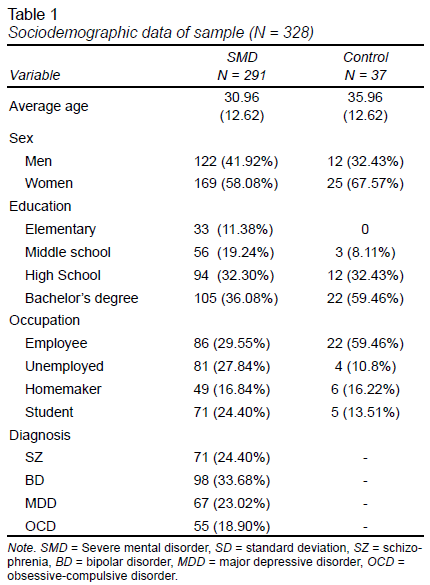
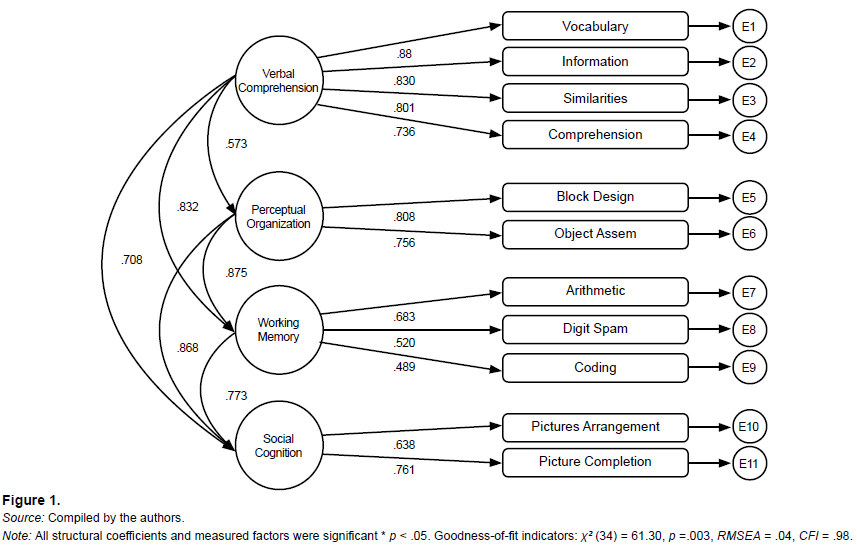
Confirmatory Factor Analysis (CFA) demonstrated significant, high factor loadings (p < .05) ranging from.48 to .88. The model showed a four-factor factor structure supported by statistical goodness-of-fit indicators (χ2 (34) = 61.30, p = .003), a Comparative Fit Index (CFI) of .98, a Goodness-of-Fit Index (GFI) of .96, a root mean square error of approximation (RMSEA) of .04 and an Akaike Information Criterion (AIC) of 125.30. The RMSEA of .04 and CFE of .98 indicate excellent model fit, supporting the robustness of the four-factor structure.
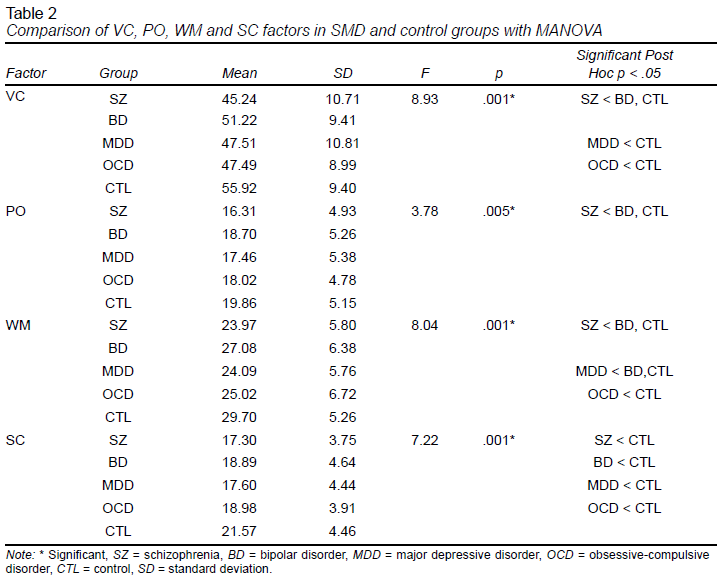
Multivariate effects (MANOVA) were observed for the Verbal Comprehension (VC), Perceptual Organization (PO), Working Memory (WM) and Social Cognition (SC) factors (Pillai’s trace: F = 3.42 (16), p < .001), between the patient and control groups. The results of this analysis are shown in Table 2 with a priori contrasts. Statistically significant differences were observed in all factors of the model. For the Verbal Comprehension (VC) and Perceptual Organization (PO) factors, the SZ group showed significant differences from the BD and control groups (F = 3.78 (4), p = .005). The MDD and OCD groups had lower scores than the control group in the Verbal Comprehension (VC) factor (F = 8.93 (4), p = .001). In the Working Memory (WM) factor, the SZ, MDD and OCD groups presented lower scores than the BD and control groups (F = 8.04 (4), p = .001). Finally, in the Social Cognition (SC) factor, it was observed that all the SPD groups exhibited significantly lower scores than the control group (F = 7.22 (4), p = .001). The BD group showed no significant differences in the Verbal Comprehension (VC), Perceptual Organization (PO) or Working Memory (WM) factors compared to the control group.
DISCUSSION AND CONCLUSION
The aim of the present study was to identify the Social Cognition (SC) factor in a sample of SPD patients using the WAIS and WAIS-III subtests with CFA and to compare the model factors in the SPD groups. The CFA of the 11 subtests shared by the WAIS and WAIS-III supported a four-factor model comprising the Verbal Comprehension (VC), Perceptual Organization (PO), Working Memory (WM) and Social Cognition (SC) factors. The Social Cognition (SC) factor comprised the Picture Arrangement (PA) and Picture Completion (PC) subtests. To our knowledge, this is the first study to identify the Social Cognition (SC) factor for the subscales shared by the WAIS and WAIS-III in patients with SPD. It is also one of the few to have used factor analysis to identify this construct as a separate factor from non-social verbal and visuospatial cognitive processes in this population. It should be noted that it had previously been identified using CFA in patients with schizophrenia (Allen et al., 2007) and autism spectrum disorder (ASD) (Goldstein et al., 2008). However, it had not yet been identified in a broader sample of patients with SPD that included conditions such as BD, MDD and OCD. This is relevant as it validates the use of factor analysis for the WAIS and WAIS-III subtests in clinical contexts.
As discussed earlier, the Social Cognition (SC) factor in this study comprised two subtests with social content. Each of them had relatively high loading for the SC factor (> .60). This factor loading, together with adequate model fit, support the construct validity of the SC factor gauged with WAIS and WAIS-III. This is significant because in the most recent versions of the Wechsler scales, such as the WAIS-IV (Wechsler, 2012), the Picture Arrangement subtests have been removed, while new subtests such as Visual Puzzles, Figure Weights, and Cancellation have been added. These new subtests examine the ability to analyze and synthesize abstract visual stimuli, nonverbal reasoning, quantitative reasoning, and processing speed. We therefore consider that the removal of the Picture Arrangement subtest in the WAIS-IV could limit the assessment of certain aspects of social cognition. These include visual sequencing of social events, which are extremely useful in both clinical and forensic settings (Nestor et al., 2010; Nestor et al., 2013).
Assessing the Social Cognition (SC) construct with the WAIS and WAIS-III Picture Arrangement (PA) and Picture Completion (PC) subtests allows us to evaluate the social perception and social cognition domains within the Social Cognition (SC) construct. These domains have not been the specific assessment target of other instruments to gauge theory of mind, emotional perception, and attributional bias. Examples include the Reading the Mind in the Eyes Test (RMET), the Facial Emotion and Identification Test (FEIT), the Mayer-Salovey-Caruso Emotional Intelligence Test (MSCEIT), the Emotion Processing Test, and the Ambiguous Intentions Hostility Questionnaire (AIHQ) (Vlad et al., 2018).
According to Allen et al., (2007) and Green et al., (2005), the picture arrangement and picture completion subtests require the analysis of simple line drawings representing social situations, people and objects and the identification of specific details. The social content of the picture arrangement and certain details of the picture completion subtest require knowledge of common social situations. The social construct consisting of the picture arrangement and completion subtests therefore comprises the domains of social perception and social knowledge that interact closely to understand social situations and interpret socio-affective signals.
It would be interesting for future research to examine the results obtained in Social Cognition (SC) assessment instruments including this construct with the WAIS and WAIS-III subtests. This would enhance the understanding of the integrity or impairment of social cognitive processes in patients with psychiatric conditions. who may perform adequately in certain Social Cognition (SC) domains yet experience severe impairment in social functioning. This could be due to impaired skills in other social cognition domains depending on the specific situational demands as well as the chronicity or evolution of the condition (Allen et al. , 2007). The results of this research support the proposal of Allen et al., (2007), Nestor et al., (2010), and Castañeda et al., (2009). These authors suggest using the Wechsler scales to study social cognition in patients with psychiatric disorders with the Comprehension and Picture Arrangement subtests that can be used in neuropsychological settings.
This study provided additional information by comparing the scores of the Verbal Comprehension (VC), Perceptual Organization (PO), Working Memory (WM), and Social Cognition (SC) factors between the SPD groups and a control group. Scores obtained in the Social Cognition (SC) factor were significantly lower in all four clinical groups, SZ, BD, MDD, and OCD, compared to the control group. They were also significantly lower than the scores obtained in the verbal comprehension, perceptual organization, and working memory factors. These findings suggest that the Social Cognition (SC) factor may be sensitive to neurocognitive deficits across clinical groups. Neuroimaging techniques used to explore Social Cognition (SC) in various neuropsychiatric disorders provide evidence associating the activity and dysfunction of the orbital prefrontal network with the amygdala and dorsal cingulate gyrus. This has been observed in both healthy subjects and patients with autism, depression, schizophrenia and post-traumatic stress disorder (Grady & Keightley, 2002; Salehinejad et al., 2021). It has been corroborated by studies using these techniques and the WAIS Picture Arrangement and Comprehension subtests, which have observed the same brain structures involved in Social Cognition (SC) processes (Nestor et al., 2010; Nestor et al., 2013). Future lines of research should investigate the relationship between the Social Cognition (SC) construct assessed with the WAIS and WAIS-III and the results of neuroimaging studies in various psychiatric disorders to broaden the picture. It would also be useful to design and explore the effect of specific interventions for social cognition, a crucial aspect for the well-being and social integration of these patients.
Limitations of this study include the following. First, we did not assess the relationship of the model factors with behavioral, functional evaluations of daily life or quality of life to determine the relation with psychosocial disability in SPD. Second, we did not undertake a qualitative analysis of the stories patients can create when interpreting the Picture Arrangement subtest. This would have enabled us to identify specific failures such as the type of confabulations or overinterpretations between different SPD, since patients do not interpret social situations in the same way (Green et al., 2015; Lee et al., 2013).
In conclusion, this study highlights the importance of using validated instruments such as the Wechsler scales (WAIS and WAIS-III) to evaluate social cognition in clinical settings. It underlines the need to include the assessment of this construct in neuropsychological test batteries. It stresses the value of researching the social cognition construct assessed with WAIS and WAIS-III in patients with other types of pathologies such as personality disorders, neurodevelopmental disorders and psychopathy. Finally, it is important to consider this type of results in the development of specific rehabilitation strategies that could facilitate effective social reintegration.