INTRODUCTION
Medicine, historically built on a patriarchal structure, continues to reproduce gender inequalities, affecting the professional training of its practitioners (Esteban, 2006; Federici et al., 2010; Villanueva, 2023). Although the feminization of medical schools has increased in recent decades, this shift has not been accompanied by a substantial transformation of dominant professional practices. Rather, it primarily reflects the growing number of female students and graduates without challenging the underlying power dynamics (Wiedmann et al., 2023). Hegemonic masculinity, defined as a set of practices that legitimize and reproduce the dominance of men over women and subordinate masculinities (Connell, 1995), serves as a cultural standard that shapes professional education and clinical practice, perpetuating stereotypes that disproportionately affect women (Sharma, 2019; Villanueva, 2023). This model reproduces inequalities and symbolic violence within the medical field (Frias & Erviti, 2012).
From Bourdieu’s perspective (2007), this model is internalized through the medical habitus, embodied dispositions shaped by professional socialization. Structured within a hierarchical field, this habitus reflects symbolic capital tied to hegemonic masculinity, which grants recognition, authority, and legitimacy. Medical students therefore not only acquire clinical knowledge but also gendered ways of acting and relating that reinforce dominant norms. This dynamic legitimizes hierarchy without coercion, enacting symbolic violence and pressuring those who deviate to conform, thereby reproducing gender inequality as professional neutrality (Bourdieu, 2007).
This study focuses on the experiences of students in the Undergraduate Medical Internship (UMI) undertaken during the last year of the medical degree, a theoretical-practical academic cycle completed in clinical fields forming part of the Bachelor of Medicine core curriculum, according to the Secretaría de Salud de México (SSA, 2023). It is an essential stage due to its formative and critical nature for medical careers, as it constitutes the transition between theoretical learning and clinical practice, a period when students directly encounter hospital dynamics, characterized by strict hierarchies, unequal power relations, and stringent demands (Villanueva, 2019).
These conditions make them a particularly vulnerable group to abuses of power, including forms of gender-based violence. In Mexico, it has been reported that during the UMI, 71% of medical students did not have their mealtimes respected by the authorities; 25% were subjected to harassment; 35% were exposed to violence and abuse, and a further 35% were victims of discrimination (Fuentes et al., 2015). A prevalence of 83% of sexual harassment was recently identified in this population, which was higher in women (89.4%) than men (71.4%) (Granados et al., 2024). This context of vulnerability has been found to be associated with the deterioration of student mental health, including high rates of depression (Anderson et al., 2022; Ayala-Burboa et al., 2024; Vilchez et al., 2020) and even suicidal ideation (Ayala-Burboa et al., 2024).
UMI is also a key point in the construction of medical identity, since it is during this stage that students internalize the norms and values that will define their professional practice. This socialization process is heavily shaped by patriarchal structures that perpetuate a masculinized medical identity, leading to the systematic exclusion and devaluation of women, especially those in training, and of non-hegemonic forms of masculinity within the medical field (Sharma, 2019; Villanueva, 2023). International studies have shown that the perception of the doctor as a male authority figure limits women’s learning and leadership opportunities, even in contexts where they have the same or more training than their male colleagues (Overland et al., 2019; Sánchez et al., 2024).
Given the evidence that patriarchal structures perpetuating a masculinized medical field affect the professional training of male and female physicians by consolidating inequalities that persist in medical practice (Fnais et al., 2014; Sharma, 2019), it is essential to explore how hegemonic masculinity influences the construction of medical identity among male and female students during the UMI. Exploring the experiences of this group makes it possible to identify the factors that perpetuate inequalities and generate knowledge to inform institutional policies and practices aimed at transforming medical culture. This could contribute to proposing strategies to mitigate negative impacts on student well-being, and promote a more equitable and inclusive environment from the earliest stages of training (Chávez et al., 2016; Granados et al., 2024).
METHOD
Study desing
Interpretative Phenomenological Analysis (IPA) was selected as it facilitates an in-depth exploration of the subjective experiences of Undergraduate Medical Interns (UMIs), focusing on the meanings they assign to their lived experiences (Creswell, 2017; Duque & Aristizábal, 2019; Smith et al., 2009). Rooted in Husserl’s phenomenology, IPA emphasizes the analysis of individual perspectives on specific events (Fuster, 2019; Husserl, 1982). This study adhered to the methodological guidelines proposed by Smith et al. (2009).
IPA is particularly suited to the UMI context, which is marked by emotional challenges, hierarchical dynamics, and power abuse. It allows for both the description and interpretation of experiences, situating them within the institutional and cultural framework of medicine, and integrating individual narratives with shared social meanings to illustrate power dynamics.
Participants
Participants were selected via purposive sampling to identify those with relevant, direct experience of the phenomenon (Smith et al., 2009). Inclusion criteria were voluntary participation; being aged over 18; and having completed the UMI at a Mexican public hospital within the year prior to data collection. This ensured recent recall while avoiding administrative ties that might limit free expression. The number of participants was determined based on the criterion of theoretical saturation.
Procedure
Informants were recruited through both a virtual and an in-person call for participation.
For the virtual call, a Facebook group of former medical interns was identified, and an invitation posted with the administrator’s approval. It included the study’s objective, eligibility criteria, participation method, confidentiality assurances, and the principal investigator’s email. The use of digital platforms expanded the study’s geographical reach, overcoming travel and cost barriers while incorporating diverse perspectives. It also offered greater flexibility regarding time and location for participation.
For the in-person call to participate, permission was requested from the Health Services of a state in central Mexico. Once granted, eight medical units were visited, and six information sessions were held to personally invite students to participate in the study. The in-person recruitment strategy complemented the virtual call and contributed to achieving an adequate number of participants for the study’s objectives. This approach enabled direct engagement in relevant settings, enhancing both study dissemination and recruitment.
Of those who were invited virtually, 15 contacted the researcher, eight of whom participated in an interview. Regarding the face-to-face invitation, 82 personal invitations were made, 15 of which resulted in an interview.
A semi-structured interview was conducted, as this technique allows sensitive topics to be addressed and provides a deep understanding from the perspective of those involved (Balcazar et al., 2015). A semi-structured interview guide (Table 1) was developed based on the objective of the study and an extensive literature review. The guide outlined areas of inquiry to be explored but was flexible regarding sequence and content, as the interviewer was free to introduce additional questions to clarify concepts or gather more information. The areas of inquiry focused on participants’ recognition and interpretation of experiences of violence, their perceptions of gender and hierarchy, and the emotional and behavioral responses resulting from these experiences.
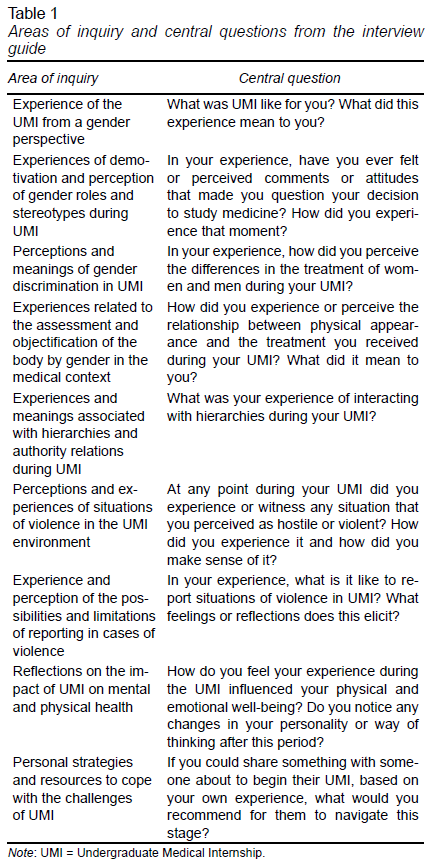
Because some topics could be sensitive for participants, or in case situations arose during the interview that required emotional support, the principal researcher and sole interviewer received training in psychological first aid. Likewise, if a participant requested advice or psychological support related to a particular situation, the appropriate information would be provided. No situations requiring emotional support occurred, nor were any requests for psychological assistance received after the interview. On the contrary, participants expressed gratitude for the opportunity to share their experiences.
All interviews, regardless of whether participants were recruited through a virtual or in-person call, were conducted remotely online, lasting between 60 and 90 minutes. All of them were audio-recorded, with the interviewee’s prior authorization, using a digital recorder. The files were stored in .mp3 format and transferred to a secure device for subsequent transcription and will be held by the principal investigator for five years and then deleted. To ensure confidentiality, participants were assigned alphanumeric codes, and quotes were adapted when necessary to prevent identification.
All interviews took place without incident. At the end of each interview, an informative infographic on how to identify gender violence in hospital settings was sent to participants’ personal emails, together with a directory of places to report cases of violence in any state in Mexico and a list of contact numbers for free online psychological support.
Analysis
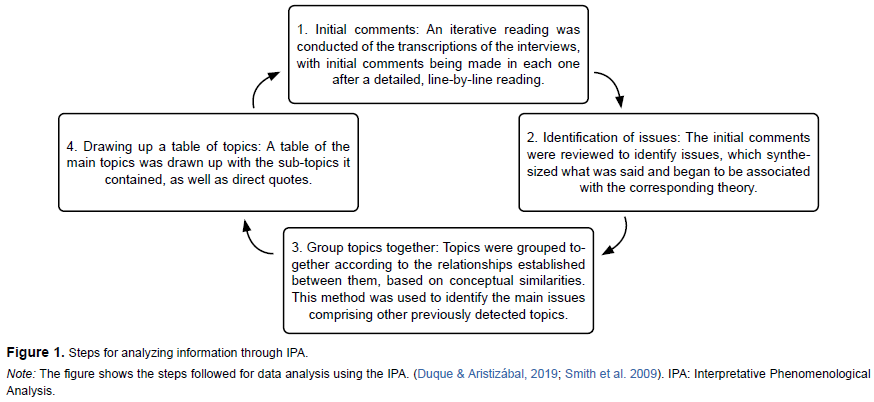
Data analysis was conducted using the IPA approach, which emphasizes the exploration of personal experiences by focusing on events that hold particular significance for those who undergo them. Theoretical saturation was reached through the identification of consistent reiterations, with no new relevant information emerging in consecutive interviews and the analytical process followed the stages outlined by Smith et al. (2009) and Duque & Aristizábal (2019) (Figure 1).
The audio-recorded interviews were transcribed verbatim by the principal investigator. Each transcript was then thoroughly reviewed to verify accuracy. The information was subsequently systematized using the qualitative analysis software ATLAS.ti 24, based on the following inclusion and exclusion criteria: inclusion criteria consisted of text fragments relevant to the research objectives; expressions of experiences, perceptions, emotions, or meanings related to the phenomenon; data that enriched thematic analysis; and recurring patterns or themes. Exclusion criteria included ambiguous comments or insufficient context, as well as fragments with comprehension issues or poor audio quality. Reflexivity was integrated into the analytical process through critical review of emerging categories with the co-author and constant comparison across cases, ensuring interpretative coherence and internal validation.
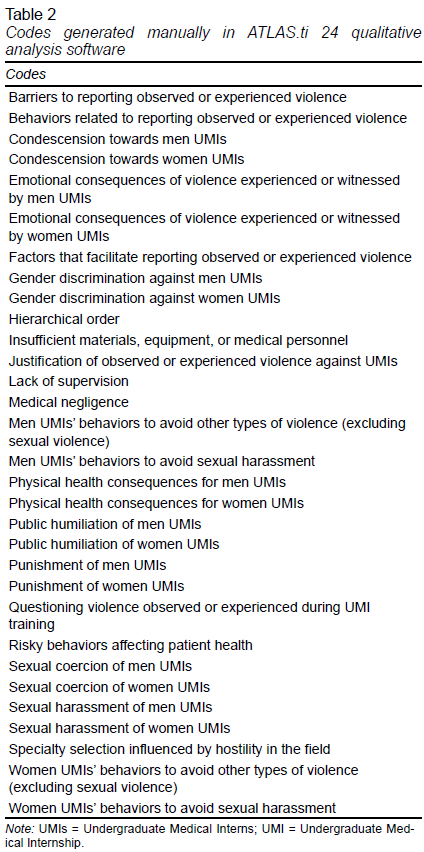
The coding strategy in ATLAS.ti 24 was performed manually, resulting in the creation of codes (Table 2). This process, aligned with the IPA approach, facilitated the systematic organization and rigorous analysis of qualitative data, ensuring both theoretical and conceptual coherence.
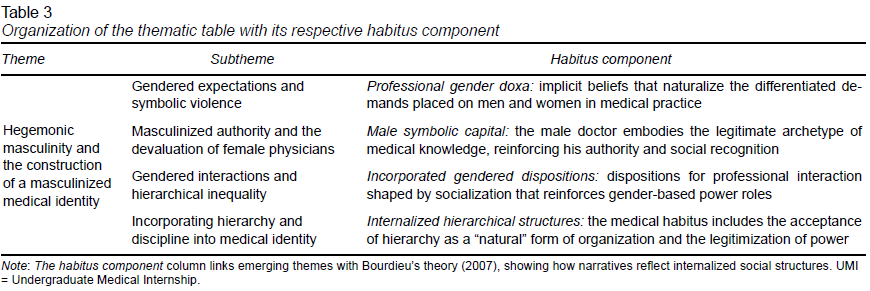
Following the IPA approach, the themes were organized and grouped based on their meaning or conceptual relationship. The analysis based on Bourdieu’s theory (2007) allowed the narratives to be interpreted as expressions of the medical habitus, understood as a system of internalized dispositions that normalize symbolic violence. This coding was carried out through thematic nodes (e.g., professional gender doxa, male symbolic capital) that connected emerging categories with Bourdieusian postulates. A thematic table (Table 3) was then created to summarize this structure, presenting the classification of the main themes and their corresponding subthemes. For this publication, only Theme 1 Hegemonic Masculinity and the Construction of a Masculinized Medical Identity and its subthemes were considered.
Ethical considerations
The study was approved by the Research Ethics Committee of the Ramón de la Fuente Muñiz National Institute of Psychiatry with registration number CONBIOETICA-09CEI-010-20170316, and approval number CEI/C/026/2022.
RESULTS
Twenty-three interviews were conducted with 10 men and 13 women (ages 23–29) who had completed their UMI in public hospitals across various Mexican states, primarily in the northwest and central regions. Testimonies were coded by participant number (P#), W (woman), and M (man). The analysis revealed that medical identity was shaped by gender traits and stereotypes associated with hegemonic masculinity. This identity was constructed through mechanisms that reproduced male hegemony, organized into four main categories:
Gendered expectations and symbolic violence
This category examines how gender shapes expectations and treatment in medical training, influencing learning and professional identity. Hegemonic masculinity legitimizes unequal standards, normalizes violence against men, and rewards female conformity through symbolic devaluation. These dynamics reinforce hierarchies, perpetuating gender stereotypes in medicine. This is exemplified in the following participant’s account:
The doctors made the men do more and kind of spoiled us: “Just do the rounds and you can go.” Men had to take notes, do lab tests, electrocardiograms, or dressings. In surgery, during wound care, women were allowed to go eat, but not the men.(P9M)
Paradoxically, although differential behavior towards women would seem to benefit them, it reduces the opportunities for learning and practice. The “benefits” UMIs women receive are related to expectations of conformity and submission that fail to recognize their professional capabilities. In fact, submission in the lower hierarchies is valued in the medical field as it contributes to the maintenance of the established order, with this conformity being associated with the stereotype of kindness, gentleness and servility that exists about women based on traditional femininity. This is reflected in this testimonial, “Since we were only women and never caused any problems, the doctors never had any complaints about us and with other male colleagues, it was not like that” (P6W).
These testimonies show how hegemonic masculinity shapes the treatment of UMIs, demanding more from men through verbal and physical violence on the assumption they should endure it. Women, in contrast, are spared physical abuse but face gendered forms of violence such as harassment. As one participant explained, “Some attendings still believe men must endure insults, hits, even slaps. With the girls, it was more about sexual harassment, touching, staring, caressing.” (P10H)
Differentiated treatment not only reproduces gender stereotypes but also normalizes hostility and reinforces hierarchy in medical training. The medical habitus incorporates gender expectations, giving more credibility to male voices while minimizing or invalidating female contributions. As one participant noted, “When we presented patients, some attendings would ask women extra questions, trying to make us slip up. Meanwhile, male peers got quick approval even when they explained less.” (P7M)
Masculinized authority and the devaluation of female physicians
This category examines how gender stereotypes shape the social representation of medical authority. The doctor is still perceived as male, influencing patient preferences and institutional dynamics. This perception undermines the legitimacy of female physicians, even when they hold higher hierarchical positions, reinforcing male dominance in professional recognition.
We were doing medical rounds: the attending, the resident, and I were all women, and there was a male student. The patient always addressed him: “Doctor, what will happen to me?”, ignoring the attending. I realized that if patients see a man, even a student, they assume he’s the doctor; if it’s a woman, they say, “young lady” or “girl.” (P7W)
This social perception reinforces hegemonic masculinity in medicine, perpetuating the idea of the doctor as a figure of male authority, and therefore once again, belittling women’s competence in this field.
In any rotation, even if we are both at the same level, a man and a woman, if a patient turns and sees us both, he nearly always prefers to speak to the man because it is sort of stigmatized: “He wants to see the (male) doctor” rather than a female one. I don’t agree with that because in the end, we are both equally qualified. (P2M)
In the medical field, symbolic capital, encompassing professional respect, access to leadership positions, and public or institutional recognition, is unequally distributed, favoring the visibility and recognition of men and affecting the self-perception of female doctors in training, who must therefore do more to prove their ability.
Gendered interactions and hierarchical inequality
This category explores how medical identity is shaped by interactions within the hospital hierarchy. Gender influences how UMIs are treated by other health professionals, particularly nurses, who tend to respond more attentively to male interns and overlook female interns, reinforcing their subordinate status. As one participant noted, “Nurses paid more attention to us than to female interns. I don’t know why, but I noticed: if you’re a woman, they ignore you; if you’re a man, they respond.” (P2M)
This dynamic shows how the habitus of the medical field incorporates gender into the hierarchy, reinforcing the dominant position of men. As a result, female UMIs begin to incorporate this gender power gap into their medical identity, assuming an inferior hierarchical status to their male peers.
Sometimes nurses were nicer to men: “Yes, doctor, I’ve got the material.” We women had to get it ourselves. I knew I couldn’t ask for anything. I learned to manage on my own, what to bring, how to prepare it. But with men it was: “Here’s the probe, the gel…” They treated them completely differently. (P6W)
Relationships with senior doctors also reflect gender bias. Some female senior doctors give preferential treatment to male UMIs, who in turn recognize this difference. As one participant observed, “The women gynecologists yelled at [female interns], made them run around, gave things back. But with male interns, it was: ‘Don’t worry, I’ll do it, you’ve got your hands full.’” (P9M)
These testimonials illustrate how the intersection between professional hierarchy and gender creates additional barriers for women in medicine, reflecting the persistence of hegemonic masculinity in power structures, which women themselves often reproduce.
Hegemonic masculinity shapes medical identity through gendered hierarchies. Within this logic, the “protective mantle” acts as relational capital that grants informal protection to women who conform to traditional gender roles. Women are protected but also sexualized; affective ties mediate access to opportunities, displacing technical knowledge and reinforcing stereotypes. This logic sustains symbolic violence by disguising inequality as subtle exchanges.
There’s the term “protective mantle.” If you date another intern, you don’t get any protection because you’re at the same level. If you’re an intern with a resident, your level of protection depends on their year. But if you’re with an attending, you get the supreme mantle, since the attending outranks the resident, the resident won’t scold you. It’s a way of saying, “I’m using my position to protect you.” (P11M)
Hierarchy becomes an instrument of domination that determines what is taught, who is protected, and who is recognized. This dynamic, echoed in participants’ accounts, illustrates how gendered hierarchies shape medical training by privileging those who align with dominant norms. As one participant remarked:
I heard disparaging comments, mostly from male doctors (attendings and residents), “You don’t know because you’re a woman, he’s stronger, he knows more.” It was ironic; they flirted with us, explained and taught us more, but still preferred to rotate with men or assumed they were more capable than us. (P11W)
Incorporating hierarchy and discipline into medical identity
This subcategory analyzes how hierarchical structures are internalized and reproduced in medical practice, becoming part of the professional habitus. Hierarchy in this field is linked to hegemonic masculinity, expressed through authority, emotional control, and physical endurance, shaping an ideal physician model that excludes or marginalizes alternative professional roles.
Although hospital hierarchy defines functions, it also reinforces the inferior position of those at a lower rank. This logic imposes expectations of sacrifice and submission (to those at a higher rank with symbolic masculine power) as proof of commitment. It is reflected in repetitive minor tasks that wear down students for no pedagogical purpose. As one participant reflected:
The hierarchy is strict and you have to understand your place. Throughout a doctor’s career, hospital hierarchies are very rigid for better or worse. For better, because they help define your functions. For worse, because they’re used to make you feel inferior and exploit you. (P11W)
Male and female UMIs depend on their superiors for knowledge, which forces them to submit to these hierarchies even if they perceive their negative effects. This position fosters a sense of devaluation in how both perceive themselves. One participant recalled being seen “as someone who does the paperwork,” treated like a secretary and scolded, “You don’t know anything, you shouldn’t be here in the procedure, go do the paperwork.” (P2W)
These testimonials show how hierarchy becomes part of medical identity early on. It works as a mechanism of domination through power abuse and devaluation of subordinate experiences. As one participant recalled, “Sometimes, just because of an attending’s whim, we were all punished for a missed task: staying late, doing dressings, or taking on duties that weren’t ours. But once we had been assigned, we couldn’t say no.” (P6H)
As they rise in rank, some residents replicate the mistreatment they once received, regarding it as part of their role as superiors. Abuse of power therefore becomes normalized within medical training. As one participant recalled:
Many of my peers adopted a superior attitude toward lower-ranking UMIs. I remember the day three female interns arrived, they pressured them a lot, saying: “Let her do everything. Why are you doing it? You already have your servant, let her deal with it.” (P9H)
This behavior suggests that abuse of power is considered an inherent part of the learning process and career advancement. The rigid hierarchy restricts collaboration and reinforces isolation. One participant illustrated this dynamic in gynecology: “The attending spoke to R4, who spoke to R3, then R2, even though the intern was there, R3 would tell R2, “Hey, tell R1 to tell his intern,” and the intern would be right in front of him, so it seemed absurd to me. There were certain members we were not allowed to speak to. The R1s used to say to us, ‘Tell us whatever you need, because remember that everything is done by hierarchy’” (P10M).
Hospital hierarchy embodies a masculinized medical identity, concentrating power in authority figures who tend to reflect hegemonic masculinity. This authority not only organizes clinical work but imposes a logic of obedience and submission. As one participant remarked:
There was a surgeon who was the assistant director. When he wanted to operate, no one else could use the operating room—even if it had already been scheduled. His wishes had to be respected, because he was the assistant director. (P5H)
DISCUSSION AND CONCLUSION
This study reveals that the construction of medical identity during the UMI is strongly shaped by gender norms and hierarchical power structures. Drawing on Bourdieu’s concept of habitus, the findings show that interns and residents internalize values associated with hegemonic masculinity, thereby reproducing symbolic violence and perpetuating gender-based inequalities in clinical training (Bourdieu, 2007).
These results contribute to a growing body of literature highlighting how professional identity in medicine is not neutral but is built on hierarchical and gendered logics (Connell, 1995; Bourdieu, 2007; Jendretzky et al., 2020).
Unlike most international studies, which often focus on students in high-income countries, this research offers a situated perspective from the Mexican context, where hierarchical rigidity and gender stereotypes intersect with broader social inequalities. By doing so, it adds a Latin American voice to global debates on structural discrimination in medical education (Sharma, 2019; Brown et al., 2020).
Findings highlight that the medical habitus operates as a mechanism of symbolic violence, perpetuating gender hierarchies and discriminatory practices. For instance, women internalize their subordination to the profession, perceiving it not as oppression but as intrinsic to their professional role (Bourdieu, 2007). Symbolic violence normalizes inequities by reinforcing hegemonic masculinity, which accumulates symbolic capital and excludes women from prestigious areas of practice (Fundación Juan Vives Suriá [FJVS], 2011).
Gender-differentiated performance standards within the medical field reflect expectations and treatment that vary according to the student’s gender, as borne out by previous studies (Jendretzky et al., 2020). Male students are typically subjected to higher demands for technical perfection, which are linked to notions of authority and prestige (Gallegos, 2012). However, these expectations also make male students vulnerable, as failure to meet them invites increased scrutiny, jeopardizing their professional and gender identity (Connell, 1995).
Indulgence toward women, far from benefiting them, reinforces stereotypes of inferiority and submissiveness, thereby limiting their access to demanding roles and learning opportunities. This attitude stems from the perception of an alleged natural inferiority (FJVS, 2011) and is expressed as a form of benevolent sexism which, although disguised as protection, assumes that women lack the physical and cognitive capacities required to meet professional demands. In the medical field, for instance, this can result in their exclusion from activities such as surgical procedures (Sánchez et al., 2024). Moreover, this form of sexism characterizes women as more emotional and fragile, discouraging their participation in high-demand specialties (Samuriwo et al., 2020). These dynamics perpetuate sociocultural narratives that undermine women’s abilities and rationality, thereby consolidating their exclusion from high-demand professional spaces (Sánchez-González, 2025; Brown et al., 2020).
The results showed that the historical representation of the doctor as a male figure not only structures the identity of medical professionals, but this habitus in turn structures (Bourdieu, 2007), and influences social perceptions of the doctor represented by the heterosexual white man, reinforcing gender bias (Brown et al., 2020; Sharma, 2019).
Other international (British Medical Association [BMA], 2021; Overland et al., 2019) and national studies (Sánchez et al., 2024) on UMIs showed that patients prefer to interact with male doctors, even if they are less qualified, undervaluing the competence of women. Likewise, interactions between UMIs and other health professionals, such as nursing staff and doctors, are marked by gender dynamics favoring men (Wlosko & Ros, 2019). Faced with the belittlement of their ability as doctors, women experience constant pressure to demonstrate their ability, which is why they must make more of an effort than men to avoid being judged for their alleged gender incapacity since poor performance could confirm negative stereotypes about them (Spencer et al., 2016). At the same time, female UMIs may assume this disparity as part of their professional identity, adapting to these unequal conditions (Sánchez et al., 2024).
This study highlights how medical identity is constructed by incorporating hierarchy as a central element. Hierarchies between UMIs, residents, and physicians define formal roles as well as structuring relationships of power, authority, and prestige. They are used to preserve the system that grants them dominance and abuse it for their benefit. This master-disciple socialization system promotes submission in the younger generations, developing dependence on their superiors.
Male and female UMIs are forced to accept this hostile treatment, reflecting the internalization and reproduction of gender stereotypes and power hierarchies as they rise through the ranks, perpetuating the cycle of abuse of power in teaching (Samuriwo et al., 2020).
Abuse of power by the upper hierarchy has been a constant in the medical field in the clinical part of medical studies (Fnais et al., 2014; Frank et al., 2006; Kisiel et al., 2020; Moreno et al., 2016), with those abusing their power over lower hierarchies generally being higher-ranking men (Chen et al., 2021; Fernández-Moreno, 2007; Fried et al., 2012; Jendretzky et al., 2020; Kisiel et al., 2020; Moreno et al., 2016; Reyes et al., 2019). These practices demean those occupying lower positions, limiting their opportunities for significant learning and reinforcing the self-perception of inferiority, particularly if they are women (Frank et al., 2024)
Women in medicine are challenged about their abilities and face differential treatment, microaggressions, and sexual harassment, eroding their confidence and performance (Frank et al., 2024). Moreover, microaggressions such as frequent disparaging slights, whether intentional, or unintentional, are linked to lower career and academic satisfaction, highlighting the impact of sexism on mental health and career development (Anderson et al., 2022). As a result of these experiences, women are more likely to present symptoms of burnout and suicidal ideation (Sprow et al., 2021).
Stereotype threat places an additional burden on women, who may reduce their self-efficacy and perseverance in challenging academic activities (Lin & Deemer, 2021) partly due to the pressure to prove they do not fit the stereotype (Brown et al., 2020), forcing them to make more of an effort to succeed in certain specialties (Colenbrander et al., 2020). It has also been reported that women study more than men to keep up with expectations and excel in clinical settings (Verdonk et al., 2014).
This constant onslaught of messages about their physical and cognitive inability, the stereotypes and traditional roles they must perform and the hostility they face creates a feeling in women that they are being prevented from advancing their careers (Chen et al., 2021;Kristoffersson et al., 2018), and being dissuaded from pursuing demanding specialties (Brown et al., 2020; Colenbrander et al., 2020; Jendretzky et al., 2020; Samuriwo et al., 2020; Stock & Kaifie, 2024), which stifles their professional ambitions (Chen et al., 2021) Moreover, gender expectations contradict and therefore diminish women’s ability to be determined and ambitious in their professional future (Chen et al., 2021; Frank et al., 2024; Villanueva, 2023). Unfortunately, many hostile behaviors towards women are displayed by other women, because female doctors may feel compelled to adapt to systems that prioritize male characteristics. This reveals the complexity of relationship patterns in the field of medicine where gender relations, both inter- and intra-gender, play a key role in the transformation or persistence of norms and values (Houchens et al., 2020). These behaviors hinder the development of support networks, perpetuating exclusionary practices and reinforcing the marginalization of women.
Limitations include the lack of statistical generalization due to the qualitative design, regional focus (central and northwestern Mexico), and reliance on retrospective narratives. Nonetheless, these accounts provide valuable insight into how participants made sense of their training. Gender dynamics were central to this analysis, but future research could further explore their intersection with race, class, and other axes of identity.
Several strategies could have an impact on the reduction of gender inequalities observed in medical education. First, it is important to reform medical curricula by considering a feminist and intersectional approach that promotes the dismantling of patriarchal stereotypes and prioritizes equity. Second, strong, genuinely impartial and transparent complaint mechanisms must be put in place to effectively address cases of harassment and discrimination. It is also essential to foster support networks among women, enabling them to counter horizontal violence and challenge patriarchal norms. Finally, it would be desirable to develop processes of institutional reflexivity that question hierarchical practices and promote cultural change toward a more inclusive environment (Dirk, 2020; Bourdieu, 2007).
This study uses IPA, theoretically grounded in Bourdieu and Connell, to provide a nuanced understanding of subjective experiences in medical training. Future research could enhance these insights through hermeneutic or mixed-methods designs, allowing for a more comprehensive analysis that integrates broader contextual dimensions and diversifies epistemological approaches.
In conclusion, gender norms and institutionalized hierarchical structures perpetuate a medical culture that negatively affects all professionals, but disproportionately women. Changing this paradigm requires a collective effort, structural reforms, and continuing education to foster an equitable, respectful culture.