INTRODUCTION
Bipolar disorder (BD) is a chronic mental health condition associated with functional and cognitive impairments, characterized by recurrent shifts between extreme depression and extreme mania or hypomania. Its treatment is determined by the mood phase of the patient.
BD is one of the most disabling mental disorders. According to the Global Burden of Disease Study 2000–2012, it is the sixth leading cause of disability in men and the third leading cause of disability in women (World Health Organization, 2014). Adequate care of the patient and their family, with consistent information on the disorder, systematic follow-up and comprehensive treatment shared with the health team, can facilitate intervention and treatment adherence. This in turn can directly affect their quality of life, interpersonal relationships, and autonomy (Sakurai et al., 2020).
Medication is crucial to treatment, particularly for acute episodes of BD and the prevention of their recurrence. Adherence is a major challenge, with low patient adherence being associated with increased relapses, suicide and suicide attempts, emergency room visits, hospitalization, health costs, homelessness, and encounters with the law (Inder et al., 2019; Jawad et al., 2018).
Medication adherence involves three phases: beginning treatment, implementing or following the dosage regimen, and continuing treatment. Several factors and behaviors influence each phase, including patient attitudes towards medication, clinical symptoms, adverse reactions, medication regimen complexity, health literacy, substance misuse, medication costs, and forgetfulness (Jawad et al., 2018).
It is estimated that between 10% and 66% of BD patients fail to take their medication as prescribed, with adherence often changing over time (Ligam, Scott, 2002; Jawad et al., 2018). Factors such as female gender, younger age, low socioeconomic status, and low therapeutic alliance appear to be risk factors for non-adherence to BD medication (Steardo Jr et al., 2020).
The way psychiatric drugs have been prescribed can lead to low user participation. For example, if a patient is only asked to describe their symptoms and accept their medication, this can contribute to low adherence. This points to the need to encourage changes in attitude regarding the engagement of individuals in the health care process (Sade et al., 2013).
Patients with BD have an enormous responsibility to self-manage to prevent relapse or recurrence. The growing interest in clinical practice and scientific literature has made person-centered care crucial to the care of those with BD, through an approach focusing on the individual’s self-determined goals in regard to health interventions or the lack thereof. The patient guides the care process, based on their values, preferences, and personal needs (McMillan et al., 2013; McKay et al., 2021).
The concepts of agreement, patient-centered care, and shared decision-making are based on the principles of collaboration, responsiveness, open communication, and mutual agreement regarding treatment between patients and health professionals (Zisman-Ilani et al., 2017; Morant et al., 2016). This can guide the drug treatment of people with BD, particularly during periods of remission, encouraging adherence.
The complexity of BD and the difficulty of ensuring patient adherence with the attendant readmissions and suicide risk require studies on the perspectives of patients, caregivers, and health professionals involved in the treatment process. This would enhance person-centered care for those with BD. The aim of this study was therefore to understand the perspective of patients diagnosed with BD regarding their symptoms and treatment, as well as that of their families and mental health professionals.
METHOD
Study design
This is a qualitative study, as it enables research to be conducted on the lived experiences of patients by studying their relationships in their natural environment. One of the main techniques used in qualitative studies is the person-centered approach, adopted as the theoretical reference for this study. This approach is based on the belief that every individual has an innate potential for growth and positive development. The focus is on creating a safe, welcoming therapeutic environment where the client feels understood, accepted, and valued, enabling them to explore their own experiences, emotions, and needs, and find their own solutions to their challenges (Ventura et al., 2022).
Participants
The study was conducted at three mental health facilities in a municipality in the state of São Paulo, Brazil: the Mood Disorders Outpatient Clinic at a general hospital and two psychosocial care centers (PCC), one PCC II and one PCC III.
The study population consisted of patients diagnosed with BD, who received periodic care at the mental health facilities under study, their relatives, and the health professionals attending them. Inclusion criteria for patients were being 18 or older, taking medication, having a BD diagnosis, and receiving regular treatment at the facilities. Inclusion criteria for relatives were being 18 or older and being mentioned as the person with BD as the primary family member involved in their treatment. Communication difficulties were an exclusion criterion for patients and family members. In the case of health professionals, inclusion criteria were being 18 or older and having attended the facility for a minimum of six months. Those who were on vacation or had a leave of absence were excluded. The sample comprised 10 people with BD, nine family members, and 36 mental health professionals.
Procedure
Five discussion circles with patients and their families were held at each study site by the study’s principal investigator and an assistant researcher to collect data. The researchers visited the study sites on the days when the patients had appointments and the first patients were invited face-to-face to attend, until seven had been obtained for each circle. Those who agreed to participate in the survey were asked to mention the primary family member involved in their treatment. This family member was invited to participate in the research by telephone. The circles, held in a suitable room at weekly intervals, had an average duration of one hour and none of the patients refused to take part in the study.
The recording was transcribed and analyzed after the first discussion circle to obtain a summary of the main aspects discussed. This summary was presented to the participants of the following circles (power point) to support the discussions. This procedure was followed in all the discussion circles.
All the health professionals working at the study sites were subsequently invited to take part in the research. All the interviews were scheduled in advance so as not to interfere with the activities undertaken at the study sites, and guided by the summaries obtained from the discussion circles with the patients and their families. After receiving the summary from the discussion circles, the researchers asked the initial guiding question: “Is there any additional content that you consider relevant?”
The focus groups were conducted by the female lead researcher (MD) and a male assistant researcher (MD), both trained PhD students. The participants did not have any information on them and no characteristics of the researchers were provided.
These discussion spaces were based on Gaining Autonomy & Medication Management in Mental Health (GAM), designed to encourage user autonomy in relation to their treatments.
GAM consists of an innovative mental health care management strategy promoting the existence of a “conversation space,” a space for expression and decision-making on medication, providing new meanings for the unique experiences of using psychotropic drugs.
The script guiding the dialogue and problematizing medication use became more flexible as the discussions evolved. It was initially divided into axes: management capacity and sharing decisions; user rights, especially regarding medication (access, information, refusal); use of psychiatric medication in relation to users’ autonomy and rights; and the experience of using medication.
In addition, a pilot study was conducted to determine whether the content and form of the script would make it possible to meet the proposed objective. No changes were made to the script after the pilot study.
Analysis
All the discussions were recorded and subsequently transcribed, coded line by line and analyzed using the content analysis technique proposed by Bardin (2016).
The discussion circles were based on the Canadian approach entitled “Gaining Autonomy & Medication Management in Mental Health” (GAM), translated and adapted in Brazil (Gonçalves, 2013). GAM is based on an appreciation of the subjective quality of life, (re-) appropriation of power, consideration of the meanings of medication, respect and wide-ranging care of suffering, and getting better (Nascimento, 2012). The script guided the dialogue and the problematization of the use of medicines and became more flexible as the discussions evolved.
Individual interviews with health professionals were subsequently conducted and recorded. Interviews were guided by the summary obtained from the discussion circles with people with BD and their family members. GAM allows for a better understanding of patients’ experience, their rights and psychiatric treatment; a reduction or elimination of sudden interruptions in treatment without follow-up, and contributes to a perception of greater control over their treatment. It contributes to the understanding of their inner experience and lives; improvements in the relationship between professionals with room for negotiation; and changes in prescriptions, which impacts well-being, quality of life in the community, and recovery.
Content analysis took place in three stages: 1) pre-analysis, 2) exploration of the material and 3) treatment of the results, inference, and interpretation. The organization of the data and analyses shed light on the learning needs of people with TB regarding the symptoms of the disorder and drug therapy. It revealed their perspective, as well as those of family members and mental health professionals.
Data saturation was determined by theoretical saturation. This means that when no new elements were found to support the desired (or possible) theorization, they were no longer extracted from the field of discussion.
Ethical considerations
The research was approved by the Research Ethics Committee (CAAE 88956518.6.0000.5393). All participants signed an Informed Consent Form. This procedure is designed to comply with the provisions of Resolution No. 466 of December 12, 2012, of the National Health Code. The study was conducted in accordance with the World Medical Association’s International Code of Ethics (Declaration of Helsinki). Participants were informed that their information would be kept confidential and that they could drop out of the study at any time, without being penalized. They were also informed of the study’s objectives and the fact that the data obtained would be used to prepare a scientific paper, which would subsequently be published.
RESULTS
Ten people with BD and nine caregivers participated in the study, which revealed the difficulty of adherence in people with BD and their caregivers to the proposed groups.
The people with BD who agreed to participate in the survey were female (60%), white (60%), high school graduates (50%), aged 50 to 59 (40%), married (40%), evangelical (40%), with incomes of up to one minimum wage (40%), unemployed (30%), and retired (30%). A total of 77.8% of family members were female including two partners/wives, a mother, daughter, sister, aunt, mother-in-law, and two partners/husbands.
Five nurses, three nursing technicians, six nursing assistants, ten doctors, six psychologists, four social workers, and two occupational therapists participated in the study. Most of the health professionals were female (63.9%), were only employed at the facilities (58.3%), and worked 20 to 30 hours a week (77.8%). They had worked up to 10 years in the area (55.5%) and at the facility (77.8%), specialized in mental health (52.7%), were in the 30-to-39-year age range (47.2%), and had completed 11 to 20 years of training (47.2%).
Analysis of the information obtained in the discussion groups and interviews based on the person-centered approach yielded four themes and 13 sub-themes. The accounts of the study participants will be used to clarify the content covered in each theme/subTheme (Table 1).
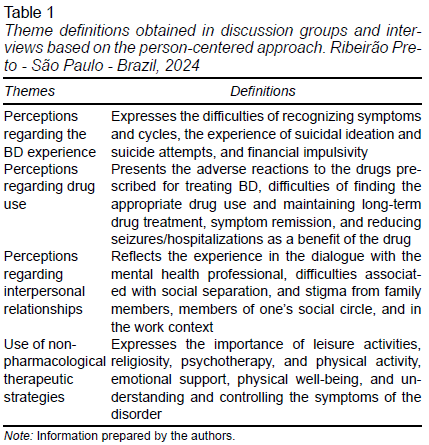
Theme 1: Perceptions regarding the BD experience
Understanding the cycles of the disorder. Participants verbalized the impact of the illness on their lives, losses, and difficulties, especially during mania, hypomania, and psychosis episodes. They highlighted the difficulty of recognizing the symptoms, characteristics, and cycles of the disorder, accessing consistent information and the limitations in professional support.
If I’m in the euphoric phase, I don’t even care about the meds... And those brilliant ideas that I had before dawn, I wanted to write a book these days, it was brilliant, it was a dream that I had, I said I’m going to write this, I’m going to make a book. I was very euphoric that day! (Patient 2, Outpatient)
Onlookers do not think that deep down there is something very serious, it is as if there were a bomb about to explode, you always have that fear... (Patient 3, Family Member, PCC III)
I think it is crucial for a person to understand this illness... understand that it is an illness…and what happens with this illness. (Patient 9, PCC II)
Suicidal ideation and suicide attempts. People with BD reported their experiences with episodes of suicidal ideation and suicide attempts. They attributed their suicidal behavior to the desire for relief from the “pain in their soul” and the experience of feeling “on edge.” Mental health professionals stressed the need for a broad approach to mental disorders and suicide and the limited dissemination of this issue in health services, including those specializing in mental health.
When you start thinking about suicide, you take five tablets, then you sleep...(Patient 3, PCC II)
I’ve already had suicidal ideation and I’ve been hospitalized because of it... when I planned to buy a gun and kill myself and other people. (Patient 2, Outpatient)
The suicidal man attacks his own life because he wants to stop the pain he feels... I went through this (Patient 3, PCC III)
I tried suicide twice; I have an experience... I think whoever commits suicide has reached their limit. (Patient 1, PCC III)
You don’t see anything inside a PCC, a banner, or a folder on mental disorders, depression, suicide, or suicide prevention. I think this should be done nationally, because nowadays. suicide is the second largest cause of death among young people aged 18 to 35. (Doctor 23, PCC III)
Impulsive administration of finance. Participants reported difficulties with financial issues arising from impulsivity. They highlighted poorly planned business endeavors, excessive, unnecessary spending, which resulted in debt and the sale of the goods, especially during the manic phase.
He wanted to sell our house, he wanted to buy a truck, he wanted to set up a company and he couldn’t get it out of his head and he went to the bank to take out a loan (Patient 2 Family Member, Outpatient)
I sold my house, I sold my car, I sold everything... I lost basically everything, everything, everything, because a lot of people used my illness to get things out of me. (Patient 3, PCC II)
They have a lot of issues with loans they usually take out when they are in the mania phase and have an impulse, and these loan companies offer loans to everyone. There are some who even request interdiction, to be free of these loans, there is a strategy that even lawyers use. (Psychologist 26, PCC II)
Theme 2: Perceptions regarding drug use
Difficulties of adequacy and adverse reactions. The participants addressed the difficulty of tolerating the side effects of drugs used to treat BD, emphasizing the difficulty of expressing themselves, weight gain, drowsiness, and muscle tightening. They pointed out the difficulty of achieving the correct drug therapy which, for some people, requires constantly changing drugs, after weighing up their risks and benefits.
I get very stuck and had difficulty articulating words. I had too much sleep, and a lack of energy, and I gained a lot of weight on the medication. (Patient 1, PCC III)
We live in a constant struggle... it’s medicine to wake up, it’s medicine to sleep. (Patient 2 Family Member, Outpatient)
It took me a long time to get my medication right... I only adapted after going through 23 antidepressants. (Patient 3, Outpatient)
Benefits of using medicine. The participants’ reports showed the perception of the benefits of the drugs, with an emphasis on mood stabilization, relapase prevention, hospitalizations, suicidal ideation, and psychosis, despite the side effects, especially at the beginning of treatment.
I’ve been on treatment for about two years, the medicine helps me not to freak out. Because what I have learned is that there are moments of sadness, moments of joy, and moments of euphoria... the medicine helps you hang on, and not go back and forth, back and forth... (Patient 3, PCC III)
we know that medicine is essential... it is something that provides benefits but also side effects, but side effects we can deal with (Patient Family member 1, PCC II)
Difficulties with adherence. Participants reported medication non-adherence, whether unintentionally (forgetfulness) or intentionally to interrupt or decrease its use in the presence of symptom improvements or in combination with other psychoactive substances. They also indicated the occurrence of non-adherence especially in the mania phase and due to the perception of excessive use of drugs and doubts concerning their benefits.
During euphoria, the person does not accept the medicine at all. The problem is that if you feel that improvement, you stop taking the medicine... it’s a cycle. (Patient 1 Family Member, PCC II)
I already stopped taking the medicine for a week. This medication business has already left me in doubt: why do I take so much medication? I was not born taking this, now all the doctors say that you have to take the medication, there are controversies.” There are people in the group who say: today I will stop taking medicine so I can drink. (Patient 2, Outpatient)
When the patient improves, he thinks that he is fine, that he no longer needs to take the medication. So, I think that something that would encourage the patient to continue the medication even when they were euthymic would be useful, because when they relapse it is very dangerous because it increases the risk of both suicide and exposing themselves to dangerous situations. (Doctor 4, Outpatient)
Theme 3: Perceptions regarding interpersonal relationships
Perception regarding the relationship with the health professional. Participants reported both experiences of facilitated and open communication with health professionals, especially at times of crisis, and the experience of not having their perspective valued by them. Moreover, confidence in the health professional and the availability of consistent information regarding the disorder, symptomatology, and treatment were cited as essential for the continuity of care, which requires the involvement of a multi-professional team.
I had a panic attack two weeks ago and I was able to get in touch with my psychiatrist, and she mentored me, and gave me full assistance, at half past eleven at night. Who can do that these days? She reassured me. I also asked, ‘Doctor, do I really need to take this medicine? There’s no way to lower the dose?’ She said, ‘In my view, this dose cannot be changed for now.’ I have to trust the professional, or else I’ll drop out of treatment. (Patient 2, Outpatient)
I was referred to a PCC and a funny thing happened because a doctor was treating me and I said: I do not want to be seen by you. Because she began asking my family what was going on. I said: instead of asking me, you’re asking them. Despite being a psychiatrist, she never told me that I could not drink so I drank, I drank beer, I took depakene, I took quetiapine. (Patient 1, Outpatient)
The one who found out he was having hormone problems was the psychologist. Can you believe that? He was seeing three doctors. (Patient 2 Family Member, Outpatient)
Perception regarding the relationship with the family. Social estrangement and stigma by family members and people from the social circle were reported by people with BD. Interdiction, at the request of the family, was listed as harmful to the social functioning of the person, preventing the individual from expressing his own will. Both the participants and health professionals underlined the importance of family support and knowledge regarding the characteristics of the disorder to understand the patient’s experience.
The greatest pain you have is when your family brushes you aside, throwing you away as if you were disposable. (Patient 3, PCC II)
The family must begin to understand that it is not just any matter, it really is an illness. The family has to really know the diagnosis and be informed of this kind of thing. (Patient 1, Outpatient)
You interdict a person thinking about their rights, and you take away their rights entirely. That’s what was going to happen to me. I would not have been able to sign my name ever again. Thank God, she (family member) did not get the interdiction. I like to be useful! If there’s one thing I value, it’s my rights. (Patient 2, Outpatient)
One thing that I think is very important, that helps the patient a lot is the support of the family. But how can the family provide support if they do not understand how the illness this person has works? There are many people who sometimes do not understand due to the lack of information. Of course, some don’t even care. (Nursing technician 11, Outpatient)
Perceptions regarding occupational performance. Participants described experiencing stigma in the work environment and losses in occupational functioning, with an accompanying loss of value and motivation to work. They also highlighted the difficulty in the Brazilian Social Security system of being able to retire due to disability or sickness.
Companies do not accept that you get sick. While you are productive, everything’s fine, if you stop being so, you are just a number in the company. That’s what happened to me. (Patient 1, Outpatient)
You arrive and your workmates and that old joke: “Ah. have you taken your medication today?” So, you quit your job, you quit everything, because it only causes you harm. (Patient 3, PCC II)
I have already thought about working, but I think if I go back to work and have a crisis, I will go back to being on leave like I was three, four years, away and back. I am retired due to disability. (Patient 2, Outpatient)
Every day, I treat people who are trying to get leave. There are people we tell, “This one I’m sure you will get, because you need it, the diagnosis is compatible. And it doesn’t work! Sometimes the one you think has no chance, goes and gets it.” (Nurse 33, PCC III)
Theme 4: Use of non-pharmacological therapeutic strategies
Leisure activities. Participants reported the importance of leisure activities to control symptoms. They mentioned walking in shopping malls and parks, observing nature, cooking, manual activities, such as crocheting, looking after animals and plants, breathing techniques, and music.
Being able to cook is already a therapy and helps with your food re-education. Strolling in the shopping mall is good, you know. (Patient 2, Outpatient)
I know all the parks. I sit there watching nature. (Patient 1, PCC II)
Where I find support is the computer, crocheting, pets, and indoors. (Patient 3 - PCC II)
I do breathing, I listen to music, and I’ve been doing something lately, I’m working with plants. And I like making lunch. I like cooking. (Patient 1, Outpatient)
Religiosity. Participants expressed the importance of their religious beliefs. Their testimonials revealed the perception of religion as a source of support, for self-control, and help with solving problems.
We went to church very early, so that’s where the church supported me so much. (Patient 1, PCC II)
It is an answer to any problem, everything you imagine, you find in the Bible. It is very up to date. So, I have read the whole Bible more than once, I’m reading it for the fourth time. A person has to read to be able to acquire knowledge to adapt to this life (Patient 1, Outpatient)
Yesterday I preached in church... for self-control, there is nothing better than reading the Bible, the word of God is a spring in response to all our problems. (Patient 2, Outpatient)
The reception of the Church was essential. The Church welcomed me. And the Church understands, people today understand, time goes by, you have daily contact, so you have that support. (Patient 1 Family Member, PCC II)
Psychotherapy. Psychotherapy was considered an important therapeutic strategy by patients and health professionals. They perceive psychotherapy as essential for self-knowledge, understanding the disorder, recognizing symptoms, and expressing feelings and emotions.
Therapy helps when you begin to understand and you become stronger as well. (Patient 1, Outpatient)
I’m doing individual therapy. It’s the day I come and say everything, and I talk, and I talk, because I have to pour everything out, I need to get it all out. (Patient 3, Outpatient)
About psychotherapy, I think it’s very important, especially at the stage of trying to understand a little about your actions and symptoms and understand that the illness is on its way. (Doctor 5, Outpatient)
Physical activity. Participants identified physical activity as a key strategy for both physical well-being and emotional regulation.
There’s a gym near my house. I put it like this: I go because the body asks you to train. I started and loved it. A lot of people go there. I get home feeling more excited; I’m going every week. (Patient 4, Outpatient)
I go to Zumba classes, then an hour’s walk. I listen to music every morning. (Patients 2, PCC III)
Walking is very good. I think physical exercise is very important in relation to the brain (Patient 3, PCC III)
Physical activity I find essential. It is very much my repertoire, because it is not even a question of believing, I know the importance of physical activity. (Patient 9, PCC II)
Given the perception of the learning needs related to symptomatology and drug treatment, the participants indicated the aspects that they considered relevant for symptom control and fostering drug adherence that can be used as adjuncts to health service interventions. These included mood diaries, psychoeducation, and suicide risk reduction.
DISCUSSION AND CONCLUSION
The testimonials revealed the need for both patients and family members to verbalize the impact of the disorder on their lives, their losses, and difficulties, especially at times of crisis, in the manic or depressive phases. They expressed their conflicts/ambivalence about the presence of psychotic symptoms and the need for guidance from health professionals on the symptoms of the disorder. They also mentioned the difficulty of accessing consistent information and the limitations of professional support.
BD patients’ perception of the disorder highlights the experience of difficulties at various stages of the illness. These include the characteristics and recognition of the symptomatology, access to information on the disorder, treatment and obtaining professional support. In BD, mood swings in both polarities, manic and depressive, and their heterogeneous symptoms, involving affective, cognitive, and physical changes, make this problem one of the main causes of disability. It has been associated with premature mortality, high levels of functional disability, and lower quality of life (Steardo Jr et al., 2020; Blanco et al., 2017).
In many cases, BD symptoms can result in limitations in the social functioning of individuals and their families. BD can cause emotional changes, such as shame, fear, anger, and sadness, even in family members, discouraging them from seeking help and leading to impairments in work, social and family functioning. Lack of introspection, insomnia, hallucinations, self-harm, and impaired decision-making are all factors that prevent those with BD from taking proper care of themselves (Steardo Jr et al., 2020).
Cognitive impairment, consistently observed in BD, even in remission, is associated with social impairment, worse illness progression, functional impairment, and reduced overall functioning (Demmo et al., 2018). Deficiencies in verbal memory and executive functions also appear to be the strongest predictors of worse psychosocial outcomes and treatment abandonment (Bonnín et al., 2016).
People with BD reported their experiences with episodes of suicidal ideation and suicide attempts. They attributed suicidal behavior to the desire for relief from “pain in the soul” and the experience of feeling “on edge.” Mental health professionals underlined the need for a broad approach to mental disorders and suicide, pointing out the limited dissemination of this theme in health services, including those specializing in mental health.
People with BD are at an extremely high risk of death by suicide, approximately 20 to 30 times that of the general population. Suicide is difficult to predict. However, risk factors such as a history of previous suicide attempts and a family history of suicide attempts or suicide completion, predominant depressive polarity, can be used to assess risk in BD (Miller & Black, 2020). Suicidal behaviors, particularly in BD, are a major public health problem. Preventive strategies require the contextualization of the problem and the design of specific actions at various government levels, with intersectoral collaboration, multidisciplinary approaches, and continuous evaluation and review (World Health Organization, 2012). Knowledge of suicidal behavior is essential for individuals with BD and their families, due to its complexity and recurrence among those with this diagnosis.
In addition to suicidal behavior, financial impulsivity was perceived as having a major impact on the life of patients and their families, due to the financial problems stemming from poorly planned entrepreneurship and uncontrolled spending. Interdiction was suggested as a possible strategy for dealing with debt. A study examining the relationship between financial and psychological variables in BD found that financial difficulties correlated with greater impulsivity, reduced mindfulness, and low self-esteem (Richardson et al., 2019).
The psychosocial disability present in BD, amply described in the reports of the participants in this research, fluctuates according to the severity of the symptoms presented. The support of mental health professionals is crucial to promoting emotional stability and reducing the likelihood of relapse (Hernández-Gómez et al., 2021).
The difficulties of adapting to medication and adverse reactions, the benefits of using it and the difficulty of drug adherence are addressed in the category of perceptions of medication use. Participants discussed the difficulty of tolerating the side effects of the drugs used to treat BD, particularly the inability to express themselves well, weight gain, drowsiness, and muscle stiffening. They highlighted the problem of adapting drug therapy which, for some people, requires constant changes of medication, based on an assessment of their risks and benefits.
Participants were ambivalent about the perception of the benefits of drugs and their suitability and adverse reactions. They emphasized the difficulty of drug adherence due to both intentional and unintentional behavior. Drug adherence is crucial to symptom stabilization in individuals with BD. However, the literature reveals that between 10% and 66% of BD patients fail to take their medication as prescribed (Jawad et al., 2018).
However, there were reports of participants who perceived the benefits of medication, particularly mood stability, and the prevention of relapses, hospitalization, suicidal ideation and psychosis, despite the side effects that occur especially at the onset of treatment. Previous experiences related to crises were cited as a reason for using the medication.
A systematic review of the attitudes of BD patients that influences treatment adherence suggested that these attitudes were based on the perceived advantages and disadvantages of treatment. Many patients regarded treatment as beneficial and necessary even though negative attitudes such as denial, and concerns about the adverse effects of treatment, and stigma were common (Chakrabarti, 2019).
Low medication adherence in BD warrants attention due to its association with increased relapses, suicide and suicide attempts, emergency room visits, hospitalizations, health costs, homelessness, and encounters with the law. Medication nonadherence in BD is harmful for both individuals and society (Inder et al., 2019; Jawad et al., 2018).
Another theme that emerged was perceptions regarding interpersonal relationships. This category encompasses the relationship with health professionals and the family, perceptions of occupational performance, difficulty expressing themselves and adherence to mental health services. The reports showed that the relationship with the health professional is of fundamental importance in that it is a source of information about the illness and its treatment and provides support at times of crisis and relapses. In this context, people with BD expressed their need to feel understood to help them accept the problem, facilitate the treatment process, and prevent relapses and crises. The literature shows that a positive experience with a mental health professional can increase the likelihood of the patient continuing treatment, and prevent the negative consequences of the disorder (Nestsiarovich et al., 2017).
Moreover, an empathetic discussion of the care plan, conveying trust, respect, and willingness to help, especially regarding pharmacological treatment, is essential for establishing a therapeutic relationship between patient and professional (Vallarino et al., 2018).
From the participants’ perspective, the family can serve as a collaborator and facilitator when properly informed. A qualitative study of family members of a person with BD observed that relatives face a range of challenges in supporting the person with BD due to the nature of bipolar disorder, the response to family members’ attempts to help, and the limitations of professional support. This was accompanied by a feeling of uncertainty, exacerbated by the lack of explanations from health professionals, which corroborates the findings of the present research (Baruch et al., 2018).
Participants in this research reported using non-pharmacological therapeutic strategies to stabilize their mood coupled with medication, with an emphasis on leisure activities, religiosity, psychotherapy, and physical activity.
A systematic review of the literature on the effects of producing art as a therapeutic resource for mental health revealed its beneficial effect on the rehabilitation process. These include the relief of negative feelings, empowerment, and social reintegration, all of which are crucial to the recovery model (Correia & Torrenté, 2016). Strategies such as musical engagement, visual art, movement and dance, drama/theater, and expressive/creative writing have been studied as adjuvant treatments for a variety of psychiatric diagnoses, including BD. They have been shown to reduce illness-specific symptoms and improve mental health, patient satisfaction, and overall well-being (Aalbers et al., 2017; Levine & Land, 2016; Chung & Woods-Giscombe, 2016).
Stroppa et al. (2018) explored the effects of religious activity and coping behaviors on the course of depression, mania, and quality of life (QOL) in people with BD. They found that together with pharmacotherapy, the incorporation of religiosity/spirituality into psychosocial interventions can enhance QOL and improve functioning, increasing the likelihood of better, longer-term recovery.
In this study, psychotherapy was regarded as a key therapeutic strategy for people with BD by patients and health professionals. The literature also points to psychotherapy as a therapeutic modality for stabilizing symptoms and reducing the recurrence of episodes (Miklowitz et al., 2021; Caldiroli et al., 2020).
Physical activity was identified as a useful resource both for promoting physical well-being and for emotional regulation. Research revealed that people with severe mental illness had significantly more sedentary behavior and performed significantly less physical activity than healthy controls (Vancampfort et al., 2017). In this respect, the literature suggests a positive association between self-reported physical activity and cognitive function and mood in patients with severe mental disorders. It indicates that, given the proven benefits and low adverse risk profile, physical activity should be offered as an adjuvant part of mental health treatment (Ashdown-Franks et al., 2019).
Participants in this research cited the use of a mood diary, psychoeducation, and suicide prevention strategies as key resources for symptom control and drug adherence. The literature corroborates this by highlighting the relevance of the daily mood record, since it can indicate early mood changes before the disorder has extreme functional consequences (Mondéjar et al., 2019). The benefits of psychoeducation for those with BD have been amply documented in the literature. Studies suggest that psychoeducation for people with BD reduces the risk of recurrence and hospitalization when implemented in routine clinical practices and contributes to treatment adherence (Joas et al., 2020).
Since suicidal behavior is a public health problem, prevalent among people with BD yet preventible, it must be effectively addressed, as noted by the participants in this study. The literature mentions the provision of psychoeducation for patients, family, and friends as prevention strategies. This enables them to recognize the warning signs of suicidal behavior, while teaching them of the importance of treatment adherence, avoiding isolation, and requesting assistance in emergency situations (Malhi et al., 2018; Dome et al., 2019).
Triangulating the perspectives of the patient, family member and health professional proved helpful. It not only involved the recognition of and dialog between several types of knowledge, but also sharing the limits of pharmacological treatments and the complex, multidimensional nature of mental health issues. The conditions inherent in BD pose a major challenge for patients, their families and health professionals that can only be overcome by working together to find solutions that take users into account.
The results of the study, shared with participants, demonstrated the need for effective interventions in health services designed to control BD symptoms, and ensure proper medication use, suicide and stigma prevention, and family involvement in treatment. Mood diaries, psychoeducation, and suicide prevention are intervention strategies indicated by the participants, and well documented in the literature, which may be useful for clinical practice.
The study had the following limitations, related to the non-generalizability of results, due to their complexity and ambiguity, as well as the influence of the researcher’s perspective, assumptions, and values. Nevertheless, it is worth highlighting the innovative aspects derived from the analysis of the triangulation of information from different contexts associated with BD. This provides a better understanding of the needs of both users and their families, allowing for more effective care.