INTRODUCTION
Suicide is a leading cause of death among young people globally, with particularly high rates in developing countries such as Mexico (World Health Organization [WHO], 2021). Over the past two decades, suicide rates in Mexico have risen steadily, reaching 6.8 cases per 100,000 population in 2023, accounting for 8,837 deaths that year (Instituto Nacional de Estadística y Geografía [INEGI], 2024). For every suicide, there are at least 20 attempts, which translates into approximately 176,000 people attempting suicide in Mexico alone in 2023 (WHO, 2021). These statistics underline the urgent need for effective prevention efforts, yet predicting suicide remains a challenge, as current tools often have limited predictive power (Kreuze & Lamis, 2018).
Suicide is a complex, multifaceted phenomenon that cannot be attributed to a single cause or stressor (Edwards et al., 2023; Mukherjee & Kumar, 2017). Some individuals contemplating suicide do not act on their thoughts, while others may attempt suicide without any prior known history of suicidal ideation (Richardson et al., 2023). This unpredictability has led to the conceptualization of distinct suicidal behaviors, such as suicidal ideation, self-harm, and suicide attempts, which are critical for informing effective prevention strategies. Early intervention is crucial, as once an individual dies by suicide, the opportunity to prevent further harm is lost (Pan American Health Organization [PHAO], 2021).
An individual is considered at risk of suicide when predisposing factors (such as genetic predisposition and personality traits) and precipitating factors (such as hopelessness and lack of social support) align at a critical moment, leading to suicidal ideation or a suicide attempt. Assessing suicide risk is further complicated by the fact that risk factors may vary across the lifespan. Among young adults, mental disorders (Bilsen, 2018; Casas-Muñoz et al., 2024), previous suicide attempts, being female (Su et al., 2020), lack of social support, familial relationship difficulties, and a history of substance use (Hermosillo-de-la-Torre et al., 2020) have been identified as key risk factors.
Suicide risk is traditionally assessed through clinical judgment or risk prediction tools, such as questionnaires. However, these methods often have low positive predictive value (Carter et al., 2017; Steeg et al., 2018). Machine learning approaches, while promising, can be resource-intensive and may require extensive personal data that are not always available (Linthicum et al., 2019). Clinical judgment is often limited by factors such as the patient’s denial of suicidal thoughts (Picard & Rosenfeld, 2021), biased questioning (McCabe et al., 2017), and clinician inexperience (Negrão et al., 2024). While we recognize the importance of thorough clinical assessment in evaluating suicide risk and informing decision-making, access to healthcare services remains a significant challenge, particularly in Mexico (Espinola-Nadurille et al., 2010).
Several theoretical models have been proposed to explain suicidal behavior. One prominent approach, known as the ideation-to-action framework, posits that the development of suicidal ideation and the transition from ideation to a suicide attempt are distinct processes. Each of these has its own set of risk factors, protective factors, and prevalence rates. While most known risk factors consistently predict suicidal ideation, research continues to struggle with accurately predicting suicide attempts (Qiu & Klonsky, 2021). According to this framework, factors such as fearlessness about death, emotional pain, distress, access to lethal means, self-inflicted injury, and previous suicide attempts are all linked to suicide risk among ideators (Klonsky et al., 2016).
Building on the ideation-to-action framework, assessment tools could focus on identifying the specific factors that contribute to suicidal ideation and those that facilitate the transition to a suicide attempt. This distinction is crucial, as it allows for a more nuanced understanding of the risk trajectory and the implementation of targeted interventions. For instance, assessing constructs such as acquired capability for suicide, emotional pain, and connectedness may provide a clearer picture of an individual’s risk level. By incorporating these elements, screening tools could move beyond a one-size-fits-all approach and offer a more tailored evaluation, improving both their predictive accuracy and clinical utility. This shift has the potential to enhance early identification and enable timely, personalized prevention efforts.
This study aimed to assess suicide risk among Mexican high school students from San Luis Potosí and Veracruz. It evaluated whether a previous history of suicide-related behaviors and stressful life events combined with the Multiphasic Inventory of Suicidal Ideation (IMIS), could serve as a cost-effective approach for suicide risk identification in school populations. This tool, grounded in the ideation-to-action framework, is particularly valuable in resource-limited contexts where there is an urgent need for practical screening tools in educational settings and comprehensive clinical assessment may not be feasible.
METHOD
Study design
This study employed a cross-sectional design to assess suicide risk among Mexican high school students, as measured by previous suicide attempts and current suicidal ideation. Data were collected through an online survey. This included demographic information, a history of suicide related behaviors, suicidal thinking, stressful life events and the Multiphasic Inventory of Suicidal Ideation (IMIS), an innovative screening tool for identifying individuals at risk of suicide.
Participants
This study included 3,481 high school students aged 13-21 (M = 16.28, SD = 1.19) from three public schools across two states in Mexico. One was in Santa María del Río, San Luis Potosí, and two in Veracruz (Poza Rica and Veracruz City). Participants were enrolled in one of two educational modalities: schooled (traditional in-person classroom instruction), or hybrid (weekend classes with flexible scheduling, designed for young working adults who have not yet completed their high school education). Both morning and evening shifts were represented and individuals over 22 were excluded. After removing 25 cases due to missing data or errors, the final dataset comprised 3,456 participants (59.3% female, 40.7% male). Participants over 18 accounted for 2.5% of the total sample (n = 89). Data were collected between 2020 and 2021.
Measurements
Participants completed an online version of the Multiphasic Inventory of Suicidal Ideation (IMIS) assessing nine dimensions (aggressiveness, anxiety, self-esteem, depression, hopelessness, suicidal thinking, family relationships, frustration tolerance, and self-efficacy). Each item is rated on a 5-point Likert scale, ranging from 1 (strongly disagree) to 5 (strongly agree). The questionnaire also includes 17 dichotomous items on stressful life events, such as pregnancy, homelessness, and parental divorce (Manzano-Delgado & Galan-Cuevas, 2019). The IMIS has excellent internal consistency (ω = .97), and its psychometric properties, including exploratory factor analysis, are detailed in the supplementary material.
Procedure
Data were collected through an online survey, following comprehensive consent procedures. Prior to participation, school authorities organized parent meetings where the study objective was explained in detail. Written informed consent was obtained from parents/legal guardians of all underage students through paper forms signed during these sessions. Students who agreed to participate voluntarily completed the anonymous online survey, which included demographic questions, the IMIS questionnaire, and items concerning stressful life events. Missing age values were imputed using the mean, while cases with missing sex values were removed. The Synthetic Minority Over-Sampling Technique (SMOTE) was applied to address class imbalance in the dataset (Chawla et al., 2002).
Statistical analysis
Data analysis was conducted using R, a programming environment for statistical computing (R Core Team, 2024). A logistic regression model was applied to the SMOTE-balanced dataset to assess the sensitivity and specificity of the IMIS instrument in predicting suicide risk, defined by self-reported previous suicide attempts and current suicidal thoughts. Model performance was evaluated using the area under the curve (AUC). Additionally, a random forest regression model was used to predict the total IMIS score based on stressful life events. The original dataset was split into training (80%, n = 1092) and testing (20%, n = 468) sets, and the model was optimized using 10-fold cross-validation. The model was tuned by varying the number of predictors considered at each split (mtry). Performance metrics, including Root Mean Squared Error (RMSE), R2, and Mean Absolute Error (MAE), were used to evaluate the model. Preprocessing and data analysis scripts can be found in supplementary materials.
Ethical considerations
This study received ethical approval from the Ethics Committee of the Universidad Autónoma del Estado de Hidalgo (UAEH) following the ethical guidelines for research on human subjects (Approval No. CEEI-000013-2019). For at-risk individuals, we implemented a safety protocol where participants received immediate access to crisis resources via email; parents of children were confidentially notified within 24 hours with referral options; and schools provided support plans. Children’s assent was obtained through a two-step process. First, parents/guardians provided written consent (paper forms) after receiving detailed information on the purpose and procedures of the study. Second, students under 18 provided digital assent through an online survey after reading an age-appropriate explanation of the study. This included clear opt-out options at any stage. All data were anonymized and securely stored with access restricted to the research team.
RESULTS
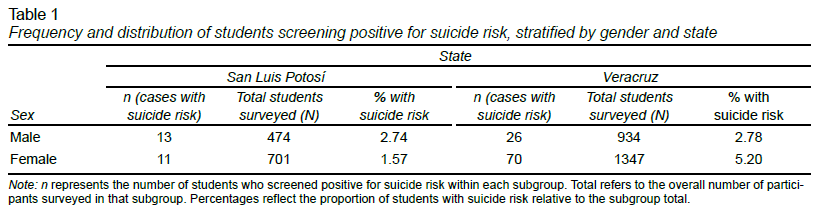
One hundred and twenty (3.4%) of the 3,456 students surveyed were classified as being at risk of suicide (Table 1). An additional 406 students (11.7%) reported suicide ideation without current risk, while 216 (6.2%) reported prior suicide attempts without active suicidal thoughts. Descriptive statistics, stratified by sex and state, revealed significant differences. The proportion of at-risk students varied by state, χ² (1, n = 24) = 10.22, p = .001, with Veracruz students exhibiting a higher likelihood of being at risk. No significant sex-based differences were found, though a marginal trend was observed. Additionally, females reported a slightly but statistically higher average number of stressful life events (M = 2.79, SD = 2.25) compared to males (M = 2.54, SD = 2.12), t (3131) = 3.39, p = .001. State-level differences in stressful events were also significant, t (38) = 7.39, p < .001, with Veracruz students reporting higher averages (M = 2.88, SD = 2.21) than those in San Luis Potosí (M = 2.31, SD = 2.12). Finally, a moderate positive correlation was found between the IMIS total score and stressful life events, r = .46, 95% CI [.43, .49] p < .001.
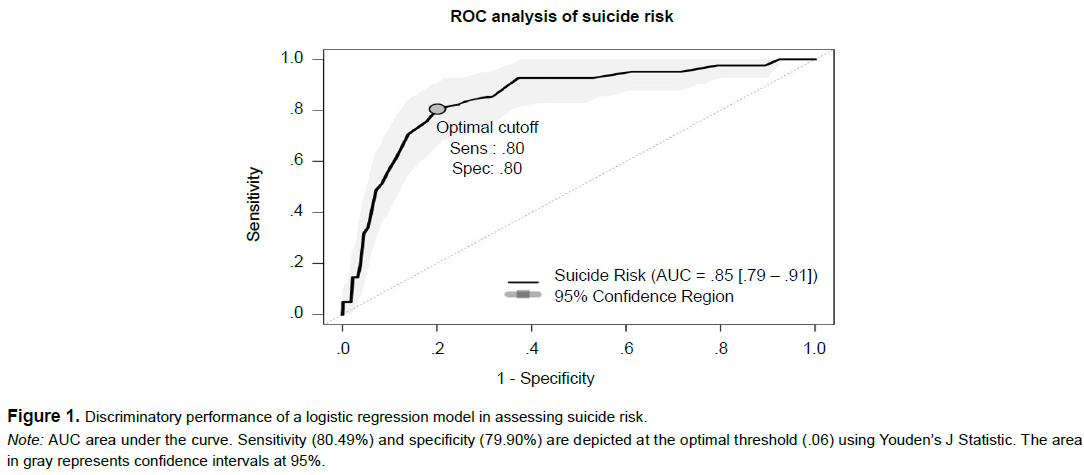
A binary logistic regression examined the association between the IMIS total score and suicide risk. The model significantly predicted suicide risk χ² (1) = 662.4, p < .001, and explained 34.5% of the variance (R2 = .3459, Nagelkerke’s R2), correctly classifying 82.3% of the cases. The IMIS total score was statistically significant (B = .256, SE = .013, z = 19.44, p < .001), with an odds ratio of 1.29 (95% CI [1.26, 1.33]). This means that for every one-unit increase in the total score, the odds of being classified as high-risk increase by 29%. The performance of the model was evaluated using a Receiver Operating Characteristic (ROC) analysis (see Figure 1). The area under the ROC curve (AUC) was .85 (95% CI [.79, .91]), indicating good discrimination between individuals with and without suicide risk. At the optimal threshold (.06), sensitivity was 80.4%, and specificity 79.9%, demonstrating a balanced ability to identify both at-risk and non at-risk individuals.
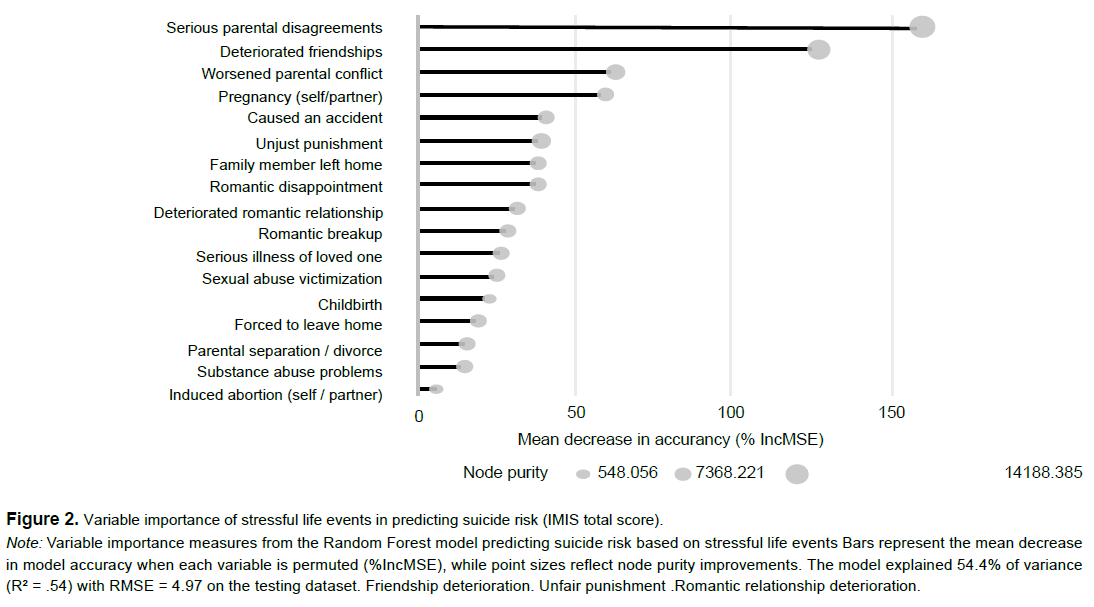
A Random Forest regression analysis was conducted to predict the IMIS total score based on 17 stressful life events (EV01 to EV17). The optimal model was selected based on the smallest RMSE, with mtry = 9. During cross-validation, the model achieved an RMSE of 4.47, an R2 of .61, and an MAE of 3.27. When applied to the testing set, the model achieved an RMSE of 4.97, with a total sum of squares (SST) of 25,409.31 and a sum of squared errors (SSE) of 11,584.88. The variance explained R2 for the testing set was .54, indicating that the model explained approximately 54.4% of the variance in the IMIS total score.
Variable importance was assessed using the mean decrease in impurity criterion. The most influential predictor was EV08 (“I had serious disagreements with my dad/mom or both”), followed by EV15 (“Relationships with my friends deteriorated”), EV05 (“Fights between my parents got worse”) and EV10 (“I got pregnant/I got my girlfriend pregnant).” The importance values are summarized in Figure 2. The mean decrease in node impurity indicated that EV08 contributed the most to reducing overall impurity, with a node purity decrease of 15,178.88.
DISCUSSION AND CONCLUSION
Our study identifies three critical advances in suicide risk assessment among Mexican adolescents. First, the Multiphasic Inventory of Suicidal Ideation (IMIS) demonstrated superior discriminative specificity (AUC = .85) compared to traditional screening tools, which often inflate risk prevalence due to low specificity (Franklin et al., 2017). This aligns with growing concerns about the unintended consequences of over-screening, including unnecessary interventions and resource strain (Gould et al., 2018). Second, we established a suicide risk prevalence of 3.4% (n = 120), attempt rates of 6.2% (n = 216), and ideation rates of 11.7% (n = 406). These are markedly lower than previous Mexican studies reporting 19-38% risk rates using less discriminating instruments (Gómez-Delgado et al., 2024; Maldonado-Arellano et al., 2022). Our estimates closely match gold standard epidemiological data (6.5% attempts; 7.6% ideation; Valdez-Santiago et al., 2023), confirming the clinical utility of the IMIS. Third, the machine learning analysis revealed that interpersonal stressors account for 54% of risk variance, exceeding the predictive value of individual psychological factors. This supports theoretical models (such as Joiner’s Interpersonal Theory; and Van Orden et al., 2010) underscoring the need for socially contextualized screening.
The IMIS offers several advantages over widely used tools such as the Electronic Columbia Suicide Severity Rating Scale (eC-SSRS; Greist et al., 2014) and the Patient Health Questionnaire-9 (PHQ-9; Kroenke et al., 2001). First, it is specifically tailored for adolescents without prior depression diagnoses, addressing developmental shifts in suicidality (Nock et al., 2013). Second, it demonstrates optimized psychometric properties: compared to the eC-SSRS, it has higher sensitivity (.80 vs .67) and better specificity than PHQ-9 (.79 vs .66), which is critical for minimizing false positives. Third, it requires no formal training, making it feasible for school-based screenings (Singer et al., 2019). Finally, the multiphasic risk profiling captures psychosocial triggers (such as familial conflict and peer rejection) often overlooked by symptom-focused tools (Foster, 2017).
Consistent with global trends (Bachmann, 2018), our data show elevated risk among female adolescents, likely tied to gender-based violence and maladaptive coping (Patel et al., 2025). Regional disparities (such as higher risk in Veracruz) may reflect socioeconomic inequities due to mental health service gaps (Arteaga-de-Luna & Hermosillo-de-la-Torre, 2022). These findings advocate for intersectional prevention strategies.
Although the IMIS is promising (AUC = .85), its current design lacks dynamic factors (such as acute stressors and protective resilience) that could improve its predictive power. Future iterations should incorporate real-time risk modifiers (such as social media use; Li et al., 2023), test alternative machine learning approaches to handle non-linear interactions (such as neural networks; Linthicum et al. 2019), and expand validations to diverse populations (such as LGBTQ+ youth; Green et al., 2022).
The IMIS has potential as a practical, evidence-based tool for early identification of suicidal risk in adolescents. Its administration in schools and mental health settings could enable timely interventions, ultimately reducing suicide rates. Policymakers and practitioners should prioritize incorporating these tools into prevention programs, particularly in regions with elevated risk, such as Veracruz.