INTRODUCTION
Mental disorders are among the leading causes of the global disease burden among adolescents. According to the World Health Organization, they account for 16% of the total burden in those aged 10 to 19, with half of all adult mental disorders beginning before age 14 (World Health Organization [WHO], 2021).
In Mexico, epidemiological data suggest a significant and growing burden in this age group. The Mexican Adolescent Mental Health Survey (ESMA), the only epidemiological study with clinical diagnoses in this population, found that 39.4% of adolescents aged 12 to 17 in the Mexico City Metropolitan Area had had at least one mental disorder in the year prior to the study, 8.5% a serious mental disorder, and 4.8% major depression (Benjet, Borges, Medina-Mora, et al., 2009). An eight-year longitudinal follow-up of the same cohort documented a cumulative incidence of major depressive episode of 12.9%, with a recurrence rate of 46.1% into early adulthood (Benjet et al., 2020). More recent symptom-based estimates from the 2022–2023 National Health and Nutrition Survey indicate that 7% of adolescents aged 10 to 19 reported two or more depression symptoms (Vázquez-Salas et al., 2023). These figures underscore the urgent need for brief, valid screening instruments capable of identifying at-risk adolescents in both population-based and clinical settings.
The Kessler Psychological Distress Scale (K10) is a 10-item self-report instrument developed to detect non-specific psychological distress, assessing depression and anxiety symptoms. Items are rated on a five-point Likert scale (from 1 = never to 5 = all the time), yielding a total score from 10 to 50, with higher scores indicating greater distress (Kessler et al., 2002). The scale has been translated and adapted into more than 15 languages, including Arabic, Chinese, German, Portuguese, Japanese, and Spanish (New South Wales Ministry of Health, 2015; Peixoto et al., 2021). The K10 has widely replicated psychometric evidence across adult populations from diverse cultural and linguistic contexts. Factor analysis studies confirm that, exploratory approaches may suggest multifactor solutions. However, the unidimensional model provides the best fit in confirmatory factor analysis in general population samples, supporting the use of the total score as a measure of psychological distress (Furukawa et al., 2003; Hoffman et al., 2022; Kessler et al., 2002; Milkias et al., 2022; Ongeri et al., 2022).
The K10 was developed for general purpose health surveys, assessing multiple topics concurrently. In such contexts, disorder-specific instruments such as the PHQ-9 or the GAD-7 are less appropriate. These tools treat depression and anxiety as distinct constructs and are better suited to clinical settings where a specific disorder is already suspected. Conversely, the K10 captures a broader dimension of non-specific psychological distress without presupposing a diagnostic category. This feature makes the K10 particularly useful for population surveys designed to identify individuals who may require further evaluation (Kessler et al., 2002). Epidemiological surveys across countries have repeatedly demonstrated K10’s high concordance with clinician-rated diagnoses of serious mental illness and mood or anxiety disorders. This finding supports K10’s value as a population-level detection instrument. It is the primary psychological distress measure in both the ESMA 2005 and the National Survey on Drug, Alcohol, and Tobacco Use (ENCODAT) 2025. Validating its psychometric properties in Mexican adolescents is therefore essential for ensuring the accurate interpretation of existing data and future national surveys.
In Mexico, a validation study of the Kessler-10 (K-10) scale in 280 adult primary care patients in Mexico City supported its unidimensional structure (with one factor explaining 53.4% of the variance and Cronbach’s α = .901). It also confirmed its adequate discriminant validity against DSM-IV diagnoses of depression and anxiety. It used MINI as the reference standard. with optimal cutoff points of 21 for depression (sensitivity 78.7%, specificity 79.0%, AUC-ROC = 87.0%) and 22 for anxiety (sensitivity 72.4%, specificity 73.8%, AUC-ROC = 82.4%) (Vargas Terrez et al., 2011). The scale has since been used as an outcome measure in both the ESMA 2005 and the ENCODAT 2025. However, the psychometric properties of the K-10 have yet to be formally evaluated in Mexican adolescents.
Existing validation studies in this age group have primarily been conducted in non-Spanish-speaking contexts. These include Hong Kong (Chan & Fung, 2013), Indonesia (Tran et al., 2019), and Australia (Blake et al., 2024; Smout, 2020), with just one Spanish-language in Ecuador (Larzabal-Fernandez et al., 2024). Collectively, these studies report high internal consistency (Cronbach’s α between .86 and .93) and a sufficiently unidimensional structure to justify using the total score as a measure of psychological distress.
Concurrent and predictive validity has been assessed against self-report instruments. These include the BDI-II (Chan & Fung, 2013) and structured diagnostic interviews such as the MINI-Kid and the DISC-IV (Smout, 2020; Tran et al., 2019), with ROC curve areas ranging from .78 to .86. The only study of Spanish-speaking adolescents (Larzabal-Fernandez et al., 2024) was conducted in Ecuador with 5,132 young people aged 11 to 20. It found that a nine-item version provided the best fit and strict measurement invariance by sex, although it did not include a clinical gold standard to assess criterion validity. No study to date has been conducted in Mexico using both a structured diagnostic interview and a representative population sample simultaneously, which is the primary purpose of this paper.
The aim of this study is to evaluate the psychometric properties and validity of the K10 in Mexican adolescents using two surveys. These include the ESMA 2005, with structured clinical diagnoses through the Composite International Diagnostic Interview (CIDI) as the gold standard, and the ENCODAT 2025, a nationally representative probability sample. As a secondary and exploratory analysis, the study examines the eight-year predictive validity of the K10 in the ESMA longitudinal subsample.
METHOD
Study design
Data were analyzed from two general population studies of Mexican adolescents. The first is the Adolescent Mental Health Survey (ESMA), with a baseline cross-sectional phase, conducted in 2005 (Benjet, Borges, Blanco, et al., 2009). A longitudinal follow-up of the same participants was undertaken eight years later in 2013 (Benjet et al., 2016). The second is the National Survey on Drug, Alcohol, and Tobacco Use (ENCODAT), a cross-sectional study conducted between July and October 2025.
Participants
The ESMA 2005 consisted of a probabilistic, stratified, multi-stage cluster household sample of 3,005 adolescents aged 12 to 17, representative of the Mexico City Metropolitan Area (MCMA), comprising 16 boroughs in Mexico City and 16 municipalities in the State of Mexico, with a 71% response rate (Benjet, Borges, Blanco, et al., 2009). In 2013, 1,071 participants (35.6% of the original sample) were successfully re-interviewed, with a 62% response rate among those who were located and eligible (Benjet et al., 2016).
The ENCODAT 2025 used a probabilistic, stratified, multi-stage cluster household sample representative at the national, regional and area (rural/urban) level, including 15,353 adults and 3,847 adolescents from across the country with an 81% response rate (Comisión Nacional de Salud Mental y Adicciones [CONASAMA], Instituto Nacional de Psiquiatría Ramón de la Fuente Muñiz [INPRFM], and Instituto Nacional de Salud Pública [INSP], 2025a).
Measurements
K10 Scale. The K10 is a 10-item self-report instrument (e.g., “How often have you felt that everything took a lot of effort?”) assessing non-specific psychological distress using a five-point Likert scale (1 = never; 5 = always or all the time). Total scores range from 10 to 50, with higher values indicating greater distress. The Spanish adaptation of the K10 used in the ESMA was developed as part of the World Mental Health Survey Initiative, coordinated by the WHO, following a standardized procedure that included translation, back-translation, and pilot testing across multiple countries (Kessler & Ustun, 2004).
For analysis, the K10 was dichotomized using two cutoff points, the first being 25 or above (25+), with scores of 10–24 indicating no or mild distress and those of 25–50 indicating moderate or severe distress. This is consistent with established use in international general population surveys (Victorian Government Department of Human Services, 2002). An alternative cutoff point of 22 or above (22+), previously suggested for Mexican health service users (Vargas Terrez et al., 2011) was also used. In the ESMA, the K10 inquired about the past 30 days whereas in the ENCODAT, it explored the past 12 months. Item wording, response options, and text adaptations in Spanish across both surveys are available as supplementary material.
Diagnostic interview. The ESMA also administered the adolescent version of the Composite International Diagnostic Interview (CIDI) (Kessler & Ustun, 2004). The latter is designed to assess DSM-IV diagnostic criteria for mood disorders (e.g., major depressive episode or dysthymia) and anxiety disorders (e.g., generalized anxiety disorder or phobias). It also explores substance use disorders (i.e., alcohol and drug abuse and dependence) (Borges et al., 2018), evaluated for lifetime, past year, and past 30 days.
Procedure
In the ESMA 2005, face-to-face household interviews were conducted by trained lay interviewers with prior experience, under both on-site and remote supervision with data quality control procedures (Benjet, Borges, Blanco, et al., 2009). The 2013 follow-up followed a similar procedure, with comparable supervision and quality control (Benjet et al., 2016).
The ENCODAT 2025 was conducted through face-to-face household interviews by interviewers trained in instrument administration, data collection, ethics, data protection, and handling of sensitive information. Procedural details are described in CONASAMA, INPRFM & INSP (2025a, 2025b).
Statistical analyses
All analyses were conducted in Stata version 19.0 and Mplus version 7.4, incorporating the complex design (weights, strata, and primary sampling units) of both surveys (West et al., 2025). Descriptive statistics are reported as unweighted frequencies and weighted percentages for qualitative variables, and as means and standard deviations (SD) for quantitative variables. For supplementary analyses, adolescents residing in metropolitan areas (≥ 100,000 inhabitants) of Mexico City and the State of Mexico were identified in the ENCODAT to form a geographically more comparable subsample to the ESMA.
To evaluate the psychometric properties of the K10 at baseline in both surveys, Cronbach’s α and McDonald’s ω were calculated as internal consistency measures. An Exploratory Factor Analysis with one to four factors was conducted. Given the prior evidence supporting the unidimensionality of the K10, only the eigenvalue and fit indices (CFI, TLI, and RMSEA) for the one-factor solution are reported (Shmulewitz et al., 2011).
Evidence of a unifactorial structure was defined as a single factor with eigenvalue > 1; good model fit was defined as CFI and TLI ≥ .95 and RMSEA 0 ≥ .06 (Hu & Bentler, 1999). Given the ordinal nature of item responses, the WLSMV estimator was used (Muthén & Muthen, 2015). Measurement invariance was tested by sex (male vs. female) and age group (12–14 vs. 15–17 years) by comparing a configural model (no constraints) with a scalar model (equal factor loadings and thresholds across groups) (Bowen, 2021; Najera et al., 2024). Evidence of non-invariance was defined as a significant Δχ² (p < .05), ΔCFI ≥ −.01, or ΔRMSEA ≥ .015 (Chen, 2007; Kiraly et al., 2019).
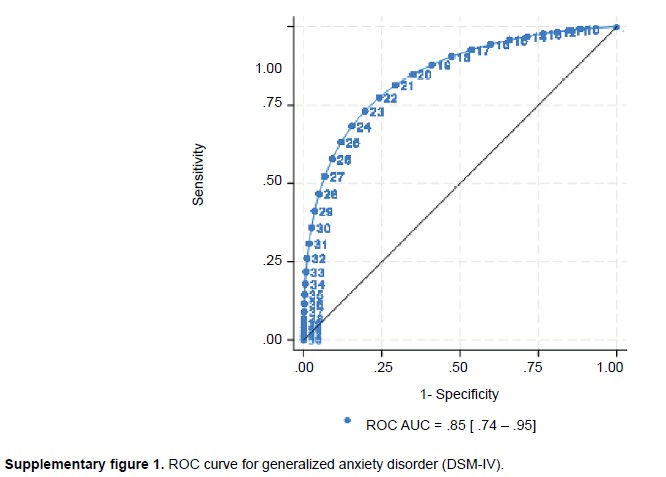
Criterion validity was only evaluated in the ESMA 2005, where the K10 and CIDI were simultaneously administered to the same participants. Following the approach of Vargas Terrez et al. (2011), sensitivity, specificity, positive predictive value (PPV), and negative predictive value (NPV) were calculated (Szklo & Nieto, 2019). The 25+ and 22+ cutoffs were contrasted against CIDI DSM-IV diagnoses of major depressive episode and generalized anxiety disorder as the gold standard. ROC curves and AUC values were estimated using maximum-likelihood weighted probit models with Stata’s rocreg command (StataCorp, 2025).
Lastly, predictive validity was analyzed in the ESMA 2005 subsample re-interviewed in 2013, restricted to participants free of each outcome at baseline. The association between psychological distress (cutoffs 25+ and 22+) and the eight-year cumulative incidence of any mood, anxiety, or substance use disorder (Borges et al., 2018) was estimated. Adjusted risk ratios (aRR) from generalized linear models with a binomial family and log link function (Cummings, 2009) were used, adjusted for age, sex, and school attendance at baseline.
Ethical considerations
The research ethics committee of the Ramón de la Fuente Muñiz National Institute of Psychiatry approved the recruitment, consent, and procedures for both the ESMA 2005 and the ESMA 2013 follow-up survey. For the ESMA 2005, explanations about the study were provided to both adolescents and their parents or legal guardians. Only adolescents who gave their assent, and whose parents or guardians signed the informed consent form were interviewed. Participants who had provided their contact details in 2005 were followed up in 2013. Informed consent for the follow-up interview was obtained from the participants, all of whom were over the age of 18 by then.
The protocol, instruments, and informed consent form for ENCODAT 2025 (CI:1967) were approved by the Research Ethics Committee of the National Institute of Public Health (CONBIOETICA–17-CEI-004-20160708). Participation was voluntary, obtained through informed consent for adults and assent for adolescents, accompanied by the consent of their parents or guardians.
RESULTS
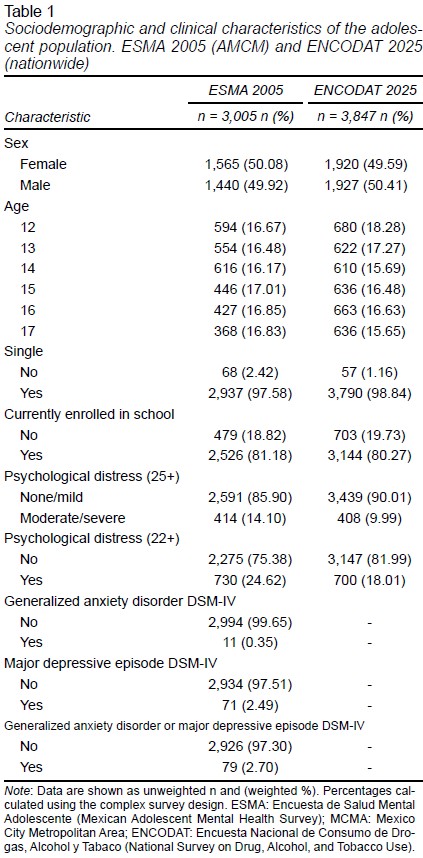
Table 1 presents the sociodemographic and clinical characteristics of adolescents aged 12 to 17 from the ESMA 2005 (MCMA) and the national ENCODAT 2025. Sex distribution was comparable in the two surveys, with similar proportions of males and females. Ages were evenly distributed across the 12-to-17 range; approximately 98% of participants were single; and around 80% were enrolled in school at the time of the survey. In the ESMA, past-month prevalence of generalized anxiety disorder was .35% and of major depressive episode was 2.49%. The prevalence of psychological distress in the ESMA was 14.10% using the 25+ cutoff point and 24.62% using the 22+ cutoff point. These were 9.99% and 18.01% respectively in the ENCODAT at the national level, and 10.94% and 20.12% in the MCMA subsample (available as supplementary material).
As shown in Table 2, the nervousness item obtained the highest mean score in both surveys (2.19 in the ESMA; 1.96 in the ENCODAT). Conversely, the lowest means were recorded for the hopelessness item in the ESMA (1.40) and the inability to calm down due to nervousness in the ENCODAT (1.37).
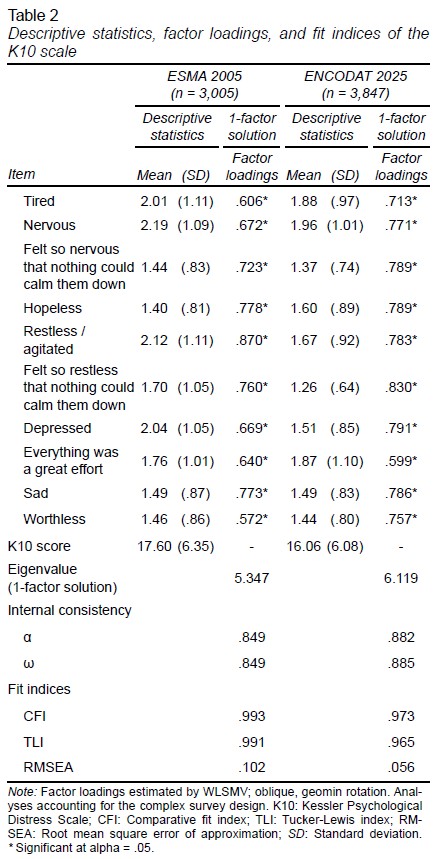
Mean K10 scores were 17.60 ± 6.35 in the ESMA and 16.06 ± 6.08 in the ENCODAT. In both studies, the one-factor solution yielded factor loadings above .60 on most items, with eigenvalues of 5.347 (ESMA) and 6.119 (ENCODAT). Internal consistency was adequate in both surveys according to Cronbach’s α and McDonald’s ω. Fit indices for the one-factor solution were satisfactory, except for the RMSEA in the ESMA (> .06), which slightly exceeded the conventional threshold.
Measurement invariance analyses by sex and age group in the ESMA yielded inconclusive results: Δχ² indicated non-invariance (p < .001), while ΔCFI and ΔRMSEA remained within invariance thresholds. In the ENCODAT 2025, all three indices consistently supported invariance by both sex and age group, supporting the use of the total score for subgroup comparisons (available as supplementary material).
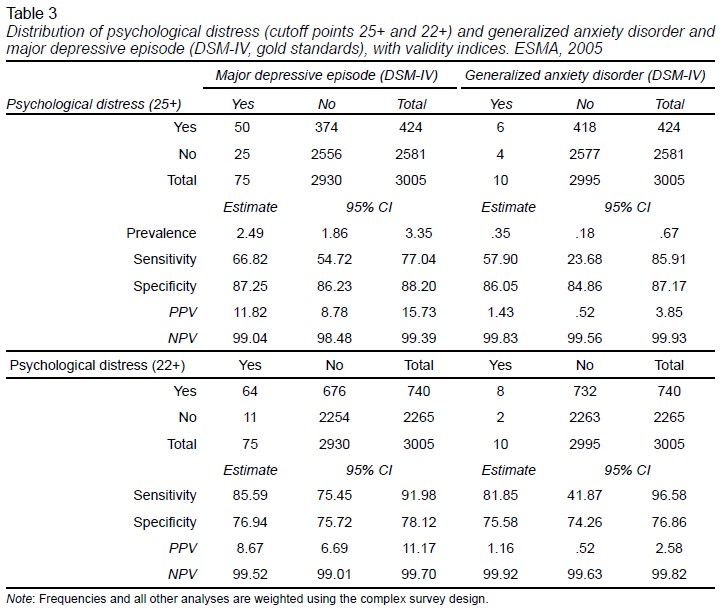
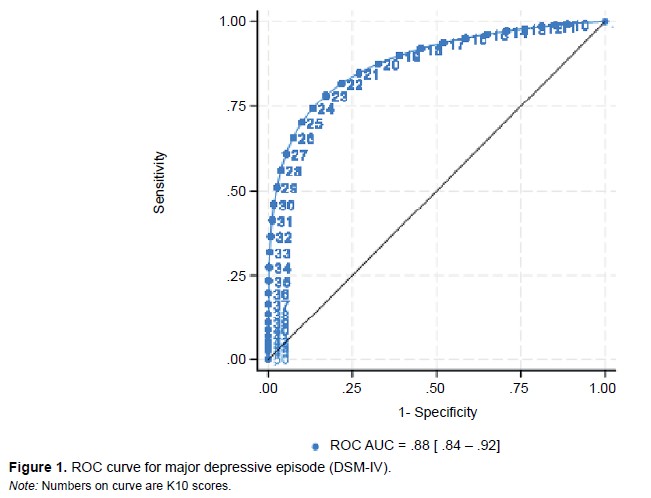
The ESMA allows for two extra analyses to test the adequacy of the K10. First, Table 3 presents the criterion validity of the K10 against major depressive episode and generalized anxiety disorder in the ESMA 2005. In the upper left panel, the past-month prevalence of major depressive episode in the MCMA was 2.49% (95% CI: 1.86–3.35). Using this as the gold standard, the K10 with a 25+ cutoff point showed a sensitivity of 66.82% and a specificity of 87.25%, with PPV and NPV of 11.82% and 99.04% respectively. The 22+ cutoff increased sensitivity to 85.59% at the cost of reduced specificity (76.94%). A similar pattern was observed for generalized anxiety disorder. Overall, the 22+ cutoff point showed a better balance of sensitivity and specificity, as reflected by its position closer to the upper left corner of the ROC curve (Figure 1, and available as supplementary material). AUC values were .88 for major depressive episode and .85 for generalized anxiety disorder.
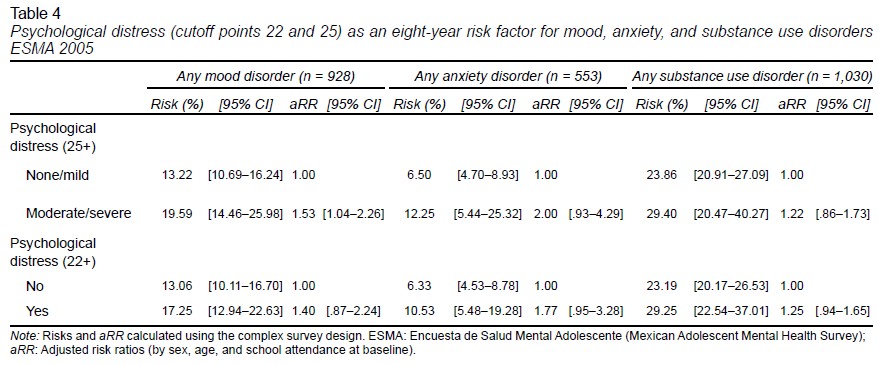
Lastly, Table 4 presents the association between baseline psychological distress and the eight-year cumulative incidence of mood, anxiety, and substance use disorders in the ESMA 2005, restricted to participants free of each outcome at baseline. According to the 25+ cutoff point, the eight-year incidence of any mood disorder was 13.22% among those with or without mild distress and 19.59% among those with moderate or severe distress (aRR = 1.53), indicating a 53% higher risk in the latter group. Point estimates for anxiety and substance use disorders were consistently higher in the distress group but did not reach statistical significance in adjusted models.
DISCUSSION AND CONCLUSION
The prevalence of psychological distress in Mexican adolescents with the 25+ cutoff point was 14.10% in the past month according to the ESMA 2005 (MCMA) and 9.99% in the past year in the ENCODAT 2025 at the national level. With the 22+ cutoff point, these estimates were 24.62% and 18.01% respectively.
The K10 showed a unidimensional structure with adequate internal consistency in both studies. Fit indices were satisfactory in the ENCODAT and largely so in the ESMA, except for the RMSEA, which slightly exceeded the conventional threshold in the latter. Measurement invariance analyses, particularly from the ENCODAT, support the comparative use of the K10 by sex and age group, indicating its suitability for the Mexican adolescent population. These findings are consistent with international evidence on the K10’s psychometric properties. The unidimensional structure and adequate internal consistency (α and ω > .88) are comparable to those reported for adults in WMH Initiative surveys (Kessler & Ustun, 2004). They are also comparable to those of the study conducted in Ecuador with 5,132 young people, which found strict sex invariance (Larzabal-Fernandez et al., 2024).
According to the ESMA, AUC values were adequate for both major depressive episode and generalized anxiety disorder (.88 and .85, respectively) and, in both cases, the 22+ cutoff point showed a better balance of sensitivity and specificity than the 25+ cutoff point, which is more specific than sensitive. However, only the 25+ classification was associated with a significant increase in the eight-year incidence of mood disorders. The AUC values in our study are slightly lower but comparable to those from national adult surveys (AUC = .90) (Furukawa et al., 2003). They are higher than those reported in adolescent studies from Indonesia (Tran et al., 2019), where K10 AUC values for depressive and anxiety disorders ranged from .78 to .86. This indicates that the discriminative capacity of the K10 in Mexican adolescents is equivalent to that observed in adults.
The results of the two surveys must be interpreted within their respective socio-cultural contexts. The 2005 ESMA was conducted exclusively in the Mexico City Metropolitan Area, an urbanized environment with greater access to healthcare services. Conversely, the 2025 ENCODAT reflects the country’s diversity, including rural areas, where the conceptualization and expression of psychological distress may differ from those in urban contexts. The available evidence suggests that adolescents in rural communities in Mexico face specific stressors, such as barriers to accessing mental health services or linguistic and cultural barriers. These may not always be captured by instruments validated in urban contexts (Serván-Mori et al. 2021). The higher prevalence of psychological distress in the ESMA may not only reflect the different reference period of the K10 (30 days vs. 12 months). It may also indicate stressors specific to the urban environment, such as exposure to violence and social fragmentation, which have been independently associated with greater psychological distress among Mexican adolescents (Pérez-Sastré et al., 2024). These contextual differences limit direct comparisons between surveys, suggesting that future research should examine the properties of the K10 by region and type of locality (rural vs. urban).
The choice of cutoff point should be guided by the purpose and context of use. The 25+ cutoff point favors specificity over sensitivity in detecting major depressive episode and generalized anxiety disorder, making it preferable for population-level screening in resource-limited settings where minimizing false positives is a priority. It is the only cutoff point that has demonstrated longitudinal predictive value for mood disorders. It is also the only one to have been used in international general population surveys (Victorian Government Department of Human Services, 2002) and in the official ENCODAT 2025 report (CONASAMA, INPRFM & INSP, 2025a). The 22+ cutoff point, previously suggested for adult health service users in Mexico (Vargas Terrez et al., 2011), showed a better balance of sensitivity and specificity in this study. It is therefore preferable for clinical or early intervention settings where missing true cases is of greater concern. With either cutoff, the PPV was very low, as expected given the low prevalence of major depressive episode and generalized anxiety disorder in the general population. This underscores the fact that a positive screening result must be confirmed through specialized clinical evaluation (Szklo & Nieto, 2019).
This study’s strengths include the use of the CIDI as a diagnostic gold standard in a probability sample of adolescents, which is uncommon in the regional literature. Other advantages include the availability of eight-year longitudinal follow-up data to assess predictive validity, and the replication of the K10’s psychometric properties in two independent samples with different geographic and temporal coverage.
Limitations
Several limitations of this study warrant consideration. Firstly, criterion-related validity analyses were restricted to the 2005 ESMA, as the 2025 ENCODAT did not include a structured diagnostic interview, and invariance results in the ESMA were inconclusive, limiting subgroup comparisons in that study. Additionally, predictive validity findings should be interpreted with caution. The 35.6% retention rate at the eight-year follow-up may introduce selection bias into incidence estimates. Moreover, this analysis was not a primary study objective but an exploratory use of available longitudinal data.
Direct comparisons between the two surveys should be made with caution, as they differ in several methodologically relevant aspects. The most important of these is the K10 reference period, 30 days in the ESMA versus 12 months in the ENCODAT, which may partially explain the differences in prevalence estimates. Research suggests that changing the recall period may produce minor but non-negligible differences in K10 scores (Chilver et al., 2023). Additional sources of non-equivalence include minor variations in item wording and presentation order across surveys. In regard to geographical coverage, the ESMA was restricted to the Mexico City Metropolitan Area whereas the ENCODAT covers a nationally representative sample including rural and indigenous communities. Moreover, the approximately 20-year interval between the two surveys spans almost a generation of social change and may influence how adolescents understand and interpret K10 items across different socio-historical contexts.
Despite these limitations, this is the first report of findings of the K10 in Mexican adolescents, based on two large, representative surveys. The findings are strengthened by being compared to a gold standard, coupled with the evaluation of the predictive validity of the K10 over eight years from a prospective study.
CONCLUSION
The K10 has proved to be a valid, reliable instrument for the identification of psychological distress in Mexican adolescents from the general population. It has been shown to possess adequate psychometric properties, which have been replicated in two independent surveys with different geographical coverage and temporal contexts. A cutoff score of 22+ is recommended for clinical or early intervention settings, where sensitivity is prioritized, and of 25+ for population-based surveys, where specificity and resource constraints are more relevant. In both cases, a positive result does not constitute a diagnosis and must be confirmed by a specialist clinical assessment. The cutoff points and validated psychometric properties reported here provide an empirical basis for incorporating the K10 into national adolescent mental health monitoring systems in Mexico. The aim of its incorporation is to reduce the gap between the burden of psychological distress and the availability of timely, evidence-based care, particularly for adolescents in rural communities where access to mental health services is more limited.